

We love maps.
We love imagery.
We love work breaks.
We hope you like them as well!
In 1885, 29-year-old Eliza Ruhamah Scidmore returned to the United States following her first visit to Japan, where her brother George worked for the U.S. Consular Service. While there, she developed a great appreciation for Japanese culture, and the beauty of the Japanese flowering cherry trees. She brought back with her a desire to introduce the beauty of Japanese cherry blossoms to Americans. She unsuccessfully petitioned superintendents of the Tidal Basin to plant cherry blossoms there for 24 years.
U.S. Department of Agriculture Plant Explorer David Fairchild began experimenting with and advocating for the introduction of Japanese flowering cherry trees in the United States. Following the successful planting of several varieties on his personal property in Chevy Chase, Maryland, and in the neighboring area, he began promoting the idea of planting Japanese flowering cherry trees along avenues in the nation’s capital. His efforts included supplying cherry trees to children to plant in Washington, D.C. schoolyards on Arbor Day in 1908.
On the day before the big event, Scidmore spoke with Fairchild about her dream of planting Japanese cherry trees on the newly reclaimed land of Potomac Park. Both Scidmore and Fairchild began working on plans to acquire trees for the park. At the White House, First Lady Helen Taft was working on plans to beautify this area. Fairchild offered to import Japanese cherry trees for the project. Taft also had fallen in love with the cherry blossoms when she visited Japan.
At the time, Japanese chemist Dr. Jokichi Takamine learned of the plan to acquire cherry trees for America’s capital city. He was in Washington, D.C. at the time with New York’s Japanese consul general Kokichi Mizuno. Takamine offered a gift of 2,000 trees for the city to Taft to be donated in Tokyo’s honor. Sadly, the first shipment in 1910 included trees that were infested with insects and had to be burned. A second shipment of 3,020 trees from 12 varieties were shipped to the U.S. in 1912.
Fewer than 100 of these original trees survive today among the nearly 4,000 cherry trees growing in West and East Potomac Parks, on the Washington Monument grounds, and in several other park locations.
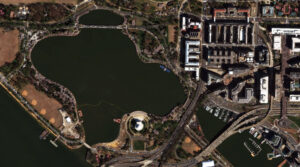
For this month’s Imagery Work Break, we feature a WorldView-3 30-cm color enhanced photo from March 27, 2025. It was taken over the Tidal Basin in Washington, D.C., which is peak season for cheery blossoms. The Cherry blossoms captured here look almost white in the image with a few pinks popping through.
Have a great rest of your workday! 😊
(Image Courtesy: Vantor. Processed by Apollo Mapping for improved color accuracy and clarity.)


 Copyright © 2025 All Rights Reserved -
Leave a Reply