

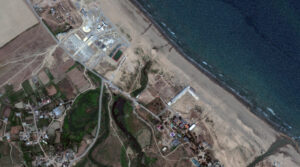
 Stranded on the western shoreline of the Caspian Sea for more than a year, the “sea monster” – also known as a “Lun-class Ekranoplan” – doesn’t look like it could actually take flight. It weighs 320 tons but was abandoned after the 1990s collapse of the Soviet Union at Kaspiysk naval base, approximately 60 miles up the cost from Derbent. Decades ago, the Lun actually took flight. An ekranoplan, also known as a ground effect vehicle, is a hybrid of an airplane and ship. It glides over the water without actually going in it. The International Maritime Organization classifies them as ships, but they derive their high-speed capabilities from the fact that they skim the surface of the water at a height of between three to 16 feet, utilizing an aerodynamic principle called ground effect. Flying so low right over the water made them difficult to detect by radar, which is why the Soviet military experimented with different versions of the machine during the Cold War. As they were deployed on the inland body of water between the Soviet Union and Iran, they ended with their nickname, the Caspian Sea Monster. But after lying dormant along the coast of the Caspian Sea for more than three decades, in July 2020, the sea monster was dragged 14 hours by three tug boats and two escort vessels slowly along the seashore to its final destination – a stretch of coast near Russia’s southernmost point that’s part of Patriot Park, a theme park in Kubinka, that is themed around equipment of the Russian military and the Soviet Union’s victory in World War II. The park, which officially opened in 2016, features interactive exhibits with military equipment (including a mini-Reichstag to storm). In the image above, we can see the sea monster parked in a special spot at Patriot Park, its final resting place. The 30-cm WorldView Legion image was collected on July 18, 2025, and has custom processing and color balance applied by Apollo Mapping. (Satellite Imagery © 2026 Vantor)
In this monthly article, we travel the world to check out unique, fun and sometimes a bit weird 30-centimeter (cm) color imagery samples from the WorldView constellation. In March, we looked at the 21st Century Museum of Contemporary Art in Kanazawa, Ishikawa, Japan. For this edition of the 30-cm Color WorldView Image of the Month, we feature an image of the Caspian sea monster, officially known as a Lun-class Ekranoplan.
30-cm WorldView-3 (WV3) launched in late 2014, WorldView-4 (WV4) launched in late 2016 and then the first WorldView Legion satellites launched in 2024. Taken together, this is the most advanced satellite constellation the commercial marketplace has ever had access to. Here are a few of the features that really set these satellites apart from the competition:
- Improved Resolution
- Higher resolution means you can see more detail in WorldView imagery.
- Data collected at nadir will have 31-centimeter (cm) panchromatic, 1.24-meter (m) visible and near infrared, 3.7-m SWIR (WV3 only) and 30-m CAVIS (WV3 only) bands.
- Additional Spectral Bands
- If spectral analysis is part of your project, then no other satellite can match WorldView-3 and WorldView Legion with their 8 bands of visible and near-infrared data; and then 8 shortwave infrared bands (WV3 only) which are crucial for geological studies.
- Better Positional Accuracy
- With accuracies of 3.5-m CE90% or better (without ground control even!), the 30-cm WorldView constellation has no rivals for its enhanced positional accuracy.
- Daily Revisits
- With multiple WorldView-3 and WorldView Legion satellites orbiting our planet, daily revisits are available for most locations.
- WV4 is no longer collecting new imagery.
- Increased Collection Capacity
- WV3/4 feature 13.1-km swath widths (at nadir) with the ability to collect up to 680,000 square kilometers (sq km) of high-resolution data per day per satellite (though WV4 is dead now).
- WorldView Legion features six 30-cm satellites, significantly boosting the collection capacity of this leading high-resolution constellation.
If you are interested in WorldView-3, WorldView-4 and/or WorldView Legion imagery for your next project, please let us know by phone, 303-993-3863, or by email, sales@apollomapping.com.
You can also find more WV3 samples and technical information on our website here; WV4 samples and information can be found here; and then finally here is more information about WorldView Legion.


 Copyright © 2025 All Rights Reserved -
Leave a Reply