

In this monthly article, we travel the world to check out unique, fun and sometimes a bit weird 30-centimeter (cm) color imagery samples from the WorldView constellation. In February, we looked at an art installation called Shadows Travelling on the Sea of the Day located in a remote region of Quatar. For this edition of the 30-cm Color WorldView Image of the Month, we feature an image of the 21st Century Museum of Contemporary Art in Kanazawa, Ishikawa, Japan.
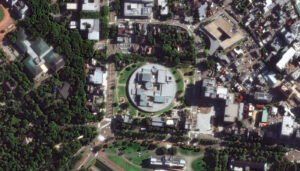 The 21st Century Museum of Contemporary Art in Kanazawa was designed by Japanese architects Kazuyo Sejima and Ryue Nishizawa in 2004. In October 2005, one year after its opening, the museum marked 1,570,000 visitors and earned a spot on the list of the most-visited art museums in the world. The building was built as circle and includes community gathering spaces, such as a library, lecture hall, and children’s workshop with spaces in the middle. The exhibition areas include numerous galleries with multiple options for division, expansion, or concentration. The galleries range from featuring bright daylight through glass ceilings to spaces with no natural light source. All the walls of the circular museum are made of glass and the building features five gates, all pointing toward different parts of the city. The collection of the 21st Century Museum of Contemporary Art focuses on works produced since 1980 that “propose new values.” Artists in the collection are encouraged to produce site-specific installations that become “closely associated with the Kanazawa area.” The 21st Century Museum of Contemporary Art offers visitors experiences that can’t be found anywhere else. Highlights include Leandro Erlich’s The Swimming Pool, which enables visitors to feel as if they’re standing at the bottom of a swimming pool, and a wall decorated with flowers gathered from the suburbs of Kanazawa. Last year marked the museum’s 20th anniversary and there were several special exhibits. The museum also focuses on art communication with programs aimed at revitalizing local culture through the performing arts and programs that give citizens a role in making the Museum a “town square,” where diverse people freely come and go. On occasion, activities are taken out into the city in programs open to limitless participation, such as creative activities centered on artist collaborations with the community. In the 30-cm WorldView Legion image featured here, we can clearly see the circular shaped museum with various roof peaks that offer the varying ceiling heights within the displays. The museum is surrounded by trees and buildings in an eclectic mix. This 30-cm WorldView Legion image was collected on August 28, 2025, and has custom processing and color balance applied by Apollo Mapping. (Satellite Imagery © 2026 Vantor)
30-cm WorldView-3 (WV3) launched in late 2014, WorldView-4 (WV4) launched in late 2016 and then the first WorldView Legion satellites launched in 2024. Taken together, this is the most advanced satellite constellation the commercial marketplace has ever had access to. Here are a few of the features that really set these satellites apart from the competition:
- Improved Resolution
- Higher resolution means you can see more detail in WorldView imagery.
- Data collected at nadir will have 31-centimeter (cm) panchromatic, 1.24-meter (m) visible and near infrared, 3.7-m SWIR (WV3 only) and 30-m CAVIS (WV3 only) bands.
- Additional Spectral Bands
- If spectral analysis is part of your project, then no other satellite can match WorldView-3 and WorldView Legion with their 8 bands of visible and near-infrared data; and then 8 shortwave infrared bands (WV3 only) which are crucial for geological studies.
- Better Positional Accuracy
- With accuracies of 3.5-m CE90% or better (without ground control even!), the 30-cm WorldView constellation has no rivals for its enhanced positional accuracy.
- Daily Revisits
- With multiple WorldView-3 and WorldView Legion satellites orbiting our planet, daily revisits are available for most locations.
- WV4 is no longer collecting new imagery.
- Increased Collection Capacity
-
- WV3/4 feature 13.1-km swath widths (at nadir) with the ability to collect up to 680,000 square kilometers (sq km) of high-resolution data per day per satellite (though WV4 is dead now).
- WorldView Legion features six 30-cm satellites, significantly boosting the collection capacity of this leading high-resolution constellation.
If you are interested in WorldView-3, WorldView-4 and/or WorldView Legion imagery for your next project, please let us know by phone, 303-993-3863, or by email, sales@apollomapping.com.
You can also find more WV3 samples and technical information on our website here; WV4 samples and information can be found here; and then finally here is more information about WorldView Legion.


 Copyright © 2025 All Rights Reserved -
Leave a Reply