

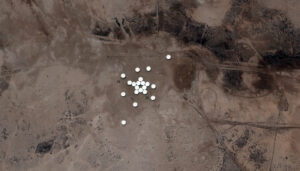
 In the middle of the Quatar desert has popped up a most unlikely thing – an art installation consisting of giant round mirrors attached to black wrought iron supporting pipes. About an hour’s drive north of colossal monolithic sculptures installed by U.S. artist Richard Serra can be found the piece of art called Shadows Travelling on the Sea of the Day. The free-standing black rings and silvered-glass mirrors are the creative brainstorm of Olafur Eliasson, an Icelandic-Danish artist known for his exploration of humanity’s deep-rooted connection to nature. His artwork was installed in 2022 in northwestern Qatar and includes 20 large circular shelters, three single rings and two double rings that are placed according to the axes of a fivefold symmetrical pattern. Eliasson, who lives and works in Copenhagen and Berlin, has explained that he was drawn to this remote corner of Qatar by its surprising similarities to the terrain of his family’s windswept homelands in the North Atlantic. Eliasson told CNN that the structures are designed to draw people in, to interact with the installation and to encourage them to contemplate their surroundings. The artist said his work is intended to create a sense of passing time and of disconnecting from our standard perception of time. In the image above, we can see the circular mirrors reflecting back at the satellite. This 30-cm WorldView Legion image was collected on July 202, 2025, and has custom processing and color balance applied by Apollo Mapping. (Satellite Imagery © 2026 Vantor)
In this monthly article, we travel the world to check out unique, fun and sometimes a bit weird 30-centimeter (cm) color imagery samples from the WorldView constellation. In January, we looked at the Schwetzingen Palace in Germany. For this edition of the 30-cm Color WorldView Image of the Month, we feature an image of an art installation called Shadows Travelling on the Sea of the Day located in Al ‘Arish, Quatar.
30-cm WorldView-3 (WV3) launched in late 2014, WorldView-4 (WV4) launched in late 2016 and then the first WorldView Legion satellites launched in 2024. Taken together, this is the most advanced satellite constellation the commercial marketplace has ever had access to. Here are a few of the features that really set these satellites apart from the competition:
- Improved Resolution
- Higher resolution means you can see more detail in WorldView imagery.
- Data collected at nadir will have 31-centimeter (cm) panchromatic, 1.24-meter (m) visible and near infrared, 3.7-m SWIR (WV3 only) and 30-m CAVIS (WV3 only) bands.
- Additional Spectral Bands
- If spectral analysis is part of your project, then no other satellite can match WorldView-3 and WorldView Legion with their 8 bands of visible and near-infrared data; and then 8 shortwave infrared bands (WV3 only) which are crucial for geological studies.
- Better Positional Accuracy
- With accuracies of 3.5-m CE90% or better (without ground control even!), the 30-cm WorldView constellation has no rivals for its enhanced positional accuracy.
- Daily Revisits
- With multiple WorldView-3 and WorldView Legion satellites orbiting our planet, daily revisits are available for most locations.
- WV4 is no longer collecting new imagery.
- Increased Collection Capacity
- WV3/4 feature 13.1-km swath widths (at nadir) with the ability to collect up to 680,000 square kilometers (sq km) of high-resolution data per day per satellite (though WV4 is dead now).
- WorldView Legion features six 30-cm satellites, significantly boosting the collection capacity of this leading high-resolution constellation.
If you are interested in WorldView-3, WorldView-4 and/or WorldView Legion imagery for your next project, please let us know by phone, 303-993-3863, or by email, sales@apollomapping.com.
You can also find more WV3 samples and technical information on our website here; WV4 samples and information can be found here; and then finally here is more information about WorldView Legion.


 Copyright © 2025 All Rights Reserved -
Leave a Reply