

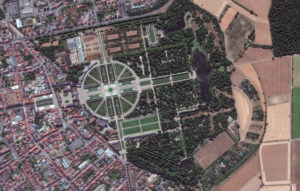
 The origins of Schwetzingen Palace (Schloss Schwetzingen) date back to 1350 when a small, moated castle occupied the site. For several centuries, the baroque Schwetzingen Palace served the Wittelsbach dynasty as a summer residence and hunting palace. The Schwetzingen mosque is Germany’s last representative of the paradigmatic “garden mosques” that were popular in late 18th Century Europe and emblazoned the palace gardens of absolutist rulers. By erecting a mosque, along with other “exotic” buildings, kings and dukes aimed to show their enlightenment, tolerance, and cosmopolitanism. After an eventful history, Schwetzingen flourished under the Palatine Prince Elector Carl Theodor (1724 – 1799). The palace owes its current form to the Prince Elector Johann Wilhelm, who commissioned alterations in 1697. The addition of two wings significantly increased its size. Schwetzingen Palace reached the height of splendor under the Prince Elector Carl Theodor. He instructed the leading landscape architects of the age to design the gardens. In the late 18th Century, an English-style landscape park was added to the Baroque garden – the Arborium Theodoricum, as it is called, is one of the earliest of its kind in Germany. More than 100 sculptures are scattered throughout the gardens and an assortment of buildings add to the ambience, including the Apollotempel (temple of Apollo), a small, round building that houses a statue of the ancient Greek god of light and the arts, playing the lyre. The Badehaus (bath house) is a summerhouse with its own garden, modelled on an Italian villa. The Türkischer Garten (Turkish gardens) is where you’ll find the mosque, the largest structure of its kind in a German garden. The palace’s rooms contain furniture from the 18th and early 19th Century. The palace theater in the north wing is a particular highlight. It was the first theatre in Europe with galleries – and it is still used as a venue for performances today. During the last 220 years, the site has served different purposes. It was an open-air opera stage where Mozart’s, “The Abduction from the Seraglio,” was performed; a military hospital during Germany’s war with France in 1870; a meeting room for the founders of Germany’s first Islamic Academy (a project that was never realized); and as a nightclub for American soldiers after World War II. Today, Schwetzingen Palace is a state-owned heritage monument, cared for by the institution of the State Palaces and Gardens of Baden-Württemberg. The garden is publicly accessible, while tours are led through the Palace and Theatre. In the image featured, we can see the palace with its dark colored roof and numerous wings branching off from the central part of the structure. Behind can be found a circular garden and beyond, several buildings, more gardens, and woods with maze-like paths meandering through. This 30-cm WorldView Legion image was collected on July 1, 2025, and has custom processing and color balance applied by Apollo Mapping. (Satellite Imagery © 2026 Maxar Technologies)
In this monthly article, we travel the world to check out unique, fun and sometimes a bit weird 30-centimeter (cm) color imagery samples from the WorldView constellation. In December, we looked at Gibbs Farm in Makarau, New Zealand. For this edition of the 30-cm Color WorldView Image of the Month, we feature an image of Schwetzingen Palace in Germany.
30-cm WorldView-3 (WV3) launched in late 2014, WorldView-4 (WV4) launched in late 2016 and then the first WorldView Legion satellites launched in 2024. Taken together, this is the most advanced satellite constellation the commercial marketplace has ever had access to. Here are a few of the features that really set these satellites apart from the competition:
- Improved Resolution
- Higher resolution means you can see more detail in WorldView imagery.
- Data collected at nadir will have 31-centimeter (cm) panchromatic, 1.24-meter (m) visible and near infrared, 3.7-m SWIR (WV3 only) and 30-m CAVIS (WV3 only) bands.
- Additional Spectral Bands
- If spectral analysis is part of your project, then no other satellite can match WorldView-3 and WorldView Legion with their 8 bands of visible and near-infrared data; and then 8 shortwave infrared bands (WV3 only) which are crucial for geological studies.
- Better Positional Accuracy
- With accuracies of 3.5-m CE90% or better (without ground control even!), the 30-cm WorldView constellation has no rivals for its enhanced positional accuracy.
- Daily Revisits
- With multiple WorldView-3 and WorldView Legion satellites orbiting our planet, daily revisits are available for most locations.
- WV4 is no longer collecting new imagery.
- Increased Collection Capacity
- WV3/4 feature 13.1-km swath widths (at nadir) with the ability to collect up to 680,000 square kilometers (sq km) of high-resolution data per day per satellite (though WV4 is dead now).
- When fully launched, WorldView Legion will feature six 30-cm satellites, significantly boosting the collection capacity of this leading high-resolution constellation.
If you are interested in WorldView-3, WorldView-4 and/or WorldView Legion imagery for your next project, please let us know by phone, 303-993-3863, or by email, sales@apollomapping.com.
You can also find more WV3 samples and technical information on our website here; WV4 samples and information can be found here; and then finally here is more information about WorldView Legion.


 Copyright © 2025 All Rights Reserved -
Leave a Reply