

If you’ve been reading along with me, you’ll notice that interesting scientific research intrigues me, especially the ones that connect humans to animals and landscapes. How we connect and communicate is a foundation of spatial awareness, thinking, and analysis.
How long has that been part of our humanity? I recommend checking out the movie, In the Blink of an Eye. The film illustrates an undeniable thread that knits humanity across millennia. (If you take the leap to watch it, follow the acorn.) Filmmakers also show us more community and creativity than has been popular lore regarding early humanity. Afdhel Aziz in Forbes interviewed Ian Goldman, the film’s producer and passionate storyteller, in early 2026. What struck me is the need for the right question in good storytelling. For the movie, the question was “How can you be a good ancestor?” That matters in map making and data collection too. Why are we doing this? What’s the purpose?
Let’s take an example from 60,000 years ago. I was taught that those human ancestors were “simple minded.” Turns out that is not true! Researchers at the University of Bologna found clear evidence of planned spatial patterns on carved ostrich eggs. While the eggs were probably used as containers, the real revelation is the art on them. Science Daily says, “The results showed consistent spatial patterns in over 80% of configurations, including repeated near-90° angles, parallel lines, hatched bands, grids, diamond motifs, and signs of rotation, translation, repetition, and embedded hierarchical designs. The researchers emphasize that the importance of the engravings goes beyond whatever meaning the individual markings may once have carried. Their broader significance lies in the mental abilities required to create visual designs according to consistent rules.” Their analysis shows how homo sapiens tens of thousands of years ago had, “a remarkable ability to organize visual space according to abstract principles.” They were not so simple minded after all.
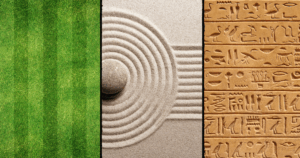 Created in canva by BD.
For the math haters out there, guess what? Geometry matters here. Repeating patterns in particular, “help students recognize regularities, predict what comes next, and understand more complex patterns such as arithmetic sequences and geometric shapes,” according to Meaningful Math. What comes next and noticing irregularities are important general life skills if you want to drive to the store and then pick out the ripest apple. Maybe you’re looking for your friend in a red-striped shirt in a sea of concert goers.
Geometry became language too. Examining Greek and Celtic shapes are collections of basic lines that became language and art. René Descartes said, “We could never know the geometric triangle through the one we see traced on paper, if our mind had not had the idea of it elsewhere.” We are hard-wired to process patterns to understand other concepts.
Patterns also have psychology. By understanding the psychology of visual art and patterns, artists can use repetition in graphic design and fine art to create compelling works that evoke strong viewer responses. We are naturally drawn to repeat patterns. Consider a Zen Garden that’s intended for meditation and contemplation. Every plant, rock, and line in the sand are there to create harmony, tranquility, and balance. Even those tiny desktop versions give you the opportunity to rake the sand in repeating patterns to ease your stress.
How many other hobbies or modern crafts use the same principles of repeating patterns and simplicity to ease our minds and bring joy? Crochet, knitting, quilting, carpentry, needlepoint, cross-stitch, swimming, running, we could go on. It just might be the simple repeating patterns in our lives that fuel our analysis and problem-solving abilities. I’m not an expert, but it makes sense to me.
If you need me, I’ll be out making repeat patterns in the yard with my lawn mower.
Barbaree Duke
Geospatial Crusader


 Copyright © 2025 All Rights Reserved -
Leave a Reply