
Created in Canva by BD.
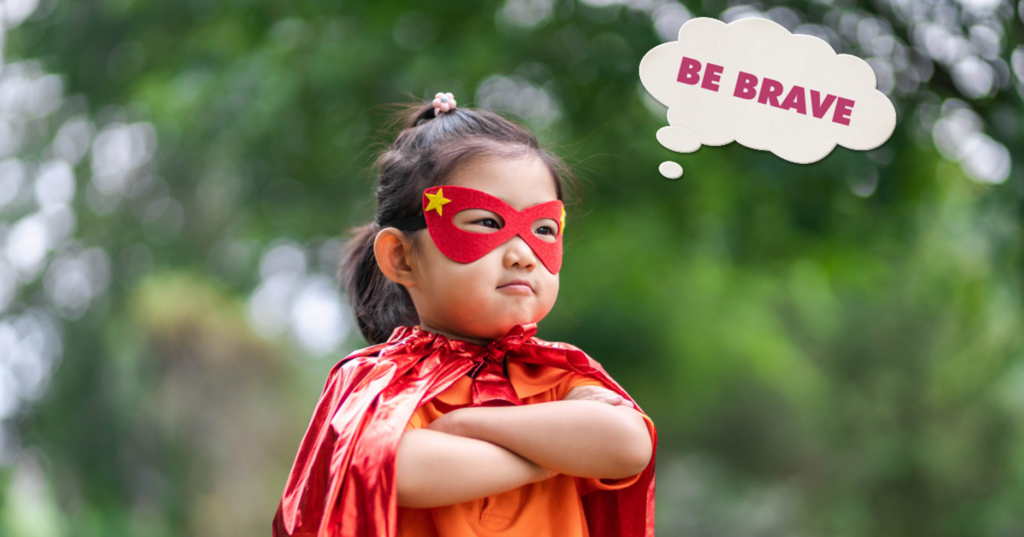
I grew up watching television’s super women: Wonder Woman, the Bionic Woman, and Charlie’s Angels. With their example and my parents’ encouragement, I felt ready to conquer the world – even in the Deep South. As women grow older, bravery becomes more strategic. I was fascinated to learn that some ancient cultures recognized that young women needed the same strength and training as young men. No sewing or cooking classes for those girls!
The young princesses in Egypt were trained to be strong women. According to Science Daily, “Researchers studying royal mummies from Dahshur found bone changes consistent with years of archery and other strenuous weapon use. Several women also showed evidence of healed injuries, suggesting surprisingly active lifestyles that may have included hunting or military training.” While the assumption for many years had been that the weapons buried with these women were ornamental or ceremonial, more recent research shows quite the opposite. That dagger was probably on her hip and used regularly. The remains analysis of six princesses of the pharaoh Amenemhat II show muscle development, scars, and broken bones. Most interesting to me is that the research focus is on who these people were and the life they led, not just the treasures in their tombs.
More ancient cultures trained female warriors through strict physical conditioning, martial arts, and weapon handling tailored to their society’s survival needs or military structure. Spartan girls were educated and trained beginning at age 7 until marriage. Compared with women in other Greek city-states during the Classical Period, Spartan women had greater rights and autonomy. They could inherit property, own land, conduct business, and generally received more education than women elsewhere in ancient Greece. Aristotle was bothered by their strength and criticized their independence and influence. He preferred the traditions of Athens where women were second class citizens.
Eurasian Steppe Nomads trained their girls and young women in horseback riding, archery, and close quarters defense. Groups like the Sarmatians and Scythians lived a mobile equestrian lifestyle and needed to be ready for the rigors of that life. Like the princesses in Egypt, they were buried with weapons, battle injuries and military kits.
Women from samurai families were trained to protect estates, castles and families while the men were away on campaigns. Onna-bugeisha – the female martial warriors of feudal Japan’s noble bushi class—received rigorous physical, mental, and tactical training from an early age to defend their homes, families, and domains. They were also trained in specialized weaponry.
In other ancient and classical societies (such as Celtic, Germanic, or ancient Chinese communities), women trained or fought primarily during desperate sieges or neighborhood defense when settlements faced destruction or enslavement. The use of ranged weapons like the crossbow or bow allowed women to participate effectively in militia and fortress defense.
There are six societies where women are in charge. The Mosuo People in China are “officially classified by the Chinese government as part of another ethnic minority known as the Naxi, but the two are distinct in both culture and language.” Indonesia’s Minangkabau People “hold a high status in Minangkabau culture and are often the ones who make decisions regarding family and community affairs.” Ghana’s Akan People trace their lineage by their female ancestry. In Costa Rica’s Bribri People a child belongs to the mother’s clan. Women are trusted with land ownership and preparation of the sacred cacao. India’s Garo People also are matrilineal. Papua New Guinea’s Nagovisi women take pride in their land and participate in leadership and ceremonies. It is no Wonder Woman’s Paradise Island, but it is real life.
The Story Exchange has collected stories of women that are sure to inform and inspire. Learn about a groundbreaking photojournalist who grabbed her camera and headed to the riskiest places. Explore North American Indigenous female chiefs. Read about women journalists that went undercover and bravely challenged fascism or reported lynchings in the South. Learn about the woman that was told she was “too strong” and championed Title IX.
I am thankful to these courageous trailblazing women. I appreciate that my dad was ahead of his time when he insisted that I know how to: fix my car, throw a punch, install a faucet, build stuff, mend a fence, drive a tractor, mow the lawn, and fix the clogged carburetor on the mower. He said, “I don’t want you to have to be waiting around for some man to just fix something or take care of you.” While these were all practical skills for life, my dad was building confidence just like those ancient fathers. Let’s continue that tradition and empower all of our young people to be problem-solving champions for good in the world!
If you need me, I’m working on a new project or helping young people develop skills and courage to get the job done.
Barbaree Duke
Geospatial Crusader
As an educator and curriculum theory enthusiast, I found that understanding students as individuals improved both my teaching and their long-term success. Personality types and natural preferences can shape how productive, collaborative, and positive people feel. Popular assessments I’ve used or been asked to complete include the Enneagram, True Colors, the Myers-Briggs Type Indicator, and Clifton Strengths. Understanding ourselves and one another influences how we work, analyze, and respond. Social media platforms attempt something similar by tracking the content that holds our attention, then using algorithms to show us more of it and keep us engaged.
If you work with students, the semester’s novelty may have faded into schedules, deadlines, and perhaps concern about grades at the halfway point. In the office, the glow of vacation may have given way to meetings and routine frustrations. It may be time for a boost – a positively powered pep rally. How can we create one here? We can turn to memorable quotes, practical wisdom, and healthy perspectives from people who are smart, successful, kind, famous, or unexpected. Inspirational quotes offer quick perspective, emotional validation, and a mental spark that can shift your mindset.
 Created in Canva by BD.
Why can quotes inspire us? A Fast Company article notes, “If your teacher, coach, or mentor believes you can do something, you’re more likely to do it.” People are drawn to “well-expressed wisdom,” and rhyme or parallel phrasing can make ideas more memorable. Confession: I keep a thick folder and a growing collection of inspirational Instagram stories, along with a box of kind notes labeled, “Need a lift?” I know – it’s a problem. So, let’s have some fun pairing traditional encouragement with mappy and geospatial wisdom.
Courage & Affirmation
- “I am in the right place at the right time, doing the right thing.” Louise Hay
- “Courage starts with showing up and letting ourselves be seen.” Brené Brown
- “Make way for the unprecedented and watch your reality rearrange itself.” Yrsa Daly-Ward
- “You are loved just for being who you are, just for existing.” Ram Dass
- “The chance to love and be loved exists no matter who you are.” Oprah
Map Fun
- “Born to map, forced to attend meetings.”
- “ELLIPSOID – Perfect in Theory, Distorted in Reality.”
- “Friends don’t let friends use the Mercator projection.”
- “I map, therefore I am.”
- “I have many layers.”
GIS Pick-Up Lines & Puns
- “How do GIS folks find a spouse? They datum.”
- “You complete my polygon.”
- “Ay, baby, are you an attribute table? ‘Cause I’d like to join and relate myself to you.”
- “Your contours are so fine, I’m delineating watersheds all over your body.”
GIS Office
- “Save work early and often.”
- “Everything is related to everything else, but near things are more related than distant things.” Tobler
- “Everything is somewhere. But understanding why things are where they are is a different story.”
- “The application of GIS is limited only by the imagination of those who use it.” Jack Dangermond
- “GIS is waking up the world to the power of geography, this science of integration, and has the framework for creating a better future.” Jack Dangermond
- “GIS is not just a tool, it’s a way of thinking.” Tanish Brown
- “GIS is not just about mapping, it’s about understanding the world around us.”
Maps
- “I wisely started with a map and made the story fit (generally with meticulous care for distances).” J. R. R. Tolkien
- “A map is the greatest of all epic poems. Its lines and colors show the realization of great dreams.” Gilbert H. Grosvenor
- “Knowing where things are, and why, is essential to rational decision making.”
I hope you found some inspiration, shared a laugh, discovered someone new, created a little cubicle art, or simply paused to reflect – all worthwhile outcomes. I’ll leave you with my favorite reminder: “Bloom where you’re planted.” Life takes us to places that are both rewarding and challenging. When we learn to thrive wherever we are, we keep moving forward and make the best of our circumstances.
If you need me, I’ll be reorganizing my folder…maybe it’s time to go digital.
Barbaree Duke
Geospatial Crusader
If you’ve been reading along with me, you’ll notice that interesting scientific research intrigues me, especially the ones that connect humans to animals and landscapes. How we connect and communicate is a foundation of spatial awareness, thinking, and analysis.
How long has that been part of our humanity? I recommend checking out the movie, In the Blink of an Eye. The film illustrates an undeniable thread that knits humanity across millennia. (If you take the leap to watch it, follow the acorn.) Filmmakers also show us more community and creativity than has been popular lore regarding early humanity. Afdhel Aziz in Forbes interviewed Ian Goldman, the film’s producer and passionate storyteller, in early 2026. What struck me is the need for the right question in good storytelling. For the movie, the question was “How can you be a good ancestor?” That matters in map making and data collection too. Why are we doing this? What’s the purpose?
Let’s take an example from 60,000 years ago. I was taught that those human ancestors were “simple minded.” Turns out that is not true! Researchers at the University of Bologna found clear evidence of planned spatial patterns on carved ostrich eggs. While the eggs were probably used as containers, the real revelation is the art on them. Science Daily says, “The results showed consistent spatial patterns in over 80% of configurations, including repeated near-90° angles, parallel lines, hatched bands, grids, diamond motifs, and signs of rotation, translation, repetition, and embedded hierarchical designs. The researchers emphasize that the importance of the engravings goes beyond whatever meaning the individual markings may once have carried. Their broader significance lies in the mental abilities required to create visual designs according to consistent rules.” Their analysis shows how homo sapiens tens of thousands of years ago had, “a remarkable ability to organize visual space according to abstract principles.” They were not so simple minded after all.
 Created in canva by BD.
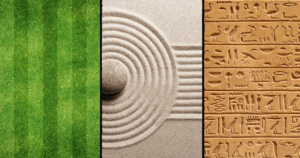
For the math haters out there, guess what? Geometry matters here. Repeating patterns in particular, “help students recognize regularities, predict what comes next, and understand more complex patterns such as arithmetic sequences and geometric shapes,” according to Meaningful Math. What comes next and noticing irregularities are important general life skills if you want to drive to the store and then pick out the ripest apple. Maybe you’re looking for your friend in a red-striped shirt in a sea of concert goers.
Geometry became language too. Examining Greek and Celtic shapes are collections of basic lines that became language and art. René Descartes said, “We could never know the geometric triangle through the one we see traced on paper, if our mind had not had the idea of it elsewhere.” We are hard-wired to process patterns to understand other concepts.
Patterns also have psychology. By understanding the psychology of visual art and patterns, artists can use repetition in graphic design and fine art to create compelling works that evoke strong viewer responses. We are naturally drawn to repeat patterns. Consider a Zen Garden that’s intended for meditation and contemplation. Every plant, rock, and line in the sand are there to create harmony, tranquility, and balance. Even those tiny desktop versions give you the opportunity to rake the sand in repeating patterns to ease your stress.
How many other hobbies or modern crafts use the same principles of repeating patterns and simplicity to ease our minds and bring joy? Crochet, knitting, quilting, carpentry, needlepoint, cross-stitch, swimming, running, we could go on. It just might be the simple repeating patterns in our lives that fuel our analysis and problem-solving abilities. I’m not an expert, but it makes sense to me.
If you need me, I’ll be out making repeat patterns in the yard with my lawn mower.
Barbaree Duke
Geospatial Crusader
Every person is unmistakably unique, yet most of us spend our lives looking for connection – for signs that our private experiences belong to a larger human pattern. The brain may be one of the best places to look. Imagine it’s not finished, but as a structure under constant construction: wired with basic necessities, shaped by use, remodeled by time, and always leaving room for expansion.
Buildings have eras. Anyone who has inherited an older home knows the evidence: a dated fixture, a tired roofline, a repair made by someone else’s hands, a room that no longer fits the life being lived inside it. Sometimes the problem is style. Sometimes it is wear. Either way, the structure changes with its caretakers – and it will change again when the next person arrives.
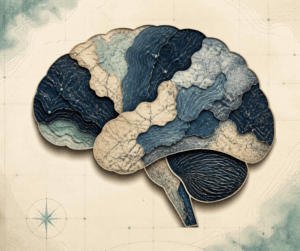
Our brains, it turns out, have eras too. Scientists at the University of Cambridge identified five ages of the brain, marked by major turning points around ages nine, 32, 66, and 83. The finding is striking because it suggests brain development is not a smooth, steady climb from childhood to old age. It is more like a series of renovations – periods when neural wiring shifts to support different ways of learning, adapting, stabilizing, and aging. One detail especially stops me: the adolescent phase may last until about age 32. Think of all the life that happens between nine and 32 – the classrooms, friendships, jobs, heartbreaks, risks, responsibilities, and discoveries. If the brain is still actively reorganizing through all of that, then a powerful question follows: how do our choices, work, tools, and habits shape each era of development?
Created in Canva by B. Duke
The case for everyday influence is hard to miss. A growing body of public health and medical guidance links lifestyle with cognitive health, and Dr. Gajendra at Nivok Specialty Hospital highlights several familiar choices that affect brain health:
- Food matters. Fruits, vegetables, and nourishing meals support the brain far better than a steady diet of sugary, highly processed foods.
- Movement matters. Regular physical activity increases blood flow to the brain and supports memory, growth, and resilience.
- Sleep matters. Rest gives the brain time to repair, consolidate memory, and reset for the next day.
- Stress matters. Long-term stress can strain the brain and interfere with healthy function.
- Substances matter. Smoking, excessive alcohol use, and drug use can impair brain function and reduce oxygen reaching brain cells.
And the list does not end with what we eat, how much we move, or how well we sleep. Another article points to social connection as part of brain health too. In other words, the brain is not remodeled only in gyms, kitchens, and bedrooms. It is also shaped in conversations, collaborations, classrooms, communities, and the shared work of paying attention together.
A recent study on magic mushrooms adds another layer to the story. It describes how a naturally occurring chemical may help the brain move beyond familiar patterns during and after the experience. Participants who showed greater increases in flexible, varied brain activity also reported more personal insight and later improvements in well-being. The broader idea is compelling: changing how we think – or how we perceive our lives and circumstances – is not a soft skill. It may be one of the most important forms of adaptation we have.
I saw this kind of shift firsthand when I used GIS to help students understand literature. At first, geospatial tools seemed like a way to make an abstract subject more concrete. Maps, patterns, and spatial analysis gave students a new entry point into stories that once felt distant. But something else happened too. Their brains seemed to borrow the habit of spatial thinking and apply it elsewhere. They began to notice relationships, movement, context, and evidence in new ways. My classroom observations were not formal research, but they align with studies that connect geospatial technology with improved reasoning. In a 2019 ArcWatch article, Dr. Bob Kolvoord described research in which students in the Geospatial Semester showed “greater blood flow in the parietal region of the brain, an area related to spatial reasoning, from pretest to posttest compared with a control group.”
For geospatial professionals, this is not abstract. Every hour spent wrangling data, exploring patterns, comparing layers, scanning imagery, and solving spatial problems has changed the way you notice the world – whether you meant it to or not. Details that are invisible to others become obvious to you. A parking lot becomes a flow pattern. A hillside becomes a record of water, vegetation, and human choice. Aerial and satellite imagery from tools like Image Hunter trains the eye to recognize big green circles, subtle boundaries, and sweeping variations in landform. Even non-map tasks begin to feel different: scanning code, reading dense text, spotting anomalies, and finding the one empty parking space in a crowded lot.
That may be the quiet gift of geospatial work. It does not simply teach us to make better maps. It teaches us to live with a different kind of attention.
If the brain has eras, then perhaps our daily practices are the renovation plans. We build through what we study, what we repeat, what we notice, and who we notice it with. For those of us shaped by maps and spatial thinking, the structure has already changed. We do not just look at the world. We read it.
If you need me, I’ll be working through the stack of books on my “must read” shelf.
Barbaree Duke
Geospatial Crusader
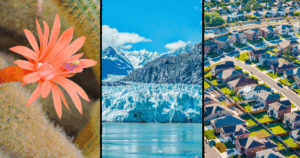
I recently returned from a conference in the desert. The dry air and sun-scorched temperatures are not my preference, but it is impossible to miss how many people, plants, and critters manage to thrive there. The landscapes were beautiful, gentle taupe-colored mountains dotted with cactus and palm trees against the brilliant blue sky, simply thriving while I personally was melting. Humans, animals, and plants all find a way to thrive and grow.
Deserts are interestingly dynamic ecosystems. A recent study from the University of Reading says that cacti are a species not only thriving but also “evolving at a shockingly high rate.” These slow-growing plants are particularly adept at creating new species. “Instead of flower size or pollinator type driving diversification, the key factor appears to be how rapidly cactus flowers change shape over time.” Changing shape quickly over time reminds me of the human impact on landscapes and other things that shape-shift and still thrive.
As geospatial folks, we are keenly aware of our planet’s natural morphing over time. The most naturally changed landscapes on Earth are characterized by rapid geological shifts, active volcanism, glacial retreat, and extreme erosion. While some evolve slowly over millions of years, others undergo drastic visible transformations in mere decades. It’s intriguing to watch the world move from Pangea to today…millions of years to slowly become our current earth.
 Canva creation by BD.
Did you realize that many popular global tourist destinations showcase our changing planet? Sea rise in Venice has humans getting creative to keep the sea in check. In 1850, Glacier National Park had about 150 documented glaciers. Today, that number has dwindled to roughly two dozen named glaciers that meet the minimum size criteria to flow under their own weight. Victoria Falls suffered from tremendous drought in recent years while the Swiss Alps saw reduced snowfall. The Maldives are working hard to adapt to climate change as well. Drier and warmer weather creates ideal conditions for wildfires, destroying communities like Lahaina, HI, and dissipates water bodies at an alarming rate such as in the Dead Sea. Its water level drops by roughly 4 feet annually, reducing its surface area by one-third over the past 50 years. Landscape change is not limited to glaciers, coastlines, or faraway tourist destinations; it is also happening in the places we call home.
Population change is easy to see and feel. The county that I call home is rapidly increasing in population. Our metro area in south Alabama is in the top ten, ranking sixth, of the fastest growing metro areas in the United States. My town is above 25% growth rate! This growth impacts so many things that might not have been on our city government’s radar. This might be why we have so many hamburger joints and new roundabouts to navigate. Sprawling corn fields have morphed to subdivisions and solar arrays. In October 2025, there were 315 active subdivisions under construction bringing 17,000 new students. Do you live near a fast-growing town?
Change is the common thread, whether it shows up in cactus flowers evolving new shapes, glaciers retreating, coastlines shifting, or cornfields becoming neighborhoods. Some landscapes change because of natural forces, some because of climate, and some because people arrive, build, and reshape what was familiar. As geospatial observers, we get a front-row seat to these transformations, but we also live inside them. The challenge is not simply to notice that places are changing, but to understand how, why, and at what cost – and maybe, like the desert itself, find thoughtful ways to adapt and thrive.
If you need me, I’ll be trying a new restaurant in town or finding new ways to help my garden thrive in these changing conditions.
Barbaree Duke
Geospatial Crusader
Summer is here! When I was a kid, summer meant being outside, almost all day. Bike riding to create a breeze, dancing through the sprinkler on a hot afternoon, flagging down the ice cream truck for a popsicle, slurping watermelon fresh from the fields, skiing on the lake, catching fireflies at dusk, and on some lucky occasions… a trip to the beach. We didn’t care about what we wore or how we looked (or smelled). It was all about…fun.
In this column, we have talked about various enriching activities and good habits to improve our wellness. With summer here, fun feels like it should be on the menu. Perhaps we need an adult recess period. How do we make that work?
 B. Duke created in Canva.
Playtime is incredibly good for you at any age. It boosts brain function, improves mental health by reducing stress and releasing endorphins, and strengthens relationships through shared connection. Playing with your dog is the ultimate bonding experience! It releases oxytocin, provides necessary physical and mental stimulation, and improves obedience. The best approach involves clear rules, safe games, and active participation.
In February, we talked about the long-standing relationship between dogs and humans. In a recent Technology.org article, the fun and bond we need might be with your dog. There’s factual evidence that playing with your dog is not only good for you but also creates a stronger bond. “The results showed a statistically significant causal relationship where the emotional bond to the dog is improved by increasing the time of play.” Karen Pryor Academy agrees with the importance of play as a vital part of the emotional health of your dog. Canine Revolution Training has some excellent recommendations to make sure the play is fun and within some good boundaries.
Dogs aren’t the only ones that need to play to develop more effectively. For children, play is the primary way they learn, build physical coordination, and develop social skills like sharing and negotiating. The Starlight Children’s Foundation shared the value of play for kids in hospitals. Brown Health recommends “some ideas for parents to set the groundwork for creative play:
- Gather a bunch of objects that could combine to make an obstacle course and let the kids take it from there.
- Take kids to a local park with woods and let them make a fort out of sticks. Being surrounded by nature and hearing the forest can be both soothing and stimulating.
- Take children to a shoreline and go “treasure hunting” for shells and interesting rocks. Create a fun collage with the items found.
- Provide minimal props like chalk and a chalkboard to encourage school age children to pretend play “school,” with one child being the teacher and others being the school children.
- Provide paints and paper, clay, or beads and allow your children to create from their imagination.”
Since 2024, the United Nations General Assembly adopted June 11th as the International Day of Play. Their site says, “Global research surveying more than 25,000 children across 36 countries reveals that as many as 73% of children don’t believe adults take play – and how it can help them learn – seriously.” The Right to Play initiative has program information, research, and ideas to help integrate more play in your life.
Perhaps all the outdoor playing and pretending that we did as kids was more valuable than we knew. Imaginary school, cooking up “pies” from mud, and “treasure hunting” in the woods was a foundation that none of us knew we needed. If you have a kid and a pet, that seems to be a bonus for the fun factor, but don’t let that hold you back if not. I hope you’ll have some fun this summer.
If you need me, I’ll be on the porch enjoying a popsicle or watching fireworks from the bed of a pickup truck. Have some fun!
Barbaree Duke
Geospatial Crusader
Spring in my town means it’s time to look at the sky on an early morning in May for balloons. The annual Hot Air Balloon Festival comes to town with almost 50 balloons and a fun festival atmosphere for the weekend. Many years ago, I had the opportunity to ride in a hot air balloon. It’s an amazing experience! For just a moment, you’re transported back in time to a 19th Century version of “The Amazing Race” with Phileas Fogg and Passepartout floating over the countryside. Did you know that aerial photography is the earliest form of remote sensing? The French photographer and balloonist Gaspard-Félix Tournachon, known as “Nadar”, snapped the first aerial image in 1858 over Paris, France. Viewing the Earth’s surface from above, he wrote, “reduces all things to their relative proportions – to the Truth.” He pioneered artificial lighting in photography while working in the Paris catacombs, becoming the first to photograph both from balloons and underground. While the first aerial photo of Paris is lost, he sparked a zeal to see the world from above. The oldest surviving aerial photo is from the 1860’s of Boston taken in a balloon at 2,000 feet.
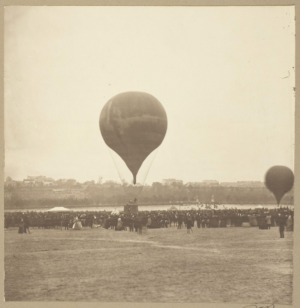 Nadar’s Balloon that took the first aerial photograph, “Le Geant, Champ de Mars, October 18, 1863”, probably printed 1880/89. (CC0 Public Domain Designation)
Remote sensing matured through aerial reconnaissance in World Wars, ultimately evolving into satellite-based earth observation in the 1960s. Other milestones include the 1972 launch of Landsat and the adoption of digital imaging, allowing for modern environmental monitoring and mapping. Can you imagine how magical your iPhone would be to Nadar if he saw us casually pulling up our route or zooming to a coffee shop on our handheld maps today?
That magical imagery has led to several discoveries. Remote sensing has revolutionized Earth observation, enabling discoveries like rapid glacier shrinkage in Patagonia, 90% volume loss in Walker Lake, and the detection of hidden archaeological structures using LiDAR, such as under the Cambodian jungle. Three discoveries in particular used remote sensing and other geospatial technologies to solve some world mysteries: the burial site of Genghis Khan, Amelia Earhart’s crash site, and newly revealed Mayan settlements.
Genghis Khan, a brilliant warrior and ruler, unified Mongolia’s nomadic tribes into a disciplined military state led by his family. He launched campaigns that extended the Mongol Empire from China’s Pacific coast to the Adriatic Sea. Dr. Albert Lin became interested in his personal heritage that led to his work using geospatial technologies to find the long hidden and mysterious burial place of the famous ruler, Genghis Khan. How do you decide where to start looking for something ancient? Crowdsourcing, or human computation, was part of the journey. I was fortunate to see Dr. Lin tell his story at Bishop Dunne high school in Dallas, TX as part of their 2013 GeoTech Conference. To find the ancient site without disturbing any land, people scanned imagery for something that “looks weird there.” The “weird” places led him to a moment where he’s walking on an ancient roof, completely swallowed by the landscape.
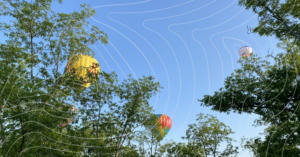 Balloons flying over my home. (By Barbaree Duke, 2024)
Dr. Lin isn’t the only person leveraging geospatial technology to solve an old mystery. What happened to Amelia Earhart? In 1928, she became the first female passenger to cross the Atlantic by plane. In 1932, she was the first woman to fly solo nonstop across the Atlantic and received the Distinguished Flying Cross. She promoted commercial aviation, authored best-selling books, and helped establish the Ninety-Nines, a group for women pilots. On July 2, 1937, she vanished over the Pacific Ocean while attempting a global flight as the first female pilot. According to an article in Popular Mechanics, Justin Myers, a pilot, used Google Earth and curiosity to solve part of the mystery. He’s not the only one to believe that she might have crash landed and survived on a small island.
Zoom from the Pacific Ocean over to Mexico. Tulane University doctoral student Luke Auld-Thomas has been part of another notable discovery. He realized that rather than hacking his way through the jungles, he needed Lidar imagery to make accurate measurements. Instead of costly new images, he sought out old and freely available imagery to complete his research. What he found in the process was a new Mayan city, Valeriana.
A new city, a modern mystery, and ancient history…all found with a photograph. It takes our human perspectives to research and interpret the mystery. We’re uniquely equipped to analyze patterns, especially if you’ve spent any time working with geospatial technologies. The proof we needed was quite literally in the pictures! If you need me, I’ll be volunteering at the balloon festival!
Barbaree Duke
Geospatial Crusader
I recently returned from a memorable trip to visit a friend I hadn’t seen in many years. We chose to meet halfway between our homes, taking the opportunity to unplug and immerse ourselves in nature. Together, we explored the historic Oak Alley Plantation, marveling at its stunning collection of oak trees, some dating back one or two centuries. The gardens were coming alive, with greenery spreading and the first blooms of the season appearing.
Spring is beginning to enliven our southernmost gardens, with azaleas bursting into bloom, daffodils emerging, and trees unfurling their first leaves. Having experienced spring in several different places, I find it fascinating to observe how the season manifests uniquely in each region. As spring arrives in your neighborhood, what signs do you notice? Let’s consider spring’s arrival from a mapping perspective.
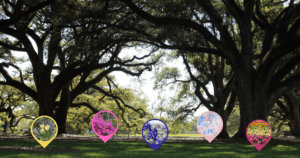 Created in Canva by B. Duke. Oaks photo by B. Duke
How do plants know it’s spring? Research conducted in Germany has revealed that a plant’s internal alarm clock is triggered by the amount of daylight. As a certain protein responds to extended hours of sunlight, it signals plants to bloom. This year, the Spring Equinox occurred on March 20th at 9:46 AM, ushering in longer days. Unless you live in an area where spring snow is common, it’s time to welcome the season. The NOAA provides key data about drought and flooding, which can influence the timing of blooms. The National Phenology Network maps the emergence of first leaves and first blooms, and this year’s maps reveal interesting trends in early spring arrivals.
For those who enjoy observing nature, many states showcase their most popular blooms on public watch sites. In Texas, the state flower – cheerful blue-purple wildflowers – blankets acres of fields each spring. It’s a beloved tradition to take photos among the bluebonnets or simply enjoy their beauty, while being mindful of snakes that also frequent these fields. The City of Brenham, Texas offers a site with daily bloom notices, a driving tour, and more. Visitors can even enjoy Blue Bell ice cream in the area. Lady Bird Johnson, the former First Lady, left a lasting legacy of wildflowers throughout her home state.
In my own garden, the delicate clusters of Lady Banks roses signify that spring has firmly arrived. The New York Botanical Garden actively tracks many blooms with a collection of online trackers. If you plan to visit New York in spring, watch for cherries, magnolias, daffodils, lilacs, azaleas, peonies, roses, water lilies, lotuses, and later, fall foliage. I also recall visiting the cherry blossoms in Washington, DC, where the lacy pink blooms lining the Tidal Basin offer a vivid contrast to winter’s chill. In Tulsa, Oklahoma, the botanical garden features “What’s Blooming?” every month, with photography that can brighten your day even from afar. Arizona’s state parks champion wildflowers, and last year Forbes published a beautiful collection of spring photos sure to lift your spirits.
Spring can have a positive impact on your wellbeing. Brené Brown once said, “I love spring because she always finds a way.” I am inspired by the mantra, “Bloom where you’re planted.” Finding contentment and peace where you are, in any season, can enhance your wellbeing. I hope you discover renewal and joy this spring. If you need me, I’ll be on the porch, admiring my Lady Banks roses and watching birds build nests among their branches.
Barbaree Duke
Geospatial Crusader