

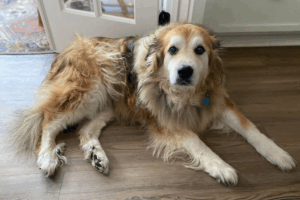
 Photo by B. Duke: Twoee, 14.5 years old, guarding the office door.
The Flintstones cartoon from my childhood colored my perspective on prehistoric pets. Fred, Wilma, Pebbles, and their pet Dino, a small, but dog-like dinosaur seemed completely reasonable, along with the foot-powered car! Animals, in particular dogs, are so much a part of human life that even the futuristic, dystopian movies have at least a robot pet, or alien species that is treated like a pet. They’re our life companions without a doubt. I’m a dog person. My two current furry adoptees, that turned out much larger than expected, bring many snuggles and comfort. We love them and believe they love us too.
The connection between humans and dogs isn’t new. Historically, domestic dogs came from wolves. According to Science Daily, “Many scientists assumed, [for decades], that most dog diversity resulted from recent selective breeding practices that emerged with Victorian Kennel Clubs. This new work challenges that idea. Instead, it reveals that dogs were already showing substantial physical variation thousands of years ago, not long after they split from wolves.” Researchers are finding new data, and they have strong evidence that human and dog evolution occurred simultaneously.
So now I’m curious, what dogs are most popular now versus the Victorian Age? The American Kennel Club has an annual list of most popular breeds. In 2024, the Top 5 breeds were:
- French Bulldog
- Labrador Retriever
- Golden Retriever
- German Shepherd Dog
- Poodle
French Bulldog?! That one surprised me as the breed joined the Top 5 in 2017 and has been climbing since that time. If we go back in time, the most popular breeds of the 1880s were hunting breeds: English setter, Irish water spaniel, Irish setter, Gordon setter, pointer, fox terrier, dachshund, mastiff, and collie. The Vanderbilts who built The Biltmore left reminders of their love for dogs, in particular a St. Bernard named Cedric.
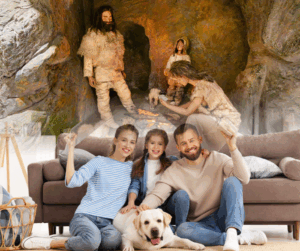 Photo by B. Duke in Canva.
Prior to popular hunting breeds, the guardians take the favorite spot. There are records of a mastiff making the journey to “the new world” on the Mayflower. Those harsh winters and stark living conditions were made more palatable with a furry companion for sure!
We need to go even further back in our time machine to ancient China and Japan to find phylogenetic studies of dogs. The Chow Chow emerges as one of the first new breeds beyond the wolves in this research. (Fair warning: serious nerd DNA stuff in that link!) And to not forget the felines, they have a strong presence in Egyptian history, perhaps to help control rats and mice. Whether you’re a canine or feline fan, they have long walked with humans in life and work.
In an iScience article from a few years ago, they explored where some breeds originated. They looked at 205 dog genomes and found connections to Mastiff, Jindo and others in Asia. I’m reminded of one of my girls. When we adopted her at just 10 weeks old, we sent off the DNA test out of curiosity. I fully expected the result of “TILT”… it’s a dog! Much to my surprise, she returned ½ Great Pyrenees/Jindo and ½ Treeing Walker Coonhound. She’s an excellent, and very vocal, guard dog!
Why do you need a pet? There’s excellent evidence that having a pet can lower your stress related cortisol levels. Animals can influence positive child development, especially with neurodivergence. How often is an animal just a kind listener or the hug that you need? Johns Hopkins has evidence that these relationships can help keep you young! I’ve always had a dog, or two. I can’t imagine life without them. I encourage you to visit your local shelter or rescue organization and expand your home with an animal friend.
If you need me, I’m in the office working on next month’s column with my faithful assistant of 14 ½ years, Twoee (pronounced 2- ē; named for those two extra toes), guarding the door!
Barbaree Duke
Geospatial Crusader



 Copyright © 2025 All Rights Reserved -
Thank you Barbaree!
Beautiful article. We’re dog people. Usually had multiples during the years. Can’t live without them.