

I recently returned from a conference in the desert. The dry air and sun-scorched temperatures are not my preference, but it is impossible to miss how many people, plants, and critters manage to thrive there. The landscapes were beautiful, gentle taupe-colored mountains dotted with cactus and palm trees against the brilliant blue sky, simply thriving while I personally was melting. Humans, animals, and plants all find a way to thrive and grow.
Deserts are interestingly dynamic ecosystems. A recent study from the University of Reading says that cacti are a species not only thriving but also “evolving at a shockingly high rate.” These slow-growing plants are particularly adept at creating new species. “Instead of flower size or pollinator type driving diversification, the key factor appears to be how rapidly cactus flowers change shape over time.” Changing shape quickly over time reminds me of the human impact on landscapes and other things that shape-shift and still thrive.
As geospatial folks, we are keenly aware of our planet’s natural morphing over time. The most naturally changed landscapes on Earth are characterized by rapid geological shifts, active volcanism, glacial retreat, and extreme erosion. While some evolve slowly over millions of years, others undergo drastic visible transformations in mere decades. It’s intriguing to watch the world move from Pangea to today…millions of years to slowly become our current earth.
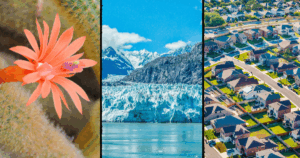 Canva creation by BD.
Did you realize that many popular global tourist destinations showcase our changing planet? Sea rise in Venice has humans getting creative to keep the sea in check. In 1850, Glacier National Park had about 150 documented glaciers. Today, that number has dwindled to roughly two dozen named glaciers that meet the minimum size criteria to flow under their own weight. Victoria Falls suffered from tremendous drought in recent years while the Swiss Alps saw reduced snowfall. The Maldives are working hard to adapt to climate change as well. Drier and warmer weather creates ideal conditions for wildfires, destroying communities like Lahaina, HI, and dissipates water bodies at an alarming rate such as in the Dead Sea. Its water level drops by roughly 4 feet annually, reducing its surface area by one-third over the past 50 years. Landscape change is not limited to glaciers, coastlines, or faraway tourist destinations; it is also happening in the places we call home.
Population change is easy to see and feel. The county that I call home is rapidly increasing in population. Our metro area in south Alabama is in the top ten, ranking sixth, of the fastest growing metro areas in the United States. My town is above 25% growth rate! This growth impacts so many things that might not have been on our city government’s radar. This might be why we have so many hamburger joints and new roundabouts to navigate. Sprawling corn fields have morphed to subdivisions and solar arrays. In October 2025, there were 315 active subdivisions under construction bringing 17,000 new students. Do you live near a fast-growing town?
Change is the common thread, whether it shows up in cactus flowers evolving new shapes, glaciers retreating, coastlines shifting, or cornfields becoming neighborhoods. Some landscapes change because of natural forces, some because of climate, and some because people arrive, build, and reshape what was familiar. As geospatial observers, we get a front-row seat to these transformations, but we also live inside them. The challenge is not simply to notice that places are changing, but to understand how, why, and at what cost – and maybe, like the desert itself, find thoughtful ways to adapt and thrive.
If you need me, I’ll be trying a new restaurant in town or finding new ways to help my garden thrive in these changing conditions.
Barbaree Duke
Geospatial Crusader


 Copyright © 2025 All Rights Reserved -
Leave a Reply