

I recently returned from a memorable trip to visit a friend I hadn’t seen in many years. We chose to meet halfway between our homes, taking the opportunity to unplug and immerse ourselves in nature. Together, we explored the historic Oak Alley Plantation, marveling at its stunning collection of oak trees, some dating back one or two centuries. The gardens were coming alive, with greenery spreading and the first blooms of the season appearing.
Spring is beginning to enliven our southernmost gardens, with azaleas bursting into bloom, daffodils emerging, and trees unfurling their first leaves. Having experienced spring in several different places, I find it fascinating to observe how the season manifests uniquely in each region. As spring arrives in your neighborhood, what signs do you notice? Let’s consider spring’s arrival from a mapping perspective.
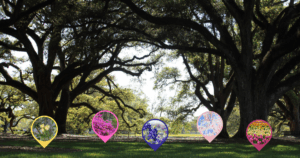 Created in Canva by B. Duke. Oaks photo by B. Duke
How do plants know it’s spring? Research conducted in Germany has revealed that a plant’s internal alarm clock is triggered by the amount of daylight. As a certain protein responds to extended hours of sunlight, it signals plants to bloom. This year, the Spring Equinox occurred on March 20th at 9:46 AM, ushering in longer days. Unless you live in an area where spring snow is common, it’s time to welcome the season. The NOAA provides key data about drought and flooding, which can influence the timing of blooms. The National Phenology Network maps the emergence of first leaves and first blooms, and this year’s maps reveal interesting trends in early spring arrivals.
For those who enjoy observing nature, many states showcase their most popular blooms on public watch sites. In Texas, the state flower – cheerful blue-purple wildflowers – blankets acres of fields each spring. It’s a beloved tradition to take photos among the bluebonnets or simply enjoy their beauty, while being mindful of snakes that also frequent these fields. The City of Brenham, Texas offers a site with daily bloom notices, a driving tour, and more. Visitors can even enjoy Blue Bell ice cream in the area. Lady Bird Johnson, the former First Lady, left a lasting legacy of wildflowers throughout her home state.
In my own garden, the delicate clusters of Lady Banks roses signify that spring has firmly arrived. The New York Botanical Garden actively tracks many blooms with a collection of online trackers. If you plan to visit New York in spring, watch for cherries, magnolias, daffodils, lilacs, azaleas, peonies, roses, water lilies, lotuses, and later, fall foliage. I also recall visiting the cherry blossoms in Washington, DC, where the lacy pink blooms lining the Tidal Basin offer a vivid contrast to winter’s chill. In Tulsa, Oklahoma, the botanical garden features “What’s Blooming?” every month, with photography that can brighten your day even from afar. Arizona’s state parks champion wildflowers, and last year Forbes published a beautiful collection of spring photos sure to lift your spirits.
Spring can have a positive impact on your wellbeing. Brené Brown once said, “I love spring because she always finds a way.” I am inspired by the mantra, “Bloom where you’re planted.” Finding contentment and peace where you are, in any season, can enhance your wellbeing. I hope you discover renewal and joy this spring. If you need me, I’ll be on the porch, admiring my Lady Banks roses and watching birds build nests among their branches.
Barbaree Duke
Geospatial Crusader


 Copyright © 2025 All Rights Reserved -
Leave a Reply