

In September, we looked at Pyongyang’s Mirae Scientists Street in North Korea. This month for the Pléiades 1 – Pléiades Neo Point of Interest, we check out Ayodhya, India, where the largest annual celebration of Diwali is held. This year, the event will be on October 20, 2025.
About the Point of Interest: Diwali, also known as the Festival of Lights, holds great significance in Hindu culture. It symbolizes the triumph of light over dark, and good over evil. The festival typically lasts five days and involves various traditions and celebrations. The largest Diwali celebration held in India relies upon thousands of volunteers who set out clay oil lamps along the banks of the Saryu River, in Ayodhya.
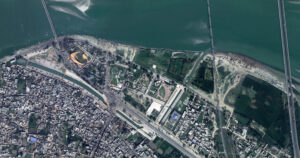
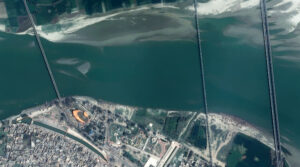 These two satellite images show where lanterns are placed along the Saryu River in Ayodhya, India during the Diwali, or Festival of Lights. The Pléiades 1B 50-cm color image from February 23, 2022, shows the richly hued waters. In the second photo, a Pléiades Neo 4 30-cm image captured March 13, 2022, we can see even more details of the happenings below, including boats floating on the river. These images have custom processing and color balancing applied by Apollo Mapping. PLEIADES © CNES 2025, Distribution Airbus DS.
Fun Factoids: (1) The city of Ayodhya set a new Guinness World Record during its Diwali celebrations on October 30, 2024 as volunteers lit 2.51 million clay oil lamps along the banks of the Saryu River. This display surpassed the previous year’s record of 2.2 million lamps. (2) During the festival, the celebrants illuminate their homes, temples and workspaces with diyas (oil lamps), candles and lanterns. Hindus, in particular, have a ritual oil bath at dawn on each day of the festival. (3) Diwali is also marked with fireworks as well as the decoration of floors with rangoli designs and other parts of the house with jhalars. Food is a major focus with families partaking in feasts and sharing mithai. (4) Some Hindus associate the festival with Goddess Lakshmi, the goddess of wealth and prosperity, and wife of Vishnu. According to Pintchman, the start of the 5-day Diwali festival is stated in some popular contemporary sources as the day goddess Lakshmi was born from Samudra Manthana, the churning of the cosmic ocean of milk by the Devas (gods) and the Asuras (demons) – a Vedic legend that is also found in several Puranas such as the Padma Purana; while the night of Diwali is when Lakshmi chose and wed Vishnu. (5) For others, the holiday symbolizes the return of Prince Rama of Ayodhya to his wife, Sita, and brother, Lakshman, from a 14-year-long exile and a war where Prince Rama stood victorious. The people of Ayodhya lit lamps along the way to light his path in the darkness.
The 50-cm Pléiades 1 High-Resolution Satellite Constellation
The Pléiades 1 constellation (or at least part of it!) has been in orbit since December 2011 and if you have not had a chance to check out any sample imagery, take a few moments and have a look at the gallery on our website. If you work with high-resolution imagery, you should consider Pléiades 1 and Pléiades Neo for your next geospatial projects.
A variety of Pléiades 1 products are available from both a well-established archive and as a new collection, including 50-centimeter (cm) pansharpened imagery and 50-cm panchromatic – 2-meter (m) 4-band multispectral bundles. We are happy to discuss the technical specifications, pricing and tasking options available with both of these satellite constellations.
The 30-cm Pléiades Neo High-Resolution Satellite Constellation
Pléiades Neo is our newest high-resolution satellite constellation. The first Neo satellite went up in April 2021 and the second in August of the same year. This 30-centimeter resolution constellation will add two more satellites in the next few months and upgrade from daily to intraday revisits. Pléiades Neo has six multispectral bands with 1.2-meter resolution, including a deep blue and two infrared bands, along with a 30-centimeter resolution panchromatic band.
The archive is growing every day, and the satellites are available for new collections, making Pléiades Neo the perfect solution for site monitoring. Check out our beautiful sample images in the Pléiades Neo gallery.
More sample images and technical information about Pléiades 1 can be found on our website here; while the same can be found here for the Pléiades Neo constellation.
The Apollo Mapping sales team can answer any questions you might have about Pléiades 1 and/or Pléiades Neo. We can be reached at (303) 993-3863 or sales@apollomapping.com.


 Copyright © 2025 All Rights Reserved -
Leave a Reply