
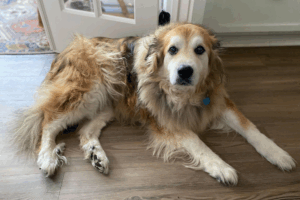
 Photo by B. Duke: Twoee, 14.5 years old, guarding the office door.
The Flintstones cartoon from my childhood colored my perspective on prehistoric pets. Fred, Wilma, Pebbles, and their pet Dino, a small, but dog-like dinosaur seemed completely reasonable, along with the foot-powered car! Animals, in particular dogs, are so much a part of human life that even the futuristic, dystopian movies have at least a robot pet, or alien species that is treated like a pet. They’re our life companions without a doubt. I’m a dog person. My two current furry adoptees, that turned out much larger than expected, bring many snuggles and comfort. We love them and believe they love us too.
The connection between humans and dogs isn’t new. Historically, domestic dogs came from wolves. According to Science Daily, “Many scientists assumed, [for decades], that most dog diversity resulted from recent selective breeding practices that emerged with Victorian Kennel Clubs. This new work challenges that idea. Instead, it reveals that dogs were already showing substantial physical variation thousands of years ago, not long after they split from wolves.” Researchers are finding new data, and they have strong evidence that human and dog evolution occurred simultaneously.
So now I’m curious, what dogs are most popular now versus the Victorian Age? The American Kennel Club has an annual list of most popular breeds. In 2024, the Top 5 breeds were:
- French Bulldog
- Labrador Retriever
- Golden Retriever
- German Shepherd Dog
- Poodle
French Bulldog?! That one surprised me as the breed joined the Top 5 in 2017 and has been climbing since that time. If we go back in time, the most popular breeds of the 1880s were hunting breeds: English setter, Irish water spaniel, Irish setter, Gordon setter, pointer, fox terrier, dachshund, mastiff, and collie. The Vanderbilts who built The Biltmore left reminders of their love for dogs, in particular a St. Bernard named Cedric.
 Photo by B. Duke in Canva.
Prior to popular hunting breeds, the guardians take the favorite spot. There are records of a mastiff making the journey to “the new world” on the Mayflower. Those harsh winters and stark living conditions were made more palatable with a furry companion for sure!
We need to go even further back in our time machine to ancient China and Japan to find phylogenetic studies of dogs. The Chow Chow emerges as one of the first new breeds beyond the wolves in this research. (Fair warning: serious nerd DNA stuff in that link!) And to not forget the felines, they have a strong presence in Egyptian history, perhaps to help control rats and mice. Whether you’re a canine or feline fan, they have long walked with humans in life and work.
In an iScience article from a few years ago, they explored where some breeds originated. They looked at 205 dog genomes and found connections to Mastiff, Jindo and others in Asia. I’m reminded of one of my girls. When we adopted her at just 10 weeks old, we sent off the DNA test out of curiosity. I fully expected the result of “TILT”… it’s a dog! Much to my surprise, she returned ½ Great Pyrenees/Jindo and ½ Treeing Walker Coonhound. She’s an excellent, and very vocal, guard dog!
Why do you need a pet? There’s excellent evidence that having a pet can lower your stress related cortisol levels. Animals can influence positive child development, especially with neurodivergence. How often is an animal just a kind listener or the hug that you need? Johns Hopkins has evidence that these relationships can help keep you young! I’ve always had a dog, or two. I can’t imagine life without them. I encourage you to visit your local shelter or rescue organization and expand your home with an animal friend.
If you need me, I’m in the office working on next month’s column with my faithful assistant of 14 ½ years, Twoee (pronounced 2- ē; named for those two extra toes), guarding the door!
Barbaree Duke
Geospatial Crusader
In January, we looked at Banwol Island in South Korea, which features 400 purple-roofed buildings, purple telephone boxes, and large lavender fields. This month for the Pléiades 1 – Pléiades Neo Point of Interest, we check out the historic Longwood House on St. Helena.

 These two satellite images show the historic Longwood House on St. Helena, dominating the middle of the district in which its situated. You can see in the Pléiades Neo 3 30-cm color image from March 22, 2022, how brightly colored the lay of the land and the buildings are, including the expansive gardens and trees surrounding the sprawling home. In the Pléiades 1B 50-cm color image taken June 12, 2022, the colors are more subdued which is common for data from this satellite constellation. These images have custom processing and color balancing applied by Apollo Mapping. PLEIADES © CNES 2026, Distribution Airbus DS.
About the Point of Interest: Longwood House is most famously known as the former residence of Napoleon. It is now a museum owned by the French government, attracting around 7,000 visitors per year. Between 2010 and 2014, the Fondation Napoleon, the Minister of Foreign Affairs and the Domaines Nationaux de Sainte-Hélène ran a large restoration project of Longwood House, at a cost of nearly 2.2 million Euros.
Fun Factoids: (1) Originally built by Governor Dunbar in 1743 as a storage barn, and formerly the summer residence of the Lieutenant Governor John Skelton and his wife Mary Moore Cassamajor Skelton, Longwood House was converted for the use of Napoleon in 1815. The building was chosen to house Napoleon because it was easy to secure as it sits on an elevated plain, largely free from woodlands. (2) Longwood House, its outbuildings and gardens (the latter designed by Napoleon himself, and replanted and maintained for the last 30 years following this design) sit inside a surrounding wall, with a total area of 1 hectare. (3) In 1657, Oliver Cromwell granted the East India Company (EIC) a charter to govern Saint Helena. The following year, the company decided to fortify the island and settle it with planters. (4) Between 1791 and 1833, Saint Helena became the site of a series of experiments in conservation, reforestation, and attempts to boost rainfall artificially. (5) Longwood House has twice been voted one of the Seven Wonders of St Helena. Most island tours include a visit to both Longwood House and Napoleon’s Tomb. (6) St. Helena’s most famous exile, Napoleon Bonaparte spent most of his time here at Longwood House, arriving on Dec. 10, 1815, and dying there May 5, 1821. His tomb is also in Longwood district.
The 50-cm Pléiades 1 High-Resolution Satellite Constellation
The Pléiades 1 constellation (or at least part of it!) has been in orbit since December 2011 and if you have not had a chance to check out any sample imagery, take a few moments and have a look at the gallery on our website. If you work with high-resolution imagery, you should consider Pléiades 1 and Pléiades Neo for your next geospatial projects.
A variety of Pléiades 1 products are available from both a well-established archive and as a new collection, including 50-centimeter (cm) pansharpened imagery and 50-cm panchromatic – 2-meter (m) 4-band multispectral bundles. We are happy to discuss the technical specifications, pricing and tasking options available with both of these satellite constellations.
The 30-cm Pléiades Neo High-Resolution Satellite Constellation
Pléiades Neo is our newest high-resolution satellite constellation. The first Neo satellite went up in April 2021 and the second in August of the same year. This 30-centimeter resolution constellation will add two more satellites in the next few months and upgrade from daily to intraday revisits. Pléiades Neo has six multispectral bands with 1.2-meter resolution, including a deep blue and two infrared bands, along with a 30-centimeter resolution panchromatic band.
The archive is growing every day, and the satellites are available for new collections, making Pléiades Neo the perfect solution for site monitoring. Check out our beautiful sample images in the Pléiades Neo gallery.
More sample images and technical information about Pléiades 1 can be found on our website here; while the same can be found here for the Pléiades Neo constellation.
The Apollo Mapping sales team can answer any questions you might have about Pléiades 1 and/or Pléiades Neo. We can be reached at (303) 993-3863 or sales@apollomapping.com.
 A 30-cm WorldView Legion imagery sample collected over Gibbs Farm, New Zealand on May 3, 2025.
With the New Year came a few price adjustments that are effective immediately for both mono and stereo Vantor imagery products. The price changes include new (lower minimum orders); a few price increases, a few price decreases; and then the temporary pauses of priority tasking while this offering is overhauled by Vantor.
To get your new price list, send us an email at sales@apollomapping.com and we will get back to you as soon as possible!
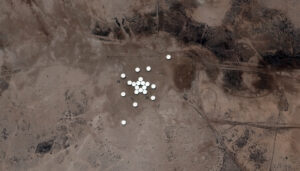 In the middle of the Quatar desert has popped up a most unlikely thing – an art installation consisting of giant round mirrors attached to black wrought iron supporting pipes. About an hour’s drive north of colossal monolithic sculptures installed by U.S. artist Richard Serra can be found the piece of art called Shadows Travelling on the Sea of the Day. The free-standing black rings and silvered-glass mirrors are the creative brainstorm of Olafur Eliasson, an Icelandic-Danish artist known for his exploration of humanity’s deep-rooted connection to nature. His artwork was installed in 2022 in northwestern Qatar and includes 20 large circular shelters, three single rings and two double rings that are placed according to the axes of a fivefold symmetrical pattern. Eliasson, who lives and works in Copenhagen and Berlin, has explained that he was drawn to this remote corner of Qatar by its surprising similarities to the terrain of his family’s windswept homelands in the North Atlantic. Eliasson told CNN that the structures are designed to draw people in, to interact with the installation and to encourage them to contemplate their surroundings. The artist said his work is intended to create a sense of passing time and of disconnecting from our standard perception of time. In the image above, we can see the circular mirrors reflecting back at the satellite. This 30-cm WorldView Legion image was collected on July 202, 2025, and has custom processing and color balance applied by Apollo Mapping. (Satellite Imagery © 2026 Vantor)
In this monthly article, we travel the world to check out unique, fun and sometimes a bit weird 30-centimeter (cm) color imagery samples from the WorldView constellation. In January, we looked at the Schwetzingen Palace in Germany. For this edition of the 30-cm Color WorldView Image of the Month, we feature an image of an art installation called Shadows Travelling on the Sea of the Day located in Al ‘Arish, Quatar.
30-cm WorldView-3 (WV3) launched in late 2014, WorldView-4 (WV4) launched in late 2016 and then the first WorldView Legion satellites launched in 2024. Taken together, this is the most advanced satellite constellation the commercial marketplace has ever had access to. Here are a few of the features that really set these satellites apart from the competition:
- Improved Resolution
- Higher resolution means you can see more detail in WorldView imagery.
- Data collected at nadir will have 31-centimeter (cm) panchromatic, 1.24-meter (m) visible and near infrared, 3.7-m SWIR (WV3 only) and 30-m CAVIS (WV3 only) bands.
- Additional Spectral Bands
- If spectral analysis is part of your project, then no other satellite can match WorldView-3 and WorldView Legion with their 8 bands of visible and near-infrared data; and then 8 shortwave infrared bands (WV3 only) which are crucial for geological studies.
- Better Positional Accuracy
- With accuracies of 3.5-m CE90% or better (without ground control even!), the 30-cm WorldView constellation has no rivals for its enhanced positional accuracy.
- Daily Revisits
- With multiple WorldView-3 and WorldView Legion satellites orbiting our planet, daily revisits are available for most locations.
- WV4 is no longer collecting new imagery.
- Increased Collection Capacity
- WV3/4 feature 13.1-km swath widths (at nadir) with the ability to collect up to 680,000 square kilometers (sq km) of high-resolution data per day per satellite (though WV4 is dead now).
- WorldView Legion features six 30-cm satellites, significantly boosting the collection capacity of this leading high-resolution constellation.
If you are interested in WorldView-3, WorldView-4 and/or WorldView Legion imagery for your next project, please let us know by phone, 303-993-3863, or by email, sales@apollomapping.com.
You can also find more WV3 samples and technical information on our website here; WV4 samples and information can be found here; and then finally here is more information about WorldView Legion.
Evermore frequently, I’m forced to question the character of a large swath of my fellow countrymen. To be fair, I was skeptical of people’s motives, beliefs, and traits far before Trump descended that elevator in 2015, but I was operating largely on a hunch and a series of mostly disconnected anecdotes, even if there were enough of them to signal a pattern and a reasonable sociological deduction.
But as soon as the tyrant fully and officially entered our political sphere – ending its fragile, yet stable, foundational moorings as we knew them forever – the empirical evidence has clearly demonstrated what I always assumed: people are just simply not good. I used to play with the argument about whether people were mostly good with bad intentions vs. mostly bad with good intentions, but now I firmly believe that people are mostly bad, and on occasion, they may have some tendency to do good for others – but only if they’re of the same ideological cloth. At least that’s what it has devolved to in this country.
While I think this is also true of those huddled at the left end of the political spectrum, they’re less predestined to wish harm and to default to violence than those at the far right end of the spectrum; many of those center-right have no problem looking away from the carnage and pretending it’s not happening or not as bad as it very clearly is. There is no shortage of criticisms for the political left and its adherents, trust me – they’re just not relevant today because they’re neither in power, nor are they the ones who are responsible for the heinous official acts of state violence we see today. Put the left back in power and I’ll gladly call them to task; as it stands, that opportunity may never come again.
 Taking to the streets may not be enough, but what will be? Amidst the worst Constitutional crisis since the Civil War, I fear that we’re watching the end of our country splinter apart, day-by-day. (Image retrieved from here and comes courtesy of Joshua Santos.)
But I cannot fault anyone who voted for Trump in 2016 – I surely didn’t vote for him; to me, it was obvious he was/is a charlatan, a clown, and a criminal. His track record has demonstrated routinely that he has few morals and the character of a B-Grade Mob Boss – at least an A-Grade Mob Boss has the decency to not lie to your face. But I understand that much of the populace had become quite disaffected and disenchanted with politics in America; it really does seem like nothing really changes, regardless of who is in power, especially for those near the lower end of the socioeconomic spectrum.
So, for them, and at that time, no fault, even if it’s unfathomable how someone could not see the evidence in front of their eyes about what was destined to come. To be clear, this is no defense of Hillary Clinton, only that despite what strong arguments can be made against her for any number of reasons, they simply don’t stack up against what Trump had done, was capable of, and likely to do – and has done while in power. I’ll even go a little further and grant some grace for those who voted for him in 2020, despite his bungling of so much of the early stages of the pandemic. But once you get to the interregnum period after he was defeated in 2020 and January 6th, as well as the vitriol he spewed from then on until his return to power, there just isn’t any forgiveness or benefit of the doubt left. At some point, you have to call a spade a spade; you have to cut your losses.
I also understand that Trump voters are not a monolith and shouldn’t be talked about or thought about as one. Not because it paints too broad a stroke per se, but because it is reductionist and leaves out nuance that is essential to understanding what we’re living through. There are many strains of Trump supporters, all with their own motivations, some more mischievous, disconcerting, criminalistic, and unimaginable than others, but this doesn’t make a wholesale dismissal of those supporters any less hard for me because, eventually, you have to accept what’s before your eyes, as hard as it is to see. But here I write that I don’t know how much longer I can make any concessions to anyone who stands by the most immoral man to hold his position since… ever?
Am I a “Never Trumper”? Most certainly. Do I have “Trump Derangement Syndrome” (TDS)? I don’t think so, but I’m sure his legions of sycophants, enablers, and henchmen would think so. But to put a little nuance into whether I should be painted as such, let me provide a few examples to the contrary.
During his first term, I thought the Great American Outdoors Act was very valuable to increasing the workforce of our public lands and protecting those special and fragile places (of course, this was severely marred by what he did to Bears Ears National Monument and allowing drilling in the Arctic National Wildlife Refuge); I think the Prevent Animal Cruelty and Torture Act, which federalizes laws against cruelty to domestic animals was a much-needed and long overdue action; and the First Step Act, aimed at reforming federal prisons and reducing recidivism was pivotal, and could serve as a model for state prisons as well. There are a number of things I could name today that he has proposed (if not followed through on yet) that would be greatly beneficial to many Americans, such as limiting credit card interest rates to 10% because of his concerns with the weight of debt and the proliferation of “usury,” as well as that he wants to sign an executive order barring real estate conglomerates from buying up all the housing inventory and perpetuating a “nation of renters.” Many think it was overdue to reschedule marijuana. There have been other good ideas, too, I’m sure.
So, if I have TDS, then it’s an intermittent case of it. I think the reality of the situation is that a corrupt and incorrigible human in the highest seat of power in the world is still susceptible to the influence of a handful of people close to him who (thankfully) have better intentions for the country than he’s predisposed to. Unfortunately, most of those with influence over Trump only operate with nefarious intentions, something that can be clearly demonstrated from what’s happened in Minneapolis just during January of 2026 – i.e., we can set aside all of the other bullshit he’s done or tried to do (seize Greenland by force, blow up NATO, isolate our allies, use the DOJ as his personal law firm, pardon all of the J6 rioters, including those who attacked law enforcement, etc.) and just use this “case study” as evidence that (1) Trump is unfit for his duties, has no respect for the rule of law and Constitution, and is motivated by causing pain at scale on anyone who crosses him, disagrees with him, or looks differently than him; and (2) that those who work in these official roles with ICE and other gestapo federal agencies, as well as all the everyday citizens who either support these raids and destructions of neighborhoods and families, or turn a blind eye to it, are of the lowest possible character and should not be trusted or empathized with in any way. That’s tough to accept, but I think we’re there.
What makes this all the harder for me to state is the sad fact that several people I consider close to me fall into this category. And outside of their embrace of these actions and ideologies – when/if I’m able to fully set that aside – they remain some of the kindest and most thoughtful people I’ve ever known. It’s a very tough reality to sit with for me. Shortly after the murder of Renee Good, I spoke with one of them by phone, and he instantly went into spin – as graciously as I could, I shut it down by simply saying, “We’re not going to agree on this. Let’s move onto another topic.” I haven’t talked to this friend since the murder of Alex Pretti. Maybe in part because there hasn’t been a need to, but maybe also because I don’t want to watch this friend lose more of his grip on reality if he responds the way I, unfortunately, expect he might. Blind allegiance to the official position; propaganda at its worst.
If I can see the good in someone who I disagree with politically so vociferously, then I have to accept that (1) that person can come to see what’s really going on at some point, hopefully sooner than later; and (2) that I have to assume the mirror is inverted for his view of me, too. He knows I’m a good person; he values our friendship; he just doesn’t understand that I don’t see what he does. He, too, hopes I’ll acknowledge the error of my ways. Thing is, only one of us is right on this issue, and if I have to explain to you which one, then you’re just not paying attention.
I’d like to say there’s still time for you to come to your senses, and maybe there is. But I just don’t think enough people have any sense to begin with, let alone any desire to accept their role in making the unthinkable our day-to-day reality…
Marco Esquandoles
I Just Live Here
¡Bienvenidos a febrero! Nosotros en Apollo Mapping estamos gustosos de tenerlos otro mes aquí en los resúmenes españoles del mes de febrero.
PRODUCTO DESTACADO – La Constelación WorldView Legion de 30 cm y 8 bandas
¿Trabajas en planificación urbana, monitoreo ambiental o gestión de recursos, y tienes la tarea de identificar usos del suelo, dar seguimiento a cambios en áreas urbanas, evaluar la salud forestal y planificar proyectos de desarrollo? Si es así, la imaginería de alta resolución, con su gran concentración de píxeles para un mayor nivel de detalle, permite un análisis y medición precisos de elementos que no son visibles en imágenes de menor resolución, lo que posibilita una cartografía más precisa, una menor necesidad de visitas de campo y una documentación detallada del mundo real.
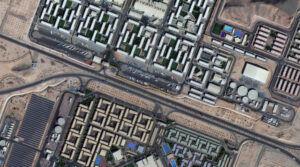 Imagen WorldView Legion de 30 cm, cortesía de Maxar, capturada sobre el Campus NEOM en Arabia Saudita el 2 de diciembre de 2024. Apollo Mapping ha aplicado balance de color personalizado y mejoras en la imagen.
Desde su lanzamiento en 2024, WorldView Legion de 30 centímetros (cm) y 8 bandas se ha convertido en una de las constelaciones satelitales de 30 cm más prolíficas disponibles en el sector de imágenes satelitales de alta resolución. Con seis satélites actualmente en órbita, la constelación WorldView Legion captura aproximadamente 3.2 millones de kilómetros cuadrados (km²) de imágenes de alta resolución de 30 cm todos los días, las cuales se incorporan a Cazador de Imágenes de manera (casi) instantánea. Además, su avanzado sensor multiespectral captura datos en ocho longitudes de onda diferentes, ofreciendo perspectivas excepcionalmente detalladas de la superficie terrestre y facilitando la identificación de objetos pequeños y la detección de cambios ambientales sutiles, tanto en entornos urbanos como naturales. Aplicaciones avanzadas como batimetría, evaluación de la vegetación, exploración mineral y monitoreo de incendios forestales son casos de uso comunes para la imaginería satelital WorldView Legion de 30 cm.
Con el 90% de la población mundial residiendo entre las latitudes 45° Norte y 45° Sur, la constelación está optimizada para intervalos de revisita más rápidos en estas regiones, al tiempo que mantiene cobertura en latitudes más altas mediante dos satélites sincronizados con el sol. Cuatro satélites WorldView Legion orbitan el planeta en órbitas persistentes de latitudes medias. La constelación WorldView Legion opera a lo largo de múltiples trayectorias orbitales con una huella de 10 km en nadir, lo que permite revisitas frecuentes; de hecho, hasta 15 veces al día en regiones seleccionadas. Esta mayor capacidad y frecuencia de revisita en las áreas más pobladas del mundo genera un archivo robusto y capacidades avanzadas de monitoreo en estas regiones críticas. La frecuencia de revisita respalda una cartografía integral, una detección de cambios sólida y un análisis profundo sobre extensas áreas geográficas. Estas capacidades permiten que WorldView Legion de 30 cm respalde una amplia gama de aplicaciones geoespaciales, incluidos proyectos que requieren análisis espectral y un nivel de detalle muy alto.
Con seis satélites activos en órbita, la constelación WorldView Legion se distingue por:
- Imágenes pancromáticas de 30 cm y multiespectrales de 8 bandas a 1.2 m (costera, azul, verde, amarillo, rojo, borde rojo 1, borde rojo 2 e infrarrojo cercano, NIR).
- Cuatro satélites en órbita media (MIO) concentrados en las áreas más pobladas del planeta.
- Captura de más de 500,000 km² diarios por satélite.
- Un promedio de tres accesos diarios a ubicaciones entre 40° de latitud Norte y Sur.
- Captura de imágenes a lo largo de todo el día, y no solo por la mañana, gracias a sus satélites en órbita media (MIO).
La constelación WorldView Legion de 30 cm permite a Apollo Mapping ofrecer mayor capacidad de adquisición de imágenes de alta resolución y tiempos de entrega más rápidos a clientes de diversos sectores, incluidos defensa, minería, petróleo y gas, ingeniería, educación e investigación, y ayuda humanitaria.
Puedes explorar hoy mismo todo nuestro archivo de imágenes satelitales en Cazador de Imágenes.Para ver cómo la imaginería WorldView Legion de 30 cm y 8 bandas puede respaldar tu próximo proyecto, u obtener recomendaciones personalizadas, comunícate ahora con nuestro equipo de ventas en sales@apollomapping.com.
Muestra de imaginería WorldView Legion de 30 cm capturada sobre Gibbs Farm, Nueva Zelanda, el 3 de mayo de 2025.Obtén tu nueva lista de precios de imágenes satelitales que incluye los cambios de Vantor
¡Con la llegada del Año Nuevo se implementaron algunos ajustes de precios que entran en vigor de manera inmediata tanto para los productos de imágenes mono como estéreo de Vantor! Estos cambios de precios incluyen nuevos mínimos de pedido (más bajos), algunos aumentos de precio, algunas reducciones de precio, y también pausas temporales en la programación prioritaria (priority tasking) mientras esta oferta es reestructurada por Vantor.
Para obtener tu nueva lista de precios, envíanos un correo electrónico a sales@apollomapping.com y nos pondremos en contacto contigo lo antes posible.
Imagen del Mes WorldView en Color de 30 cm – Sombras viajando sobre el mar del día
En medio del desierto de Catar ha surgido algo de lo más inesperado: una instalación artística compuesta por enormes espejos circulares sujetos a tuberías de soporte de hierro forjado negro. A aproximadamente una hora en automóvil al norte de las colosales esculturas monolíticas instaladas por el artista estadounidense Richard Serra, se encuentra esta obra de arte titulada Shadows Travelling on the Sea of the Day. Los anillos negros autoportantes y los espejos de vidrio plateado son el resultado del proceso creativo de Olafur Eliasson, un artista islandés-danés conocido por su exploración de la profunda conexión de la humanidad con la naturaleza. La obra fue instalada en 2022 en el noroeste de Catar e incluye 20 grandes refugios circulares, tres anillos simples y dos anillos dobles, dispuestos según los ejes de un patrón simétrico de cinco pliegues. Eliasson, quien vive y trabaja entre Copenhague y Berlín, ha explicado que se sintió atraído por este rincón remoto de Catar debido a sus sorprendentes similitudes con el terreno de las tierras ventosas de su familia en el Atlántico Norte. El artista comentó a CNN que las estructuras están diseñadas para atraer a las personas, fomentar la interacción con la instalación y alentarlas a contemplar su entorno. Asimismo, señaló que su obra busca generar una sensación del paso del tiempo y una desconexión de nuestra percepción convencional del tiempo. En la imagen superior, se pueden observar los espejos circulares reflejando hacia el satélite. Esta imagen WorldView Legion de 30 cm fue capturada el 20 de julio de 2025 y cuenta con procesamiento personalizado y balance de color aplicados por Apollo Mapping. (Imágenes satelitales © 2026 Vantor)En este artículo mensual, viajamos por el mundo para explorar muestras únicas, divertidas y, en ocasiones, un poco peculiares de imágenes en color de 30 centímetros (cm) de la constelación WorldView.
En enero, analizamos el Palacio de Schwetzingen en Alemania. Para esta edición de la Imagen del Mes WorldView en Color de 30 cm, presentamos una imagen de una instalación artística titulada Shadows Travelling on the Sea of the Day, ubicada en Al ‘Arish, Catar.
WorldView-3 (WV3) fue lanzado a finales de 2014, WorldView-4 (WV4) a finales de 2016, y los primeros satélites WorldView Legion se lanzaron en 2024. Juntas, estas plataformas forman la constelación satelital más avanzada a la que ha tenido acceso el mercado comercial.
Algunas características que distinguen a estos satélites de la competencia:
- Resolución Mejorada
- Mayor resolución significa mayor nivel de detalle en las imágenes de WorldView.
- Datos recopilados en nadir incluyen: 31 cm pancromático, 1.24 m en visible e infrarrojo cercano, 3.7 m SWIR (solo WV3) y 30 m CAVIS (solo WV3)
- Bandas Espectrales Adicionales
- Para análisis espectral, ningún otro satélite iguala a WorldView-3 y WorldView Legion con sus 8 bandas en visible e infrarrojo cercano; y también 8 bandas SWIR (solo WV3) que son esenciales para estudios geológicos
- Precisión Posicional Mejorada
- Con una precisión de 3.5 m CE90% o mejor (¡incluso sin control terrestre!), la constelación de WorldView de 30 cm no tiene rivales en cuanto a precisión posicional mejorada.
- Revisitas Diarias
- Con múltiples satélites WorldView-3 y WorldView Legion orbitando el planeta, se pueden obtener imágenes diarias en la mayoría de las ubicaciones.
- WV4 ya no recopila imágenes nuevas.
- Mayor Capacidad de Recolección
- WV3/WV4 cuentan con un ancho de barrido de 13.1 km en nadir, con la capacidad de recolectar hasta 680,000 km² de datos de alta resolución por día y por satélite (aunque WV4 ya no está operativo).
- Cuando esté completamente desplegada, WorldView Legion contará con seis satélites de 30 cm, aumentando significativamente la capacidad de recolección de esta constelación líder en alta resolución.
Si estás interesado en imágenes WorldView-3, WorldView-4 y/o WorldView Legion para tu próximo proyecto, por favor contáctanos por teléfono al 303-993-3863 o por correo electrónico a sales@apollomapping.com.
También puedes encontrar más muestras e información técnica de WV3 en nuestro sitio web aquí; muestras e información de WV4 se pueden encontrar aquí; y, por último, aquí encontrarás más información sobre WorldView Legion.
Fernando Gutierrez
Topographic Translator
 A 30-cm color Pléiades Neo image collected on April 28, 2023 over Roozengaarde in the Skagit Valley, Washington, USA during the annual Tulip Festival.
In the ever-changing world of geospatial technology, Airbus offers a groundbreaking solution for repeat imagery collections. Airbus’ Pléiades Neo OnePlan is a powerful monitoring solution that combines cutting-edge innovation with unparalleled collection capability at 30-centimeter (cm) resolution.
With 30-cm Pléiades Neo, Apollo Mapping clients are able to monitor urban growth, track environmental changes, and gain valuable insights into infrastructure development with unprecedented resolution and repeat collections. Its state-of-the-art capabilities ensure timely data delivery, enabling informed decision-making like never before. Airbus has a successful track record of quickly collecting beautiful imagery, making it the best option for monitoring applications.
The Pléiades Neo OnePlan tasking solution has a flexible pricing structure, offering a discounted per-square-kilometer cost that makes it a fantastic choice for a wide range of applications.
Airbus’ Pléiades Neo also boasts an impressive standard delivery time of 12 hours or less once the imagery is collected and downlinked, ensuring that you have access to the latest data when you need it most. Unlock a world of possibilities in monitoring, analysis, and decision-making with 30-cm resolution Pléiades Neo OnePlan tasking.
To find out more about 30-cm Pléiades Neo OnePlan tasking for site monitoring, send us an email at any time to sales@apollomapping.com and we will get right back to you!
- It’s time once again for a shout out to all our nerds as here is our list of cool technological advancements over the past month:
These bacteria can target cancer cells.
Basic building blocks of life found in close-by galaxy.
Bumblebees can learn as well.
A paint that can cool buildings while collecting water.
A new antibiotic for resistant bacterial strains.
Fungus is modified to taste like meat.
Light exerts magnetic forces on matter too.
This nearby exoplanet could have liquid water on its surface.
This wheat strain makes its own fertilizers by encouraging microbial growth.
Moss spores survived time in open space.
A new way to recycle Teflon.
This new metal composite could make planes and rockets lighter and stronger.
Chimps like to party daily!
One more reason to drink coffee daily.
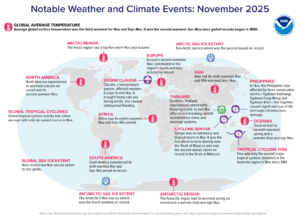 North America experienced its warmest autumn on record and its second warmest November. Scientists recorded near-record low November sea ice extent for the globe. The Antarctic’s November sea ice extent was the fourth smallest on record. The Antarctic region had its warmest spring on record and a warmer-than-average November. Claudia, a low-pressure system, affected western Europe in mid-November. It brought heavy rain and strong winds, and caused widespread flooding. The November Arctic sea ice extent was the second lowest on record. The Arctic region had a top five warm November and autumn. Southern Thailand experienced catastrophic flooding in mid- to late November after record-breaking rainfall overwhelmed rivers and drainage systems. Senyar was an extremely rare tropic storm that brewed in November and was the first storm to form directly over the Strait of Malacca. In November, the Philippines was affected by three consecutive typhoons that altogether caused significant loss of life and major infrastructure damage. (Image Credit: NOAA Global Climate Report)
- The Global Climate Change Report for November 2025 has been released by the National Centers for Environmental Information and reveals further proof that global climate change remains a concern. November 2025 ranked as the third warmest November in NOAA’s 176-year record with a global surface temperature 1.18°C (2.12°F) above the 20th Century average. The 10 warmest Novembers have all occurred since 2015 with the most recent three years (2023, 2024, and 2025) comprising the top three. This month marked the 49th consecutive November with above-average temperatures. Global land surface temperature ranked as the fourth warmest for November at 2.09°C (3.76°F) above average. Meanwhile, global ocean surface temperature was also fourth warmest on record at 0.77°C (1.39°F) above average. In November 2025, unusually high temperatures gripped large portions of the globe. Temperature departures exceeding 3.0°C (5.4°F) occurred across much of the Arctic, Northern Hemisphere land surfaces, and parts of eastern Antarctica and southern Africa. Meanwhile, widespread departures of at least 1.0°C (1.8°F) affected the western Pacific, parts of the eastern and southeastern Pacific, and the Atlantic. In total, about 4.1% of the world’s surface experienced a record high November temperature. These records included small pockets across North America, Africa, Asia, Australia, and across the western Pacific and Southern Oceans. Driven by unusual warmth throughout the month, North America experienced its second warmest November on record. The temperature departure exceeded 3.0°C (5.4°F) for only the second time on record, falling just 0.06°C (0.11°F) shy of the 2016 record. Compared to all months in North America’s period of record, November 2025 had the fourth-highest monthly temperature departure. Only the months of December 2023, January 2021, and November 2016 had a higher departure. Europe also experienced its second warmest November on record at 2.20°C (3.96°F) above average. This value was 0.17°C (0.31°F) cooler than the 2015 record. Asia had a marked contrast across the region. While much of the region experienced unusual warmth, cooler conditions were observed in parts of the south and north. Averaged as a whole, November 2025 was Asia’s ninth warmest on record. Elsewhere, the Arctic had its fifth-warmest November, Africa had its eighth warmest, and South America recorded its ninth warmest. Oceania and the Antarctic region had a warmer-than-average November.
- The New Year has arrived and with it the desire of many people to eat heathier and boost their physical fitness levels to get in shape. A component of GIS technology happens to be GPS, which is used with most modern fitness apps and wearables like a Garmin or Apple Watch that tracks your route, distance walked or ran, speed, heart rate and more. The data collected via GPS and internal sensors (heart rate, motion) is used by algorithms to estimate the number of calories burned during exercise, which is then synced to health and nutrition apps. Nutrition trackers take the guesswork out of daily calorie consumption and compares it to exercise and calories expended. By monitoring macronutrients and hydration, you can prevent energy crashes, improve muscle repair, and optimize your post-ride recovery. Correct food tracking with a weight loss app helps identify nutrient deficiencies and ensures a well-balanced diet tailored to your athletic goals. Experts recommend people wanting to be in better health use a fitness tracker like an Apple Watch, Fitbit, or Garmin device for activity tracking and another app for nutrition logging. Ensure the apps are synced for a complete picture of “calories in” versus “calories out.”
Brock Adam McCarty
Map Wizard
(720) 470-7988
brock@apollomapping.com