

- All of my nerds out there, get ready for your favorite part of our monthly newsletter, i.e. our list of technological advances!
Plants can create their own limestone mineral source.
Super-charged photosynthesis in bacteria.
Ancient rivers mapped below Antarctic ice sheets.
Bacteria can weave materials stronger than steel with the flexibility of plastic.
This sugar from a marine bacteria causes cell cancers to self-destruct.
Converting carbon dioxide in seawater into usable products.
New, more environmentally friendly plastic developed.
Here is another sustainable bioplastic.
Is this molecule the one that sparked life on Earth (and beyond)?
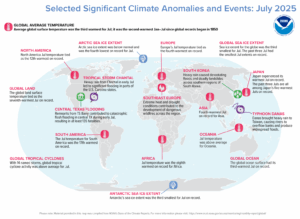
The sea ice extent for the globe was the third smallest for July. The past three July measurements had the smallest July measurements on record for that year. The global ocean surface had its third warmest July on record while Antarctica’s sea ice extent with the third smallest for July on record. With 14 named storms, global tropical cyclone activity was above average for July. Remnants from Tropical Storm Barry contributed to catastrophic flash flooding in central Texas during early July, leading to at least 135 fatalities. Extreme drought and heat contributed to the development of dangerous wildfires across southeast Europe. (Image Credit: NOAA Global Climate Report)
- The NOAA Global Climate Change Report for July 2025 has been released by the National Centers for Environmental Information and reveals further proof that global climate change remains a concern. July 2025 recorded a global surface temperature 1°C (1.80°F) higher than the 20th Century average, making it the third warmest July since records began in 1850. Only July 2024 (warmest) and July 2023 were warmer. All 10 warmest Julys on record have occurred since 2016. July 2025 also marks the 49th consecutive July with above-average global temperatures. The global ocean-only surface temperature for July 2025 was the third highest on record at 0.92°C (1.66°F) above average. This was cooler than July 2023 (warmest) and July 2024. For land areas, the global land-only surface temperature in July tied as the seventh warmest on record at 1.20°C (2.16°F) higher than the 20th Century average. This was the smallest July land temperature anomaly since 2019 and the smallest for any month since December 2022 (+1.16°C / +2.09°F). In July 2025, most of the globe experienced warmer-than-average temperatures. The most significant high temperature anomalies, exceeding 1.0°C (1.8°F) above average, happened over Europe, southern Asia, the northern Pacific Ocean, and parts of North and South America, central-western Antarctica, and the North Atlantic Ocean. Record-high July temperatures were limited to areas within southern and eastern Asia, the Arctic region, the western and southern Pacific Ocean, and parts of the Southern Ocean. Overall, record-high July temperatures were observed across close to 6% of the Earth’s surface. Regionally, Asia and Europe (tied) had their fourth warmest July on record. The Arctic region, Africa, and the Caribbean region had their seventh warmest, eighth warmest, and ninth warmest (tied) July on record, respectively. North America, South America, Oceania, and the Hawaiian region all had above average July temperatures, though none ranked among their ten warmest Julys on record. Contrasting with other regions, the Antarctic region had a slightly below-average July temperature departure of -0.02°C (-0.04°F). This was the coldest July for the region since 2016.
- King – queen – rook – bishop – knight. All are pieces in the game of chess, which is celebrated September 1 during American Chess Day. Using a checkers-style board, players take turns strategically moving their pieces about the 64-square board. To win, a player must use their pieces to capture those of their opponent with the ultimate goal of taking over the other player’s king. That’s when the player shouts: checkmate! Often called “The Game of Kings,” you can play chess with another player in person or on the computer with opponents from all over the world. But that’s not the only technological tool used in the game of chess. GIS tools can be used to analyze and visualize data related to chess, such as player locations, game patterns, and tournament distribution. GIS can be used to map the geographic locations associated with different chess openings, showing where specific opening strategies are popular. GIS can map the locations of chess players, revealing concentrations of chess skill or activity in certain areas. GIS can be used to analyze the spatial distribution of moves in chess games, potentially revealing patterns related to player skill or strategies. GIS can map the locations of chess tournaments, helping to understand the geographical reach and participation in chess events. So, you can either use GIS to advance your chess-playing proficiency or try your hand the old-fashioned way.
Brock Adam McCarty
Map Wizard
(720) 470-7988
brock@apollomapping.com
This entry was posted in The Geospatial Times and tagged apollo news, News Snippets, The Geospatial Times Bookmark the permalink.


 Copyright © 2025 All Rights Reserved -
Leave a Reply