

- If you are a nerd like I am, then this should be your favorite part of our newsletter as here is a list of the coolest technology advancements we have seen in the past month:
Evolution is a not a linear process.
A natural sunscreen discovered in hot springs.
Bamboo shoots are a new possible superfood.
Did a deadly poison help spark life in a frozen, barren landscape?
A new soybean variety could improve modern dairy farming.
A new way to investigate hurricane winds.
Fungi could replace non-renewable building materials in the near future.
New research on why some folks over 80 are as sharp as ever.
Scientists film a state of matter between liquid and solid.
Rocks found on Mars suggest a tropical climate exists in the past.
The hidden connection between exercise and bone health.
New electrode converts CO2 to usable products even at atmospheric concentrations.
A possible breakthrough in cancer research.
Electrons proven to be influenced the geometry of space-time.
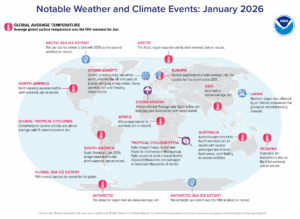
Australia endured its fourth warmest January on record and subsequently experienced several wildfires. Tropical Cyclone Fytia dumped heavy rainfall and flooding in northwestern Madagascar, causing at least a dozen deaths, damaging thousands of homes and displacing thousands. The Arctic Sea ice extent is tied with 2025 as the second smallest on record while the Antarctic Sea extent was the 13th smallest on record. (Image Credit: NOAA Global Climate Report)
- The Global Climate Change Report for January 2026 has been released by NOAA’s National Centers for Environmental Information and reveals further proof that global climate change remains a concern. The January 2026 global temperature was 1.12°C (2.02°F) above the 20th Century average, ranking as the fifth warmest January since global recordkeeping began in 1850. Drier-than-average conditions characterized January 2026 across much of the contiguous U.S. and elsewhere around the world. In contrast, wetter-than-average conditions were observed across south-central U.S. extending northeastward, and elsewhere around the globe.
- March means spring break has arrived and for lots of families, that equates to a fun trip somewhere. It could be a tropical location with scuba diving and poolside drinks, or Walt Disney World with its abundance of rides and attractions. The Mall of America in Minnesota happens to be a fun destination with its aquarium on the lower level, the amusement park in the center, and mini golf plus a mirror maze – not to mention all of the stores to shop in. So how do you decide where to go? Well, GIS can come in handy for choosing your vacation, along with mapping out where to go and what to do while you’re there. ArcGIS mapping apps, such as the “50 of the Best Spring Break Destinations in the U.S.”, allow users to visualize these locations geographically to help plan routes and find nearby attractions. People also could use Google My Maps or ArcGIS to create layers for potential destinations, organizing them by day or interest (e.g., beaches, cities, nature). Doug Rosenberg, VResorts.com founder, said the VResorts.com mapplet uses GIS to find the hotel you want, in the location you want, and with the amenities you want. Web visitors can quickly identify hotel options in a given neighborhood and drill down into individual hotel brochures, which include traveler reviews of the property. Once they have made a decision, they can book the hotel online.
Brock Adam McCarty
Map Wizard
(720) 470-7988
brock@apollomapping.com
This entry was posted in The Geospatial Times and tagged apollo news, News Snippets, The Geospatial Times Bookmark the permalink.


 Copyright © 2025 All Rights Reserved -
Leave a Reply