

- It’s time once again for a shout out to all our nerds as here is our list of cool technological advancements over the past month:
These bacteria can target cancer cells.
Basic building blocks of life found in close-by galaxy.
Bumblebees can learn as well.
A paint that can cool buildings while collecting water.
A new antibiotic for resistant bacterial strains.
Fungus is modified to taste like meat.
Light exerts magnetic forces on matter too.
This nearby exoplanet could have liquid water on its surface.
This wheat strain makes its own fertilizers by encouraging microbial growth.
Moss spores survived time in open space.
A new way to recycle Teflon.
This new metal composite could make planes and rockets lighter and stronger.
Chimps like to party daily!
One more reason to drink coffee daily.
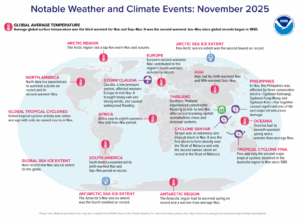 North America experienced its warmest autumn on record and its second warmest November. Scientists recorded near-record low November sea ice extent for the globe. The Antarctic’s November sea ice extent was the fourth smallest on record. The Antarctic region had its warmest spring on record and a warmer-than-average November. Claudia, a low-pressure system, affected western Europe in mid-November. It brought heavy rain and strong winds, and caused widespread flooding. The November Arctic sea ice extent was the second lowest on record. The Arctic region had a top five warm November and autumn. Southern Thailand experienced catastrophic flooding in mid- to late November after record-breaking rainfall overwhelmed rivers and drainage systems. Senyar was an extremely rare tropic storm that brewed in November and was the first storm to form directly over the Strait of Malacca. In November, the Philippines was affected by three consecutive typhoons that altogether caused significant loss of life and major infrastructure damage. (Image Credit: NOAA Global Climate Report)
- The Global Climate Change Report for November 2025 has been released by the National Centers for Environmental Information and reveals further proof that global climate change remains a concern. November 2025 ranked as the third warmest November in NOAA’s 176-year record with a global surface temperature 1.18°C (2.12°F) above the 20th Century average. The 10 warmest Novembers have all occurred since 2015 with the most recent three years (2023, 2024, and 2025) comprising the top three. This month marked the 49th consecutive November with above-average temperatures. Global land surface temperature ranked as the fourth warmest for November at 2.09°C (3.76°F) above average. Meanwhile, global ocean surface temperature was also fourth warmest on record at 0.77°C (1.39°F) above average. In November 2025, unusually high temperatures gripped large portions of the globe. Temperature departures exceeding 3.0°C (5.4°F) occurred across much of the Arctic, Northern Hemisphere land surfaces, and parts of eastern Antarctica and southern Africa. Meanwhile, widespread departures of at least 1.0°C (1.8°F) affected the western Pacific, parts of the eastern and southeastern Pacific, and the Atlantic. In total, about 4.1% of the world’s surface experienced a record high November temperature. These records included small pockets across North America, Africa, Asia, Australia, and across the western Pacific and Southern Oceans. Driven by unusual warmth throughout the month, North America experienced its second warmest November on record. The temperature departure exceeded 3.0°C (5.4°F) for only the second time on record, falling just 0.06°C (0.11°F) shy of the 2016 record. Compared to all months in North America’s period of record, November 2025 had the fourth-highest monthly temperature departure. Only the months of December 2023, January 2021, and November 2016 had a higher departure. Europe also experienced its second warmest November on record at 2.20°C (3.96°F) above average. This value was 0.17°C (0.31°F) cooler than the 2015 record. Asia had a marked contrast across the region. While much of the region experienced unusual warmth, cooler conditions were observed in parts of the south and north. Averaged as a whole, November 2025 was Asia’s ninth warmest on record. Elsewhere, the Arctic had its fifth-warmest November, Africa had its eighth warmest, and South America recorded its ninth warmest. Oceania and the Antarctic region had a warmer-than-average November.
- The New Year has arrived and with it the desire of many people to eat heathier and boost their physical fitness levels to get in shape. A component of GIS technology happens to be GPS, which is used with most modern fitness apps and wearables like a Garmin or Apple Watch that tracks your route, distance walked or ran, speed, heart rate and more. The data collected via GPS and internal sensors (heart rate, motion) is used by algorithms to estimate the number of calories burned during exercise, which is then synced to health and nutrition apps. Nutrition trackers take the guesswork out of daily calorie consumption and compares it to exercise and calories expended. By monitoring macronutrients and hydration, you can prevent energy crashes, improve muscle repair, and optimize your post-ride recovery. Correct food tracking with a weight loss app helps identify nutrient deficiencies and ensures a well-balanced diet tailored to your athletic goals. Experts recommend people wanting to be in better health use a fitness tracker like an Apple Watch, Fitbit, or Garmin device for activity tracking and another app for nutrition logging. Ensure the apps are synced for a complete picture of “calories in” versus “calories out.”
Brock Adam McCarty
Map Wizard
(720) 470-7988
brock@apollomapping.com
This entry was posted in The Geospatial Times and tagged apollo news, News Snippets, The Geospatial Times Bookmark the permalink.


 Copyright © 2025 All Rights Reserved -
Leave a Reply