

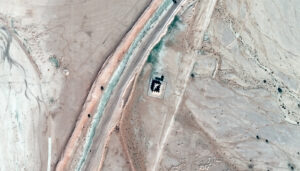
 The Pigeon Towers in Ad-Dilam (also known as Abraj Ad-Dilm) are a set of 14 historical, conical adobe towers located about 90 km south of Riyadh, Saudi Arabia. These structures, which date back to the Middle Ages, were traditionally used for breeding pigeons and collecting their manure for agricultural fertilizer. The number of towers a family owned was often a symbol of wealth and status. The towers were constructed from mud and logs, and feature intricate, eye-catching architectural designs. The interiors are filled with hundreds of small, cylindrical niches designed for pigeons to nest and roost. Wooden beams crisscross the otherwise empty space between the walls, increasing the strength of the structure, while also providing additional surface where birds can perch. The 14 towers have very few openings for the birds to enter and exit. This allows the pigeons to find shelter inside from the sandstorms and high temperatures of the desert. The towers are located near the Al Dilam Governorate and are accessible by car so they are often visited by tourists. However, they haven’t been used for several years. In addition to providing fertilizer for area farmers, people also used the pigeons’ eggs for food, they ate the pigeons too, and collected their feathers from the floor of the towers to use for pillows and other household items. Tall towers represented a symbol of wealth and status in traditional Saudi society. The more towers a family owned, the higher status they were accorded. In the image below, we can see the rectangular-shaped Pigeon Towers surrounded by desert in Ad-Dilam, Saudi Arabia. This 30-cm WorldView Legion image was collected on January 17, 2026, and has custom processing and color balance applied by Apollo Mapping. (Satellite Imagery © 2026 Vantor)
In this monthly article, we travel the world to check out unique, fun and sometimes a bit weird 30-centimeter (cm) color imagery samples from the WorldView constellation. In May, we looked at the Biosphere Environmental Museum on Chemin du Tour de I’isle in Monreal, QC. For this edition of the 30-cm Color WorldView Image of the Month, we feature an image of Pigeon Towers in Ad-Dilam, Saudi Arabia.
30-cm WorldView-3 (WV3) launched in late 2014, WorldView-4 (WV4) launched in late 2016 and then the first WorldView Legion satellites launched in 2024. Taken together, this is the most advanced satellite constellation the commercial marketplace has ever had access to. Here are a few of the features that really set these satellites apart from the competition:
- Improved Resolution
- Higher resolution means you can see more detail in WorldView imagery.
- Data collected at nadir will have 31-centimeter (cm) panchromatic, 1.24-meter (m) visible and near infrared, 3.7-m SWIR (WV3 only) and 30-m CAVIS (WV3 only) bands.
- Additional Spectral Bands
- If spectral analysis is part of your project, then no other satellite can match WorldView-3 and WorldView Legion with their 8 bands of visible and near-infrared data; and then 8 shortwave infrared bands (WV3 only) which are crucial for geological studies.
- Better Positional Accuracy
- With accuracies of 3.5-m CE90% or better (without ground control even!), the 30-cm WorldView constellation has no rivals for its enhanced positional accuracy.
- Daily Revisits
- With multiple WorldView-3 and WorldView Legion satellites orbiting our planet, daily revisits are available for most locations.
- WV4 is no longer collecting new imagery.
- Increased Collection Capacity
- WV3/4 feature 13.1-km swath widths (at nadir) with the ability to collect up to 680,000 square kilometers (sq km) of high-resolution data per day per satellite (though WV4 is dead now).
- WorldView Legion features six 30-cm satellites, significantly boosting the collection capacity of this leading high-resolution constellation.
If you are interested in WorldView-3, WorldView-4 and/or WorldView Legion imagery for your next project, please let us know by phone, 303-993-3863, or by email, sales@apollomapping.com.
You can also find more WV3 samples and technical information on our website here; WV4 samples and information can be found here; and then finally here is more information about WorldView Legion.


 Copyright © 2025 All Rights Reserved -
Leave a Reply