

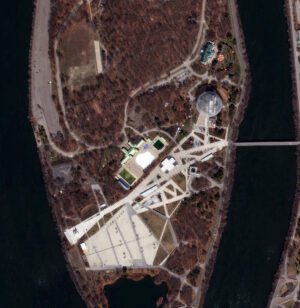
 The Biosphere Environmental Museum, also known as the Montreal Biosphere, is a museum dedicated to the environment in Montreal, Quebec, Canada. It is housed in the former United States pavilion constructed for Expo 67 located within the grounds of Parc Jean-Drapeau on Saint Helen’s Island. The museum’s geodesic dome was designed by Buckminster Fuller. The Expo opened on April 27, 1967, and ran until Oct. 29, 1967. Upon entering the pavilion, visitors ascended a 135-foot escalator, reported to be the longest unsupported escalator in the world, to reach the exhibit platforms. The two uppermost platforms held “Destination: Moon,” an exhibit on NASA‘s space programs, where spacecraft were hung from the dome’s steel frame, including the Freedom 7, Gemini 7, and Apollo AS-202 capsules. On the mezzanine level, the “American Spirit” exhibit displayed a wide variety of artifacts, including American Indian crafts, folk art objects, guitars owned by famous musicians, a collection of dolls and an array of almost 300 hats representing a range of regions and occupations. Other attractions included a gallery of Hollywood memorabilia and “American Painting Now,” an exhibit of 22 large-scale works by contemporary American artists. A 300-seat theater screened A Time to Play, a multi-screen film by Art Kane showing American schoolchildren playing various playground games. After the Expo, the site continued to operate as Man and His World, an ongoing exhibition held every summer. Like most countries at the Expo, the United States donated its pavilion structure to the City of Montreal for use in the exhibition. The pavilion was renamed to Biosphere and opened in 1968 as an aviary and arboretum, featuring four suspended gardens and hundreds of birds. On May 20, 1976, the Biosphere was severely damaged in a fire. In August 1990, Environment Canada committed $17.5 million to turn Biosphere into an interactive museum showcasing and exploring the water ecosystems of the Great Lakes–Saint Lawrence River regions. The museum opened on June 6, 1995. The Biosphere changed its name in 2007 to become an environment museum. It offers interactive activities and presents exhibitions about the major environmental issues related to water, climate change, air, ecotechnologies, and sustainable development. The museum is housed in the former pavilion built by the United States for Expo 67. In the image above, we can see the metal lattice of the Biosphere Environmental Museum, and through this lattice we can also see the various buildings of the museum. The 30-cm WorldView Legion image was collected on April 14, 2025, and has custom processing and color balance applied by Apollo Mapping. (Satellite Imagery © 2026 Vantor)
In this monthly article, we travel the world to check out unique, fun and sometimes a bit weird 30-centimeter (cm) color imagery samples from the WorldView constellation. In April, we looked at the Caspian sea monster, officially known as a Lun-class Ekranoplan. For this edition of the 30-cm Color WorldView Image of the Month, we feature an image of the Biosphere Environmental Museum on Chemin du Tour de I’isle in Monreal, Quebec.
30-cm WorldView-3 (WV3) launched in late 2014, WorldView-4 (WV4) launched in late 2016 and then the first WorldView Legion satellites launched in 2024. Taken together, this is the most advanced satellite constellation the commercial marketplace has ever had access to. Here are a few of the features that really set these satellites apart from the competition:
- Improved Resolution
- Higher resolution means you can see more detail in WorldView imagery.
- Data collected at nadir will have 31-centimeter (cm) panchromatic, 1.24-meter (m) visible and near infrared, 3.7-m SWIR (WV3 only) and 30-m CAVIS (WV3 only) bands.
- Additional Spectral Bands
- If spectral analysis is part of your project, then no other satellite can match WorldView-3 and WorldView Legion with their 8 bands of visible and near-infrared data; and then 8 shortwave infrared bands (WV3 only) which are crucial for geological studies.
- Better Positional Accuracy
- With accuracies of 3.5-m CE90% or better (without ground control even!), the 30-cm WorldView constellation has no rivals for its enhanced positional accuracy.
- Daily Revisits
- With multiple WorldView-3 and WorldView Legion satellites orbiting our planet, daily revisits are available for most locations.
- WV4 is no longer collecting new imagery.
- Increased Collection Capacity
- WV3/4 feature 13.1-km swath widths (at nadir) with the ability to collect up to 680,000 square kilometers (sq km) of high-resolution data per day per satellite (though WV4 is dead now).
- WorldView Legion features six 30-cm satellites, significantly boosting the collection capacity of this leading high-resolution constellation.
If you are interested in WorldView-3, WorldView-4 and/or WorldView Legion imagery for your next project, please let us know by phone, 303-993-3863, or by email, sales@apollomapping.com.
You can also find more WV3 samples and technical information on our website here; WV4 samples and information can be found here; and then finally here is more information about WorldView Legion.


 Copyright © 2025 All Rights Reserved -
Leave a Reply