

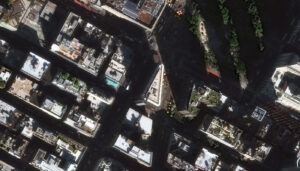
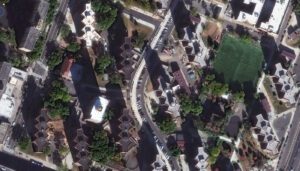
 The Flatiron Building was one of the earliest skyscrapers built in New York – 1902 to be exact. It stands tall at the corner of Fifth Avenue and 23rd Street on a triangle-shaped piece of land, and originally was named the Fuller Building after the company that built it. But that name didn’t stick, because people thought the 22-stories-tall building, which was huge for 1902, resembled an iron one would press clothes with, hence its new name was born, the Flatiron Building. The Flatiron Building might look familiar to you. It’s appeared in such movies as Godzilla and Spider-Man. It used to have only one staircase but a remodel installed more. The building also used six elevator cabs with a hydraulic system, but they were remodeled in the late 1980s to become fully electric. It’s also one of the key buildings in the Beaux-Arts Classicist movement. Among its most notable details is the reinterpretation of classical Greek columns. Like predecessors, the façade is divided into a base, shaft, and capital. The building is clad in glazed terra-cotta and limestone, with plenty of Beaux Arts decorative elements such as oriel windows, cornices, and moldings that reward a closer look. The Flatiron Building was one of the first in NYC to use a full steel skeleton for its construction. The designers also added extra bracing by using diagonal steel bars inside the frame in order to keep it steady in the wind. For most of its life, the Flatiron Building housed offices with the likes of publishers and architects renting space. Today, the building is called home by numerous people who live there in luxury condos. In the images featured here, we can see the rooftops of many buildings, including the Flatiron Building stretching high. This 30-cm WorldView Legion image was collected on October 19, 2024, and has custom processing and color balance applied by Apollo Mapping. (Satellite Imagery © 2025 Maxar Technologies)
In this monthly article, we travel the world to check out unique, fun and sometimes a bit weird 30-centimeter (cm) color imagery samples from the WorldView constellation. In August, we looked at an image of Stadium 974 in Doha, Qatar. For this edition of the 30-cm Color WorldView Image of the Month, we feature images of two well-known skyscrapers just in time for National Skyscraper Day on September 3rd.
30-cm WorldView-3 (WV3) launched in late 2014, WorldView-4 (WV4) launched in late 2016 and then the first WorldView Legion satellites launched in 2024. Taken together, this is the most advanced satellite constellation the commercial marketplace has ever had access to. Here are a few of the features that really set these satellites apart from the competition:
- Improved Resolution
- Higher resolution means you can see more detail in WorldView imagery.
- Data collected at nadir will have 31-centimeter (cm) panchromatic, 1.24-meter (m) visible and near infrared, 3.7-m SWIR (WV3 only) and 30-m CAVIS (WV3 only) bands.
- Additional Spectral Bands
- If spectral analysis is part of your project, then no other satellite can match WorldView-3 and WorldView Legion with their 8 bands of visible and near-infrared data; and then 8 shortwave infrared bands (WV3 only) which are crucial for geological studies.
- Better Positional Accuracy
- With accuracies of 3.5-m CE90% or better (without ground control even!), the 30-cm WorldView constellation has no rivals for its enhanced positional accuracy.
- Daily Revisits
- With multiple WorldView-3 and WorldView Legion satellites orbiting our planet, daily revisits are available for most locations.
- WV4 is no longer collecting new imagery.
- Increased Collection Capacity
- WV3/4 feature 13.1-km swath widths (at nadir) with the ability to collect up to 680,000 square kilometers (sq km) of high-resolution data per day per satellite (though WV4 is dead now).
- WorldView Legion features six 30-cm satellites, significantly boosting the collection capacity of this leading high-resolution constellation.
If you are interested in WorldView-3, WorldView-4 and/or WorldView Legion imagery for your next project, please let us know by phone, 303-993-3863, or by email, sales@apollomapping.com.
You can also find more WV3 samples and technical information on our website here; WV4 samples and information can be found here; and then finally here is more information about WorldView Legion.


 Copyright © 2025 All Rights Reserved -
Leave a Reply