

Every person is unmistakably unique, yet most of us spend our lives looking for connection – for signs that our private experiences belong to a larger human pattern. The brain may be one of the best places to look. Imagine it’s not finished, but as a structure under constant construction: wired with basic necessities, shaped by use, remodeled by time, and always leaving room for expansion.
Buildings have eras. Anyone who has inherited an older home knows the evidence: a dated fixture, a tired roofline, a repair made by someone else’s hands, a room that no longer fits the life being lived inside it. Sometimes the problem is style. Sometimes it is wear. Either way, the structure changes with its caretakers – and it will change again when the next person arrives.
Our brains, it turns out, have eras too. Scientists at the University of Cambridge identified five ages of the brain, marked by major turning points around ages nine, 32, 66, and 83. The finding is striking because it suggests brain development is not a smooth, steady climb from childhood to old age. It is more like a series of renovations – periods when neural wiring shifts to support different ways of learning, adapting, stabilizing, and aging. One detail especially stops me: the adolescent phase may last until about age 32. Think of all the life that happens between nine and 32 – the classrooms, friendships, jobs, heartbreaks, risks, responsibilities, and discoveries. If the brain is still actively reorganizing through all of that, then a powerful question follows: how do our choices, work, tools, and habits shape each era of development?
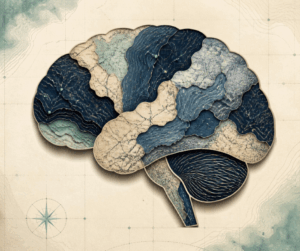
Created in Canva by B. Duke
The case for everyday influence is hard to miss. A growing body of public health and medical guidance links lifestyle with cognitive health, and Dr. Gajendra at Nivok Specialty Hospital highlights several familiar choices that affect brain health:
- Food matters. Fruits, vegetables, and nourishing meals support the brain far better than a steady diet of sugary, highly processed foods.
- Movement matters. Regular physical activity increases blood flow to the brain and supports memory, growth, and resilience.
- Sleep matters. Rest gives the brain time to repair, consolidate memory, and reset for the next day.
- Stress matters. Long-term stress can strain the brain and interfere with healthy function.
- Substances matter. Smoking, excessive alcohol use, and drug use can impair brain function and reduce oxygen reaching brain cells.
And the list does not end with what we eat, how much we move, or how well we sleep. Another article points to social connection as part of brain health too. In other words, the brain is not remodeled only in gyms, kitchens, and bedrooms. It is also shaped in conversations, collaborations, classrooms, communities, and the shared work of paying attention together.
A recent study on magic mushrooms adds another layer to the story. It describes how a naturally occurring chemical may help the brain move beyond familiar patterns during and after the experience. Participants who showed greater increases in flexible, varied brain activity also reported more personal insight and later improvements in well-being. The broader idea is compelling: changing how we think – or how we perceive our lives and circumstances – is not a soft skill. It may be one of the most important forms of adaptation we have.
I saw this kind of shift firsthand when I used GIS to help students understand literature. At first, geospatial tools seemed like a way to make an abstract subject more concrete. Maps, patterns, and spatial analysis gave students a new entry point into stories that once felt distant. But something else happened too. Their brains seemed to borrow the habit of spatial thinking and apply it elsewhere. They began to notice relationships, movement, context, and evidence in new ways. My classroom observations were not formal research, but they align with studies that connect geospatial technology with improved reasoning. In a 2019 ArcWatch article, Dr. Bob Kolvoord described research in which students in the Geospatial Semester showed “greater blood flow in the parietal region of the brain, an area related to spatial reasoning, from pretest to posttest compared with a control group.”
For geospatial professionals, this is not abstract. Every hour spent wrangling data, exploring patterns, comparing layers, scanning imagery, and solving spatial problems has changed the way you notice the world – whether you meant it to or not. Details that are invisible to others become obvious to you. A parking lot becomes a flow pattern. A hillside becomes a record of water, vegetation, and human choice. Aerial and satellite imagery from tools like Image Hunter trains the eye to recognize big green circles, subtle boundaries, and sweeping variations in landform. Even non-map tasks begin to feel different: scanning code, reading dense text, spotting anomalies, and finding the one empty parking space in a crowded lot.
That may be the quiet gift of geospatial work. It does not simply teach us to make better maps. It teaches us to live with a different kind of attention.
If the brain has eras, then perhaps our daily practices are the renovation plans. We build through what we study, what we repeat, what we notice, and who we notice it with. For those of us shaped by maps and spatial thinking, the structure has already changed. We do not just look at the world. We read it.
If you need me, I’ll be working through the stack of books on my “must read” shelf.
Barbaree Duke
Geospatial Crusader


 Copyright © 2025 All Rights Reserved -
Leave a Reply