

In May, we looked at St. Michael’s Mount in England. This month for the Pléiades 1 – Pléiades Neo Point of Interest, we check out Ulugh Beg Observatory in Samarkand, Uzbekistan.
About the Point of Interest: Perched atop a small hill north of Samarkand, Uzbekistan, one can find the remains of what was once considered to be the most advanced astronomical observatory in the world, Ulugh Beg Observatory. While the building itself has not survived the times, the underground section of its 151-foot-long sextant remains intact, according to Astronomy.
The man behind the observatory’s creation happened to be a 15th Century Timurid prince, Ulugh Beg. Not only did he fund the construction of the conservatory, he also was an astronomer and mathematician. Born in 1394, Beg was the grandson of the Turco-Mongol conqueror Timur (Tamerlane), whom he often accompanied on military campaigns. When Beg was around 8 years old, Temur took him to see the ruins of the 13th Century Maragha Observatory, built by the Mongols in what is now Iran. This visit is said to have inspired a passion for astronomy that would shape both Ulugh Beg’s life and the history of science, Astronomy reported.
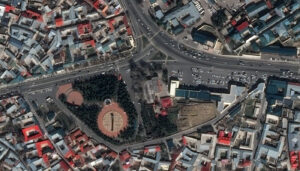
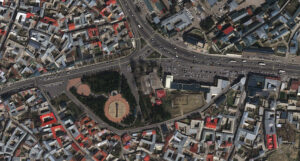 These two satellite images show an aerial view of Ulugh Beg Observatory in Samarkand, Uzbekistan. The circular observatory nestled in a thicket of trees can be seen in the 50-cm Pléiades 1B color image from February 22, 2026, surrounded by homes with colorful roofs that are equally architecturally intriguing, especially with what appears to be courtyards inside each one. The cars driving by on the thoroughfare resemble ants marching forward, which can be viewed in the Pléiades Neo 4 30-cm color image from February 25, 2026. PLEIADES © CNES 2026, Distribution Airbus DS.
In 1409, Shah Rokh appointed his teenage son – Beg – as governor of Samarkand. Beg created two schools that specialized in teaching mathematics and theoretical astronomy. According to Astronomy, Beg and his team made several significant contributions to the history of astronomy at his conservatory. Sadly, the Samarkand Observatory closed its doors after only 30 years. In 1447, Beg succeeded his father, but was overthrown and assassinated by his own son two years later.
Fun Factoids: (1) Using the observatory’s precise instruments, Ulugh Beg also calculated the length of a solar year and the tilt of Earth with greater accuracy than later Western astronomers Copernicus and Tycho Brahe. (2) Today, the foundations and the buried part of the marble quadrant are all that are visible of the original vestiges of the Ulugh Beg Observatory. (3) In 1908, the Russian archaeologist Vassily Vyatkin uncovered the remains of the observatory. (4) Beg’s catalog of 1,018 stars (some sources count 1,022) was the only such undertaking carried out between the times of Cladius Ptolemy (ca. 170 A.D.) and Tycho Brahe (ca. 1600). (5) A small museum of astronomy sits on the remains of the observatory. (6) Ulugh Beg’s observatory included the largest quadrant principle device. It could accurately measure the Sun from the horizon, the altitude of a star and other planets. The duration of the year, period of planets, and eclipses were measured by this device. Beg’s measurements of planets closely relate to today’s measurement.
The 50-cm Pléiades 1 High-Resolution Satellite Constellation
The Pléiades 1 constellation (or at least part of it!) has been in orbit since December 2011 and if you have not had a chance to check out any sample imagery, take a few moments and have a look at the gallery on our website. If you work with high-resolution imagery, you should consider Pléiades 1 and Pléiades Neo for your next geospatial projects.
A variety of Pléiades 1 products are available from both a well-established archive and as a new collection, including 50-centimeter (cm) pansharpened imagery and 50-cm panchromatic – 2-meter (m) 4-band multispectral bundles. We are happy to discuss the technical specifications, pricing and tasking options available with both of these satellite constellations.
The 30-cm Pléiades Neo High-Resolution Satellite Constellation
Pléiades Neo is our newest high-resolution satellite constellation. The first Neo satellite went up in April 2021 and the second in August of the same year. This 30-centimeter resolution constellation will add two more satellites in the next few months and upgrade from daily to intraday revisits. Pléiades Neo has six multispectral bands with 1.2-meter resolution, including a deep blue and two infrared bands, along with a 30-centimeter resolution panchromatic band.
The archive is growing every day, and the satellites are available for new collections, making Pléiades Neo the perfect solution for site monitoring. Check out our beautiful sample images in the Pléiades Neo gallery.
More sample images and technical information about Pléiades 1 can be found on our website here; while the same can be found here for the Pléiades Neo constellation.
The Apollo Mapping sales team can answer any questions you might have about Pléiades 1 and/or Pléiades Neo. We can be reached at (303) 993-3863 or sales@apollomapping.com.


 Copyright © 2025 All Rights Reserved -
Leave a Reply