Pléiades 1 – Pléiades Neo Point of Interest – Bisti/De-Na-Zin Wilderness
In October, we traveled far north to Igloo City in Alaska. And this month for the Pléiades 1 – Pléiades Neo Point of Interest, we stay in the States and explore Bisti/De-Na-Zin Wilderness in New Mexico.
Do you enjoy the high-resolution satellite imagery we post monthly in this article and elsewhere in The Geospatial Times? If so, head over to our Reddit subgroup, HighResSatelliteImage, where we post some our favorite high-resolution satellite images on a weekly basis.
About the Point of Interest: The Bisti/De-Na-Zin Wilderness in northwestern New Mexico features eroded badlands, colorful hoodoos and fossil-bearing formations dating back to the late Cretaceous period. This 45,000-acre wilderness protects unique geological features and paleontological resources, including petrified wood and vertebrate fossils, that once called New Mexico home.
Dinosaur fossils have been found across these badlands, along with the remains of prehistoric forests, plants and animal life that created large coal deposits and an oil field. The wilderness also sits inside a region that used to be a river delta feeding into a shallow inland sea some 70 million years ago called the Western Interior Seaway. There have been fossils discovered of freshwater life that prevailed in the ancient river. When the sea and river dried up, it left a 1,400-foot layer of sandstone, mudstone, shale and coal. Then 6,000 years ago, the ice from the last ice age melted and the resulting floods eroded the sandstone, exposing fossils, petrified wood, and limestone tubes. Time, wind, and water continued the erosion, leaving behind layers of stone that have become the hoodoos and towers seen today.
Fun Factoids: (1) Hikers enjoy traveling the unmarked routes spanning clay hills and sandstone outcrops. (2) There are trails available to equestrians, too. (3) Bisti offers a shaded group picnic area with an information kiosk. (4) There are also primitive camping areas. (5) The Bisti/De-Na-Zin Wilderness encompasses 41,170 acres of rock formations. The U.S. Congress designed the Bisti/De-Na-Zin as a wilderness area in 1984. (6) Translated from the Navajo word Bistahi, Bisti means “among the adobe formations.” De-Na-Zin translates from Standing Crane, which is a reference to crane petroglyphs found south of the Wilderness.
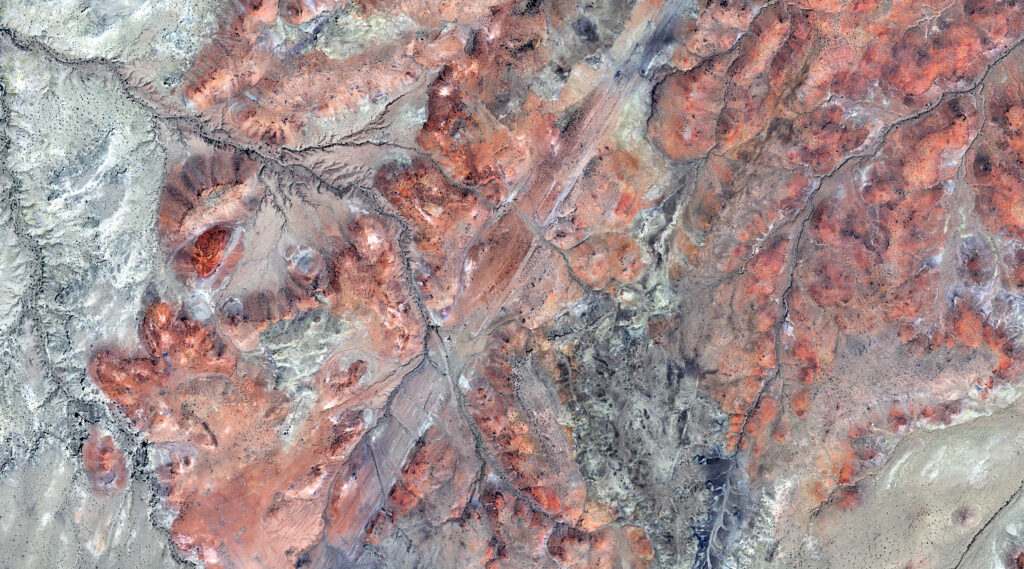
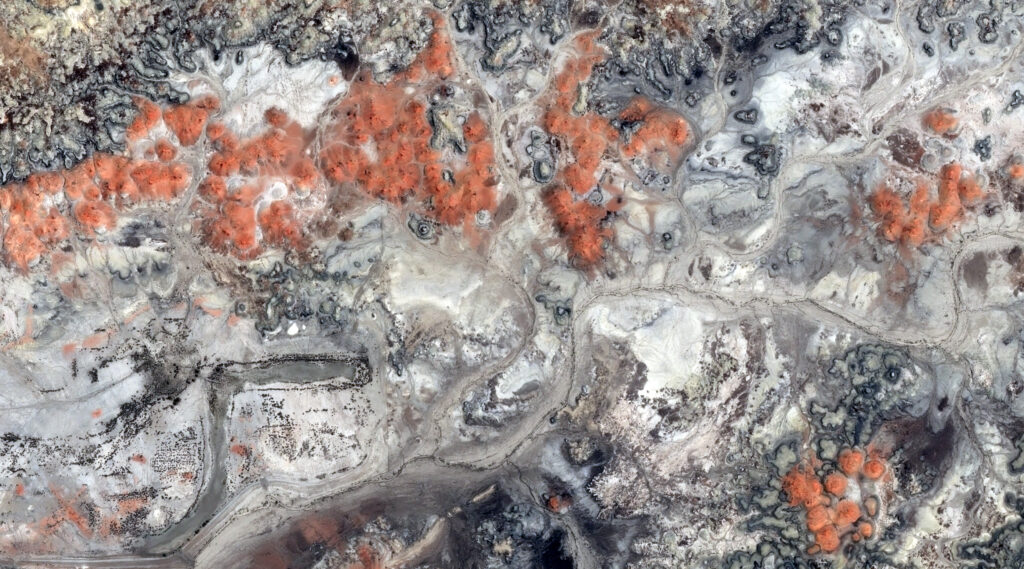
These two satellite images show an overhead view of Bisti/De-Na-Zin Wilderness. Colorful shapes carved out by weather and time can be seen in the Pléiades Neo 4 30-cm color-enhanced image taken May 27, 2024. Another stunning view of the rugged yet beautiful terrain can be seen in the Pléiades 1B 50-cm color-enhanced image taken June 16, 2022. PLEIADES © CNES 2026, Distribution Airbus DS.
The 50-cm Pléiades 1 High-Resolution Satellite Constellation
The Pléiades 1 constellation (or at least part of it!) has been in orbit since December 2011 and if you have not had a chance to check out any sample imagery, take a few moments and have a look at the gallery on our website. If you work with high-resolution imagery, you should consider Pléiades 1 and Pléiades Neo for your next geospatial projects.
A variety of Pléiades 1 products are available from both a well-established archive and as a new collection, including 50-centimeter (cm) pansharpened imagery and 50-cm panchromatic – 2-meter (m) 4-band multispectral bundles. We are happy to discuss the technical specifications, pricing and tasking options available with both of these satellite constellations.
The 30-cm Pléiades Neo High-Resolution Satellite Constellation
Pléiades Neo is our newest high-resolution satellite constellation. The first Neo satellite went up in April 2021 and the second in August of the same year. This 30-centimeter resolution constellation will add two more satellites in the next few months and upgrade from daily to intraday revisits. Pléiades Neo has six multispectral bands with 1.2-meter resolution, including a deep blue and two infrared bands, along with a 30-centimeter resolution panchromatic band.
The archive is growing every day, and the satellites are available for new collections, making Pléiades Neo the perfect solution for site monitoring. Check out our beautiful sample images in the Pléiades Neo gallery.
More sample images and technical information about Pléiades 1 can be found on our website here; while the same can be found here for the Pléiades Neo constellation.
The Apollo Mapping sales team can answer any questions you might have about Pléiades 1 and/or Pléiades Neo. We can be reached at (303) 993-3863 or sales@apollomapping.com.