
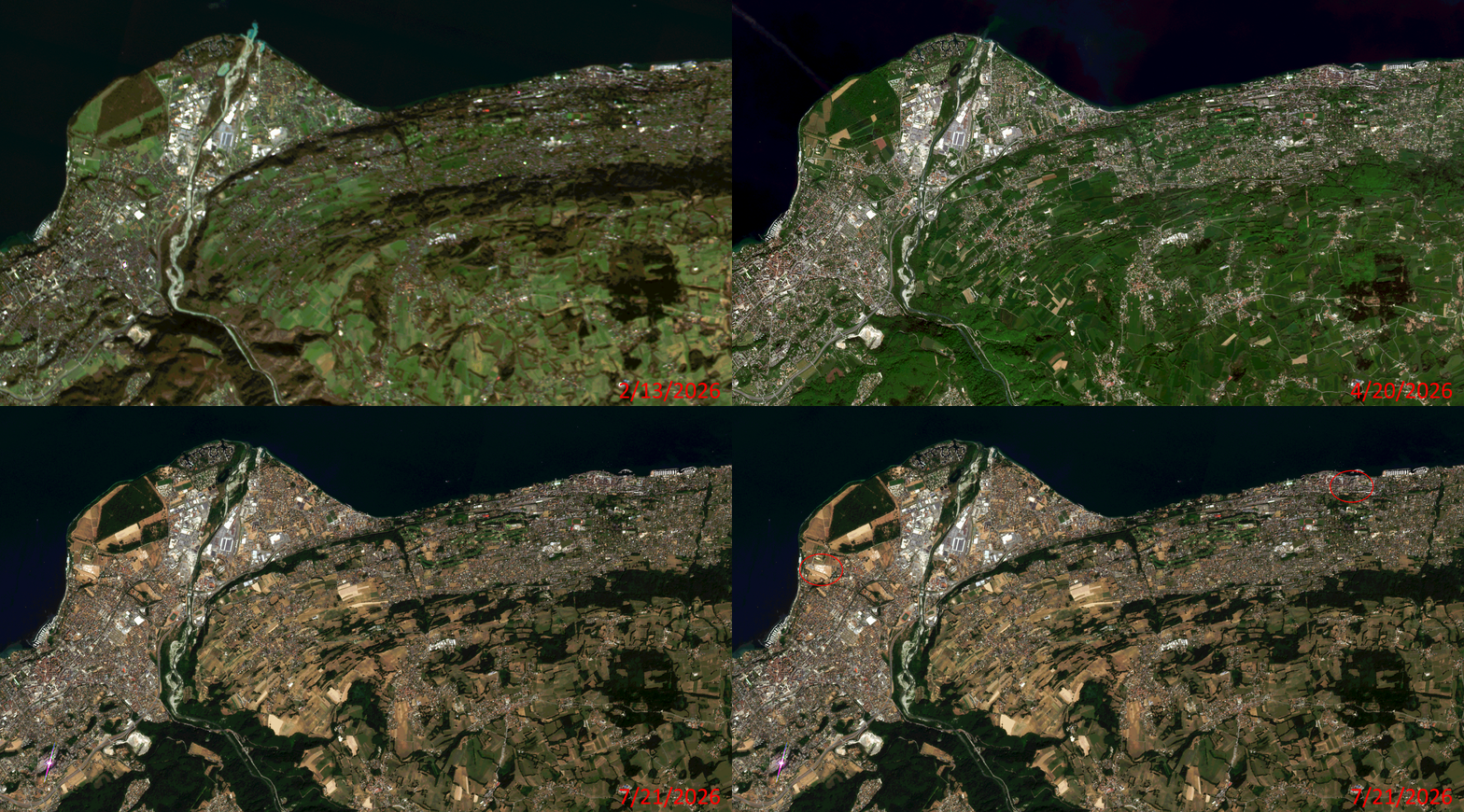
Click on the image above to see an animation of 3-meter natural color PlanetScope image collected over Lake Geneva, France on February 13, April 20, and July 21, 2026. In this animation, we can see just how much the droughts over much of Europe this summer impacted the landscape as this is typically a lush green region, but in the July 21st image, it sadly looks like a desert landscape. We have also circled both the start and finish lines for Stage 16 of the Tour de France which would have been underway when the 3-m PlanetScope image from July 21st was collected! (Images Courtesy: © Planet 2026)
In this monthly feature, we span the globe to examine Our Changing Landscape with a time series of medium-resolution PlanetScope satellite imagery. The PlanetScope constellation dates back to 2016 and collects hundreds of millions of square kilometers of four and eight-band 3-meter imagery daily! In October, we stopped at the beautiful island of Tristan da Cunha. For the November edition of this series, we travel to the shores of Lake Geneva in France.
Do you enjoy the high-resolution satellite imagery we post monthly in this article and elsewhere in The Geospatial Times? If so, head over to our Reddit subgroup, HighResSatelliteImage, where we post some our favorite high-resolution satellite images on a weekly basis.
The PlanetScope Microsat Constellation
PlanetScope is a constellation of more than 240 microsats referred to individually as Doves. Each Dove is able to collect up to 20,000 square kilometers (sq km) per day of 3-meter (m) 4-band multispectral (i.e. blue, green, red and near-infrared [NIR]) imagery; and newly launched SuperDoves collect 8-band multispectral adding in valuable red-edge spectral data. Across the constellation, PlanetScope is archiving more than 200 million sq km of medium-resolution imagery a day, making it the go to source for daily imagery over most locations. This massive archive dates back to 2016, offering the most complete and continuous record of spatial data on the planet since the start of the constellation’s ongoing launch schedule. Collecting 3-meter multispectral imagery is the equivalent of ‘high-resolution’ multispectral data imaged by a 75-centimer (cm) satellite (as this satellite would feature 75-cm panchromatic and 3-m multispectral), making PlanetScope an extremely competitively priced option at just $2.25 per sq km. With well registered images and nearly daily collections of most locations, PlanetScope is the ideal imagery source for this current-events focused series, Our Changing Landscape.
Lake Geneva & The 2026 Tour de France
In eastern France along the border of Switzerland sits Lake Geneva, which is near Evian les Bains and Thonon les Bains. Lake Geneva is a deep lake on the north side of the Alps and one of the largest lakes in western Europe, as well as the largest on the course of the Rhône. Sixty percent of the lake belongs to Switzerland (the cantons of Vaud, Geneva and Valais) and 40% to France (the department of Haute-Savoie).
Evian les Bains happens to be an upmarket holiday resort and spa town on the shores of Lake Geneva that has been visited by royalty such as Kings Edward VII and George V of the United Kingdom and King Farouk of Egypt, and celebrities such as Countess Anna de Noailles and Marcel Proust. Thonon-les-Bains, or simply Thonon, is part of a transborder metropolitan area known as Grand Genève situated on the shores of Lake Geneva.
In the 3-m PlanetScope animated image featured here, you can see brown fields full of dead foliage in the July image due to a severe drought impacting France and a considerable amount of Europe this summer, which experts attribute to climate change. According to the European Drought Observatory (EDO), more than 85% of the country was under drought warning or alert conditions in mid-July 2026, compared with around 65% at the same time in 2025, and less than 2% in 2024, a summer without widespread drought.
Within the two red circles featured on the four slide of our animation, we find the start line of the Tour de France stage 16, as well as the finish line for this stage. These two locales are at opposite ends of the image, showing how far the bicyclists must travel for just one stage of the race. It’s easy to see the tents set up for the event, plus vehicles scattered around. The race was a 26.1-kilometer individual time trial from Évian-les-Bains to Thonon-les-Bains held on July 21, 2026. World time-trial champion Remco Evenepoel won the stage in 32 minutes and 19 seconds, beating yellow jersey holder Tadej Pogačar by 28 seconds.
If you would like to find out more about using 3-meter PlanetScope imagery for your academic studies, engineering projects or any landscape analysis, let us know at sales@apollomapping.com or (303) 993-3863.
If you are searching for medium and high-resolution satellite imagery, the search is over as Image Hunter is the solution you’ve been looking for! Featuring satellite and aerial imagery as well as digital elevation models (DEMs) from a constantly expanding list of 70+ constellations/datasets and 19 vendors, our database contains more than 500-million images/records meaning there is just no other website out there with this breadth of commercial data products. Our interface is slim-lined and modern, loading quickly on all platforms, browsers and operating systems. Further, our database is updated multiple times an hour with the most recent images collected by WorldView-3, Pléiades 1, PlanetScope, SuperView Neo and many more so you are sure to get the most current view of all the imagery and DEM databases we work with. Once you submit your request, an Apollo Mapping representative will be in touch within 4 Illinois business hours to get you the pricing information you need for your project.
So why wait? Give Image Hunter a try now to find the imagery and/or DEM data you need for your next mapping project!
Key Improvement(s) From The Past Month
After releasing a new light and dark-mode GUI last month, we took October to clean up some of our known open bugs as well as clean up the new GUI a bit. We are working towards some exciting changes which should come out in the next few months. Stay tuned for those updates.
In the meantime, here is a summary of the changes/improvements we made to Image Hunter during the past month:
- The area of polygons updates in real-time now for both creation and editing modes.
- The date filter was a bit confusing to use, so we improved how it works.
- Sometimes Pléiades 1 stereo previews did not show up, now they do.
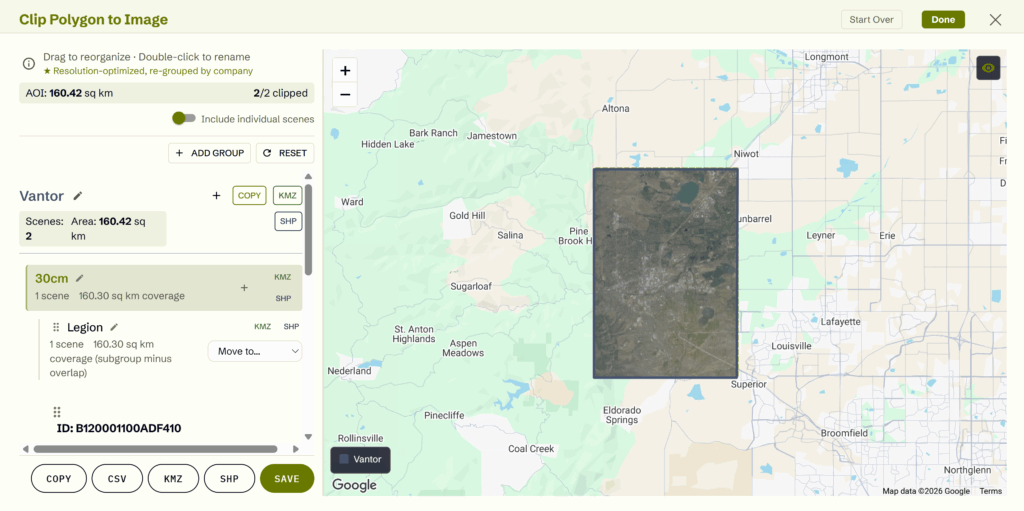
- Changed the name of our new clipping tool to Clip Image To Polygon as well that is what it does!
- We had a few bugs in the new GUI for system logins, we fixed them.
- There were multiple instances of select Jilin-1 previews going offline, we fixed these errors too.
- Improved the stability and speed of various satellite imagery updates.
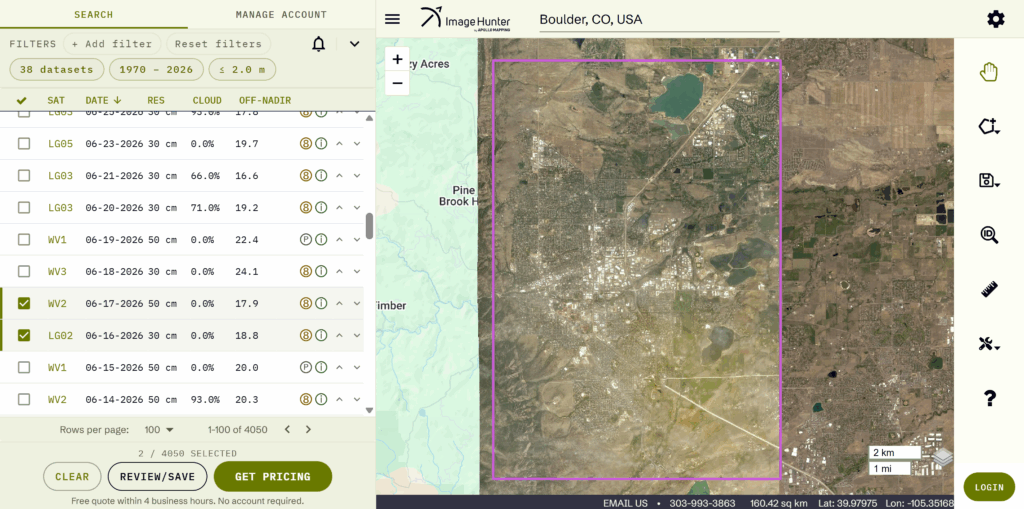
Data Alert – An Automated Daily Imagery Search
Have you checked out Data Alert which lets you define an area of interest anywhere around the globe, the resolution your project requires and the number of months we should keep the alert active? Once an alert is set up, we check for new data over your area of interest every single day, and send you an email when we find coverage that meets your specifications. We have a short YouTube video with directions to set up a Data Alert, check out the last video; and we have written directions for Data Alert here.
The Sensors Available in Image Hunter
As you might have seen in past articles, we now feature hourly updates (seriously!) of GeoEye-1, KOMPSAT 3/3A, Pléiades 1 and Neo, SPOT 6/7, SuperView-1/2/Neo, WorldView-1/2/3/Legion!
Image Hunter can be accessed 24 hours a day, 7 days a week and is a one-stop shop for every major source of medium and high-resolution satellite (and aerial!) imagery on the market today, including:
- WorldView Legion
- WorldView-4
- WorldView-3
- WorldView-2
- WorldView-1
- QuickBird
- GeoEye-1
- IKONOS
- EROS B
- KOMPSAT-3A
- KOMPSAT-3
- KOMPSAT-2
- Pléiades 1 constellation
- Pléiades Neo constellation
- TerraSAR-X (TerraSAR-X, TanDEM-X and PAZ)
- GEOSAT-1
- GEOSAT-2
- TripleSat
- BJ3A
- BJ3N
- SPOT 1 to 7 constellation
- RapidEye
- GaoFen-2
- GaoFen-1
- ZiYuan-3 01/02 (mono and stereo!)
- FORMOSAT-5
- FORMOSAT-2
- ALOS PRISM (stereo)
- AW3D Standard (DEM)
- SkySat constellation
- PlanetScope constellation (including 5-band SuperDove data)
- SuperView-1 constellation
- SuperView-2
- SuperView Neo-1 01/02/03/04
- SuperView Neo-3 01/02
- Landsat 1-8
- TeLEOS-1
- DS-EO
- Hexagon (HxGN Content Program aerial imagery) imagery + DEM
- WorldDEM
- WorldDEM Neo
- Vricon DEMs
- Orbita Hyperspectral Satellite (OHS)
- KazEOSat-1
- KazEOSat-2
- Jilin-1 Optical
- Jilin-1 Video (including nighttime imagery)
- Jilin-1 GF/DP
- Jillin-1 KF
- Orbita Video Satellites-1/2/3 (OVS-1/2/3)
- BlackSky Global series
Key Features of Image Hunter
If any of our readers have struggled with other geospatial search engines that are clunky, only query one data source and/or do not provide image previews, then Image Hunter is the solution to your woes as it features:
- Online browsing of satellite and aerial imagery from 19 data providers and 56 satellite and aerial imagery derived datasets.
- Near-instantaneous loading of low-resolution preview imagery with collection date, cloud cover and other key metadata.
- The ability to define your area of interest by address, coordinates, geometric shape or shapefile/KMZ.
- A responsive basemap with street names to provide spatial context when discovering data as well as crowd-sourced updates for the most accurate map possible.
- Exports of the area of interest you create as well as the scenes you select in shapefile or KMZ format.
- Support for all operating systems, and not just our friends with Windows machines!
Image Hunter can be accessed here all day and night, we are excited to find out what you think about our imagery search engine! So if you have any ideas and/or feedback to improve Image Hunter, please let us know at sales@apollomapping.com or (303) 993-3863.
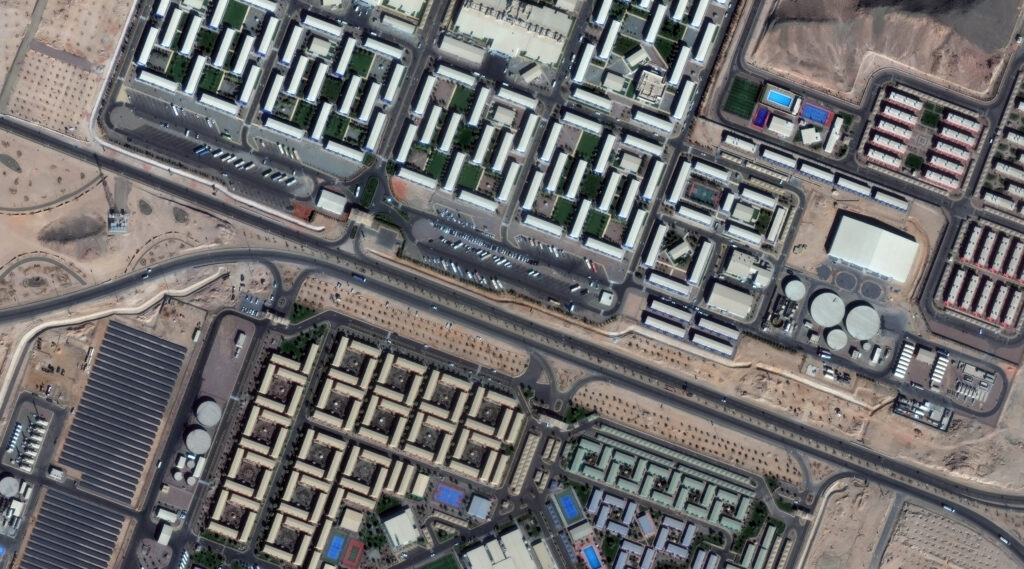
A 30-cm WorldView Legion image courtesy of Maxar collected over the NEOM Campus in Saudia Arabia on December 2, 2024. Apollo Mapping has applied custom color balance and image enhancements.
Do you work in urban planning, environmental monitoring, or resource management and are tasked with identifying land use, tracking changes in urban areas, assessing forest health, and planning development projects? If so, high-resolution imagery with its large concentration of pixels for greater detail enables precise analysis and measurement of features not visible in lower-resolution images, allowing for accurate mapping, less need for site visits, and detailed documentation of our real world.
Since its launch in 2024, 30-centimeter (cm), 8-band WorldView Legion is one of the most prolific 30-cm satellite constellations available in the high-resolution satellite imagery sector. With six satellites currently in orbit, the WorldView Legion constellation captures approximately 3.2 million square kilometers (sq km) of high-resolution 30-cm imagery daily which is added to Image Hunter (nearly) instantly. Additionally, its advanced multispectral sensor captures data across eight different wavelengths, offering exceptionally detailed perspectives of Earth’s surface; and facilitating the identification of small objects and the detection of subtle environmental changes in both urban and natural settings. Advanced applications such as bathymetry, vegetation assessment, mineral exploration, and wildfire monitoring are common use cases for 30-cm WorldView Legion satellite imagery.
With 90% of the world’s population residing between 45° North and 45° South latitudes, the constellation is optimized for quicker revisit intervals in these regions, while maintaining coverage of higher latitudes with two sun-synchronous satellites. Four WorldView Legion satellites circle the planet in persistent mid-latitude orbits. The WorldView Legion constellation operates across multiple orbital paths with a 10-km footprint at nadir, enabling frequent revisits – in fact, up to 15 times daily in select regions. This increased capacity and revisit rate for the most populated areas of the world creates a robust archive and advanced monitoring capabilities in these crucial regions. The revisit frequency supports comprehensive mapping, robust change detection, and in-depth analysis over extensive geographic areas. These capabilities allow the 30-cm WorldView Legion to support a wide range of geospatial applications, including projects requiring spectral analysis and intense detail.
With six active satellites in orbit, the WorldView Legion constellation stands out for:
- 30-cm panchromatic and 1.2-m 8-band multispectral imaging (coastal, blue, green, yellow, red, red edge 1, red edge 2, NIR).
- Offering four middle-orbit (MIO) satellites concentrated on the most populous areas of the planet.
- Imaging 500,000+ sq km daily from each satellite.
- Delivering an average of three daily accesses to locations between 40° North and South.
- Capturing images throughout the day, not just mornings, thanks to its MIO satellites.
The 30-cm WorldView Legion constellation allows Apollo Mapping to offer increased high-resolution imaging capacity and faster delivery times to customers across various sectors, including defense, mining, oil and gas, engineering, education and research, and humanitarian relief.
You can explore our entire satellite imagery archive today on Image Hunter!
To see how 30-cm, 8-band WorldView Legion imagery can support your next project, or get personalized recommendations, contact our sales team at sales@apollomapping.com now.
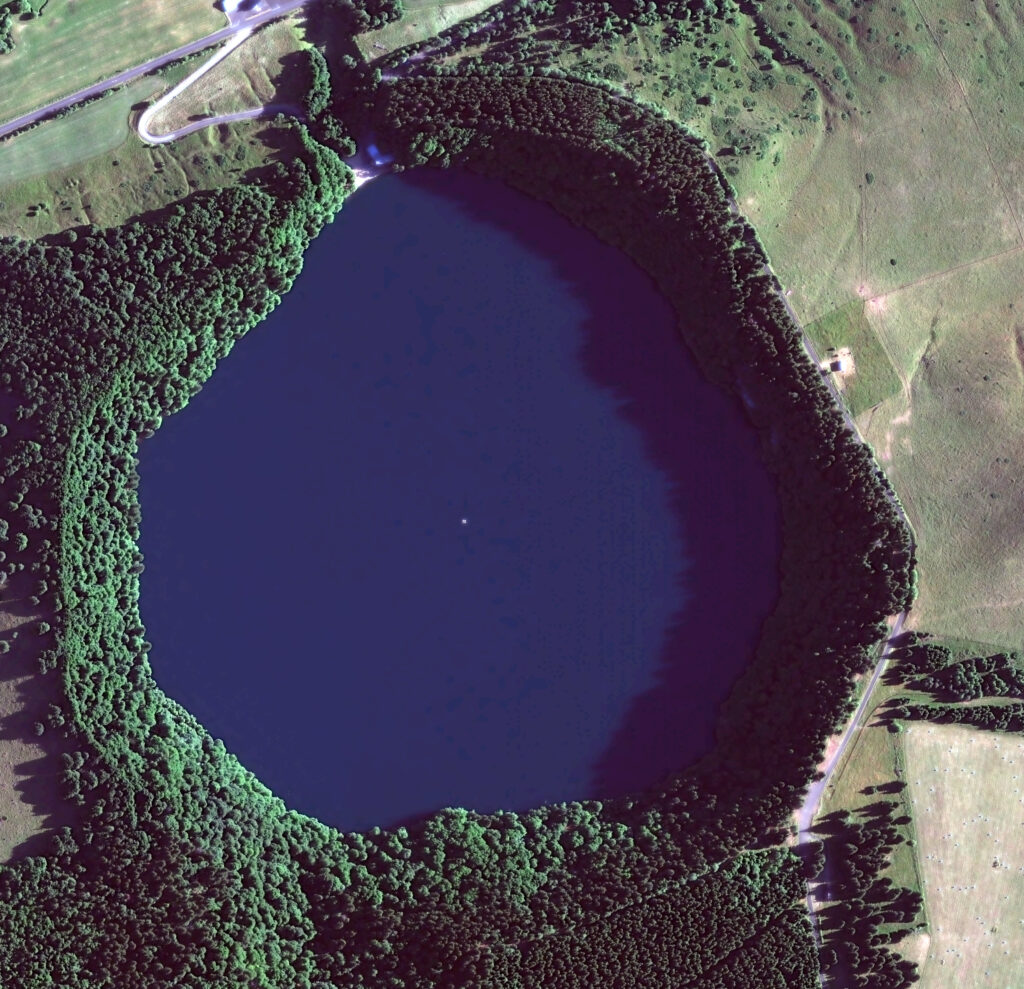
In this monthly article, we travel the world to check out unique, fun and sometimes a bit weird 30-centimeter (cm) color imagery samples from the WorldView constellation. In October, we looked at Deno’s Wonder Wheel Amusement Park in Brooklyn, New York. For this edition of the 30-cm Color WorldView Image of the Month, we travel to Europe for a look at Lac Pavin in France.
Do you enjoy the high-resolution satellite imagery we post monthly in this article and elsewhere in The Geospatial Times? If so, head over to our Reddit subgroup, HighResSatelliteImage, where we post some our favorite high-resolution satellite images on a weekly basis.
30-cm WorldView-3 (WV3) launched in late 2014, WorldView-4 (WV4) launched in late 2016 and then the first WorldView Legion satellites launched in 2024. Taken together, this is the most advanced satellite constellation the commercial marketplace has ever had access to. Here are a few of the features that really set these satellites apart from the competition:
- Improved Resolution
- Higher resolution means you can see more detail in WorldView imagery.
- Data collected at nadir will have 31-centimeter (cm) panchromatic, 1.24-meter (m) visible and near infrared, 3.7-m SWIR (WV3 only) and 30-m CAVIS (WV3 only) bands.
- Additional Spectral Bands
- If spectral analysis is part of your project, then no other satellite can match WorldView-3 and WorldView Legion with their 8 bands of visible and near-infrared data; and then 8 shortwave infrared bands (WV3 only) which are crucial for geological studies.
- Better Positional Accuracy
- With accuracies of 3.5-m CE90% or better (without ground control even!), the 30-cm WorldView constellation has no rivals for its enhanced positional accuracy.
- Daily Revisits
- With multiple WorldView-3 and WorldView Legion satellites orbiting our planet, daily revisits are available for most locations.
- WV4 is no longer collecting new imagery.
- Increased Collection Capacity
- WV3/4 feature 13.1-km swath widths (at nadir) with the ability to collect up to 680,000 square kilometers (sq km) of high-resolution data per day per satellite (though WV4 is dead now).
- WorldView Legion features six 30-cm satellites, significantly boosting the collection capacity of this leading high-resolution constellation.
If you are interested in WorldView-3, WorldView-4 and/or WorldView Legion imagery for your next project, please let us know by phone, 303-993-3863, or by email, sales@apollomapping.com.
You can also find more WV3 samples and technical information on our website here; WV4 samples and information can be found here; and then finally here is more information about WorldView Legion.
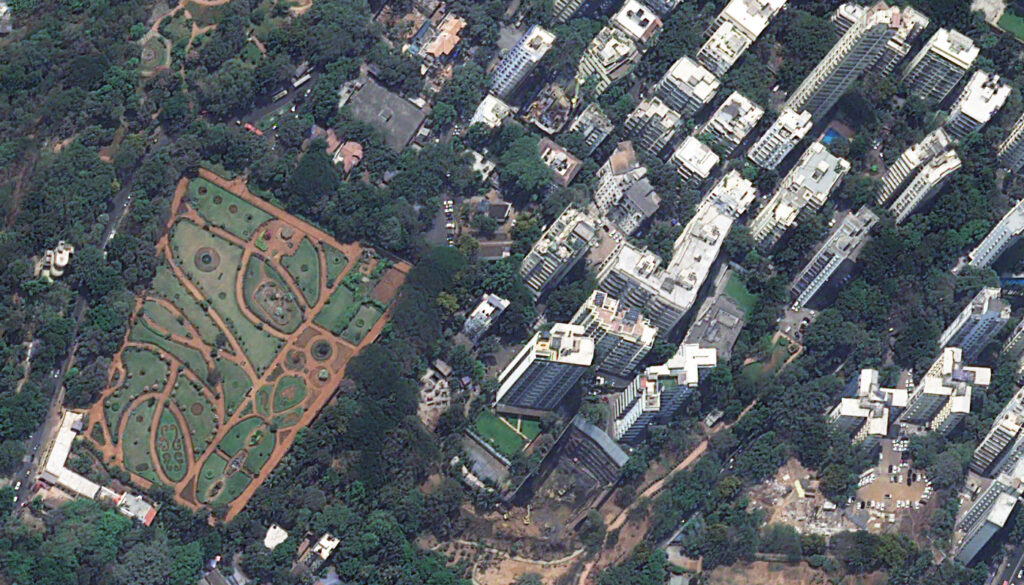
This month we feature a bird’s eye view satellite image from Pléiades Neo 4 collected over Mumbai, India on April 26, 2025. These oblique images have a native resolution of about 45-centimeters. If you want to see more high off-nadir imagery collected over Mumbai, head over to our BirdsEyeViewImagery subreddit group where we post more oblique imagery like this weekly! (Satellite Imagery © 2026 Airbus)
In this regular article, we feature a new bird’s eye view satellite image from a select location around the globe; and for this month, we travel east from Africa with a stop in one of India’s most historic cities, Mumbai.
What Is Bird’s Eye View Satellite Imagery?
Well, that’s a good question we are happy to answer! When a satellite images the ground below it, there’s always some tilt to the camera as it looks down. This tilt is called off-nadir and is measured in degrees from 0; and so, it follows that 0° off-nadir means that the satellite is pointing directly down at the ground when it images, while a 90° off-nadir would mean that the satellite is pointing to the side and not even at the ground below it when it images. The vast majority of satellite imagery is collected with an off-nadir below 30°. However, in rare occasions, be it by a customer request, or to capture a natural disaster or other important event, a satellite can tilt and image in the range of 35° to 50° which we consider ideal for a high off-nadir imagery, also called bird’s eye view imagery and oblique imagery. These bird’s eye view images lend a unique perspective to satellite imagery that is an expansive view of the landscape from the side. We hope you enjoy the bird’s eye view satellite imagery that we share in this article. And if you have any questions about this type of data or any of the imagery products we can help you with, send us an email at any time to sales@apollomapping.com!
If you are interested in additional bird’s eye view satellite images from this location, head over to our Reddit subgroup, BirdsEyeViewImagery, and become a member. We post high off-nadir satellite imagery every Friday in the BirdsEyeViewImagery subgroup – most of which is not posted here.
In this monthly article, we travel the world to check out unique, fun and sometimes a bit weird 30-centimeter (cm) color imagery samples from the WorldView constellation. In September, we looked at Ovnipuerto in Cachi, Argentina. For this edition of the 30-cm Color WorldView Image of the Month, we feature an image of Deno’s Wonder Wheel Amusement Park in Brooklyn, New York.

Deno’s Wonder Wheel not only stands as a landmark in New York City, but also as a world-famous icon. Invented by Charles Hermann, it was built in 1920 by the Eccentric Ferris Wheel Company using 100% Bethlehem steel forged right on Coney Island beach. Deno’s Wonder Wheel celebrated its 100th anniversary in 2020. The Wonder Wheel stands 150 feet tall, the equivalent of a 15-story building. It also weighs 200 tons and features 24 cars – 16 swing and eight are stationary. The swinging cars slide on a serpentine track towards the hub of the wheel and as the wheel turns, they slide toward the circumference. Each car holds six people for a total ride capacity of 144. On June 7, 1983, Denos D. Vourderis bought the Wonder Wheel from Fred Garms, whose father Herman was its first owner-operator, and it became Deno’s Wonder Wheel. The Vourderis family went to work restoring the wheel to pristine condition and made it the centerpiece of Deno’s Wonder Wheel Amusement Park. According to the park owners, the wheel offers incredible views from 150 feet high atop Coney Island stretching across the Atlantic Ocean, the Boardwalk and the beach all the way to the Manhattan skyline. The Wonder Wheel reflects an orange hue and seemingly glows in the amusement park. The 30-cm WorldView Legion image featured here was collected on October 26, 2024, and has custom processing and color balance applied by Apollo Mapping. (Satellite Imagery © 2026 Vantor)
Do you enjoy the high-resolution satellite imagery we post monthly in this article and elsewhere in The Geospatial Times? If so, head over to our Reddit subgroup, HighResSatelliteImage, where we post some our favorite high-resolution satellite images on a weekly basis.
30-cm WorldView-3 (WV3) launched in late 2014, WorldView-4 (WV4) launched in late 2016 and then the first WorldView Legion satellites launched in 2024. Taken together, this is the most advanced satellite constellation the commercial marketplace has ever had access to. Here are a few of the features that really set these satellites apart from the competition:
-
- Improved Resolution
- Higher resolution means you can see more detail in WorldView imagery.
- Data collected at nadir will have 31-centimeter (cm) panchromatic, 1.24-meter (m) visible and near infrared, 3.7-m SWIR (WV3 only) and 30-m CAVIS (WV3 only) bands.
- Improved Resolution
- Additional Spectral Bands
-
-
- If spectral analysis is part of your project, then no other satellite can match WorldView-3 and WorldView Legion with their 8 bands of visible and near-infrared data; and then 8 shortwave infrared bands (WV3 only) which are crucial for geological studies.
-
- Better Positional Accuracy
-
-
- With accuracies of 3.5-m CE90% or better (without ground control even!), the 30-cm WorldView constellation has no rivals for its enhanced positional accuracy.
-
- Daily Revisits
-
-
- With multiple WorldView-3 and WorldView Legion satellites orbiting our planet, daily revisits are available for most locations.
- WV4 is no longer collecting new imagery.
-
- Increased Collection Capacity
-
- WV3/4 feature 13.1-km swath widths (at nadir) with the ability to collect up to 680,000 square kilometers (sq km) of high-resolution data per day per satellite (though WV4 is dead now).
- WorldView Legion features six 30-cm satellites, significantly boosting the collection capacity of this leading high-resolution constellation.
If you are interested in WorldView-3, WorldView-4 and/or WorldView Legion imagery for your next project, please let us know by phone, 303-993-3863, or by email, sales@apollomapping.com.
You can also find more WV3 samples and technical information on our website here; WV4 samples and information can be found here; and then finally here is more information about WorldView Legion.
In September, we looked at Janaki Mandir in Nepal. This month for the Pléiades 1 – Pléiades Neo Point of Interest, we check out Igloo City in rural Alaska.
Do you enjoy the high-resolution satellite imagery we post monthly in this article and elsewhere in The Geospatial Times? If so, head over to our Reddit subgroup, HighResSatelliteImage, where we post some our favorite high-resolution satellite images on a weekly basis.
About the Point of Interest: Igloo City in Cantwell, Alaska, rises four stories high in one of the most remotes states in the U.S. Sadly, the concrete hotel never opened for business. Today, it’s covered with graffiti, but when built in the 1970s, it couldn’t meet building codes and so it sat cold and empty, unused. Over the years, people have tried to revive the structure, get it up to code, and push it to flourish as an odd attraction. But no one has been truly successful.
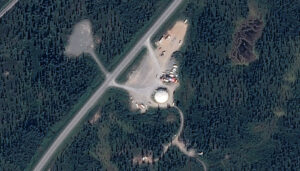
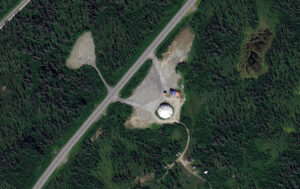
These two satellite images show an aerial view of Igloo City. You can see the circular domed building surrounded by thick thatches of pine trees and one lonely road nearby. The 50-cm color Pléiades 1A image here was taken August 6, 2015; and randomly, the Pléiades Neo 4 30-cm color enhanced image featured here was also taken August 6, 2015. PLEIADES © CNES 2026, Distribution Airbus DS.
According to a 2021 Anchorage Daily News history of the Igloo, Leon Smith started building it as a hotel, but never completed the interior and eventually sold it to Brad Fisher. Fisher ran a gas station on the property until 2010 then decided to sell it.
Fun Factoids: (1) The four-story structure can be seen by airplanes at 30,000 feet – it’s that big. (2) While the exterior is impressive size wise, the interior was never completed. (3) Despite its unsuccessful journey to becoming a fun and funky hotel, plenty of visitors sneak in to check it out. (4) The hotel marks the halfway point between Fairbanks and Anchorage, Alaska’s two largest cities along Parks Highway. (5) In 2023, Shirley Schmidt announced that she and her uncle were leasing the foam-coated dome with plans to rebuild an old convenience store next to the Igloo, then construction a distillery on one half of the interior and then on the other half of the bottom floor, a restaurant and bar/tasting room. (6) The interior is completely unfinished and only framed out.
The 50-cm Pléiades 1 High-Resolution Satellite Constellation
The Pléiades 1 constellation (or at least part of it!) has been in orbit since December 2011 and if you have not had a chance to check out any sample imagery, take a few moments and have a look at the gallery on our website. If you work with high-resolution imagery, you should consider Pléiades 1 and Pléiades Neo for your next geospatial projects.
A variety of Pléiades 1 products are available from both a well-established archive and as a new collection, including 50-centimeter (cm) pansharpened imagery and 50-cm panchromatic – 2-meter (m) 4-band multispectral bundles. We are happy to discuss the technical specifications, pricing and tasking options available with both of these satellite constellations.
The 30-cm Pléiades Neo High-Resolution Satellite Constellation
Pléiades Neo is our newest high-resolution satellite constellation. The first Neo satellite went up in April 2021 and the second in August of the same year. This 30-centimeter resolution constellation will add two more satellites in the next few months and upgrade from daily to intraday revisits. Pléiades Neo has six multispectral bands with 1.2-meter resolution, including a deep blue and two infrared bands, along with a 30-centimeter resolution panchromatic band.
The archive is growing every day, and the satellites are available for new collections, making Pléiades Neo the perfect solution for site monitoring. Check out our beautiful sample images in the Pléiades Neo gallery.
More sample images and technical information about Pléiades 1 can be found on our website here; while the same can be found here for the Pléiades Neo constellation.
The Apollo Mapping sales team can answer any questions you might have about Pléiades 1 and/or Pléiades Neo. We can be reached at (303) 993-3863 or sales@apollomapping.com.
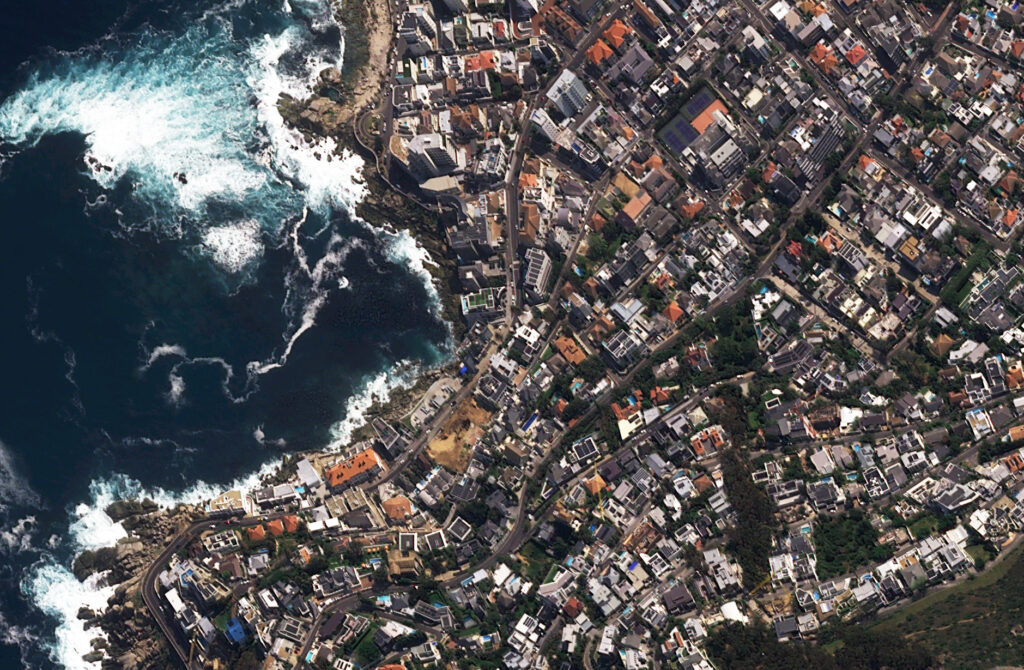
This month we feature a bird’s eye view satellite image from Pléiades Neo 3 collected over Cape Town, South Africa on October 6, 2024. These oblique images have a native resolution of about 50-centimeters. We are ready for some beach time in Cape Town, well as long as the great whites are on vacation too!(Satellite Imagery © 2026 Airbus)
In this regular article, we feature a new bird’s eye view satellite image from a select location around the globe; and for this month, we head to the other side of Africa with an oblique view of Cape Town, South Africa.
What Is Bird’s Eye View Satellite Imagery?
Well, that’s a good question we are happy to answer! When a satellite images the ground below it, there’s always some tilt to the camera as it looks down. This tilt is called off-nadir and is measured in degrees from 0; and so, it follows that 0° off-nadir means that the satellite is pointing directly down at the ground when it images, while a 90° off-nadir would mean that the satellite is pointing to the side and not even at the ground below it when it images. The vast majority of satellite imagery is collected with an off-nadir below 30°. However, in rare occasions, be it by a customer request, or to capture a natural disaster or other important event, a satellite can tilt and image in the range of 35° to 50° which we consider ideal for a high off-nadir imagery, also called bird’s eye view imagery and oblique imagery. These bird’s eye view images lend a unique perspective to satellite imagery that is an expansive view of the landscape from the side. We hope you enjoy the bird’s eye view satellite imagery that we share in this article. And if you have any questions about this type of data or any of the imagery products we can help you with, send us an email at any time to sales@apollomapping.com!
If you are interested in additional bird’s eye view satellite images from this location, head over to our Reddit subgroup, BirdsEyeViewImagery, and become a member. We post high off-nadir satellite imagery every Friday in the BirdsEyeViewImagery subgroup – most of which is not posted here.