

- As April rolls in, we roll out our latest (long) list of technology news!
Life teems even in the world’s driest locations.
Interesting research on tipping culture.
Life appears to have the ability to jump between planets.
This organic battery stores energy in its molecular structure.
SAR data can help detect bridge failures before they happen.
Ocean microbes can adapt to warmer oceans.
3D models of ants!
A new alloy developed for recycling waste vehicle scraps.
Cat genetics could help solve human cancer.
Ground-breaking catalyst to convert CO2 to methanol discovered.
Here is a list of the most likely planets with alien life.
Birds and bees drink alcohol as well!
These flies produce their own heat and antifreeze.
Super food for super-charged bees.
Are cows smarter than we think?
Biodegradable film outperforms plastic.
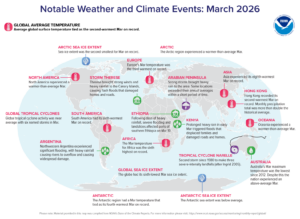 Sea ice extent in the Arctic was the second smallest on record for March while the Antarctic region saw a March temperature that tied as its fourth warmest March on record. Northwestern Argentina experienced significant flooding, with heavy rainfall causing rivers to overflow and causing widespread damage. The globe saw its sixth lowest March sea ice extent and Oceania experienced a warmer than average March. Tropical Cyclone Narabelle became the second storm since 1980 to make three severe intensity landfalls. Strong storms also swept across the Arabian Peninsula while Storm Therese dumped heavy rainfall on the Canary Islands, leading to flash flooding that damaged homes and roads. (Image Credit: NOAA Global Climate Report)
- The Global Climate Change Report for March 2026 has been released by NOAA’s National Centers for Environmental Information and it reveals further proof that global Climate Change remains a significant concern. March 2026 was the second warmest March in the 177-year global record, with a surface temperature 1.31°C (2.36°F) above the 20th Century average. Only March 2025 recorded a higher temperature. The global ocean recorded its second-warmest March at 0.91°C (1.64°F) above average, behind only 2024 (+0.97°C / +1.75°F). Meanwhile, the global land surfaces ranked third warmest at 2.19°C (3.94°F) above average.
- Even in 2026, there still are families who lovingly assembly small May Day baskets for neighbors, friends and relatives. As the tradition goes, May baskets used to be filled with flowers, candies, and treats, then left hanging on front doorknobs or sitting on a porch. The basket-giver would sneak onto the front stoop, situate the basket, ring the doorbell and scamper off. The May Day basket is supposed to be a surprise for the recipient. This act of affection dates back to the 1800s when a reporter for the Illinois-based Gazette described a May basket as being made of paper and can contain almost anything. In the olden days, boys would hang them on their sweetheart’s doorknob as a sign of affection or to secretly show interest, according to the St. Louis Republic. Two bold children hung May baskets on the White House front door on May Day 1925. The Indiana, Pennsylvania, Gazette reported that then First Lady Grace Coolidge found her admirers and gave them flowers she had picked. For some communities, May Day and the creation of baskets “became almost as exciting as Christmas.” A local Extension home economist reminisced in Humboldt, Iowa’s Independent in the late 1900s that her families used old milk cartons for containers, which they then filled with popcorn and Boston crème pies. One way some families have modernized May Day and the act of leaving baskets is by using ArcGIS to map out their delivery route for the fastest paths and the quickest getaway times. Once this routing and analysis is completed using ArcGIS Online, it then can be used in Navigator. Here’s a tutorial on how to make your own May Day basket delivery route using GIS technology.
Brock Adam McCarty
Map Wizard
(720) 470-7988
brock@apollomapping.com
This entry was posted in The Geospatial Times and tagged apollo news, News Snippets, The Geospatial Times Bookmark the permalink.


 Copyright © 2025 All Rights Reserved -
Leave a Reply