

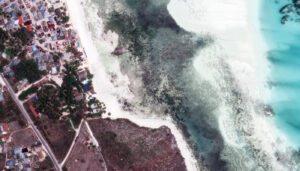
 A meal at The Rock is like no other. Patrons must boat out to a giant rock on which the restaurant is perched, offering breathtaking views of the ocean stretching beyond. The Rock was founded in 2011 by Andrea Brunetti, Claudio Moras, and Nigel Firman. It quickly became an iconic destination known for its beautiful setting, mouthwatering cuisine, and Italian hospitality. It’s nestled on the shores of Michamvi Pingwe Beach in Zanzibar, Tanzania. Nigel first discovered the rock while strolling along the beach. The rock was a fisherman’s outpost, and after a lengthy process building strong community relationships, local fishermen were convinced to lease the rock to Nigel and Andrea. But it’s not just the views that impress guests. The menu features locally sourced Zanzibari ingredients that blend together for an impressive culinary adventure, including seafood harvested from the reefs around the restaurant, fish caught daily by local fishermen, and spices from Zanzibar’s spice farms. They combine traditional Italian cooking techniques with innovative twists to showcase the vibrant flavors and aromas of Zanzibari cuisine. On the menu, The Rock Special features lobster, king prawns, octopus, and calamari from the grill. There’s also the grilled fish fillet catch of the day served with carrots, ginger cream, vegetables, and crispy and spicy chips. The stewed rock lobster comes with cous-cous, greens, ginger and lime. There is English-style roast beef, golden fried vegetables with mango, and tempura for just a few of the appetizer options; and a section of the menu dedicated to home pastas such as Zanzibarian dumplings, seafood paccheri, and creamy purple cauliflower soup. Desserts range from a simple fresh fruit mix with vanilla ice cream to a Zanzibar passion ring, and a Chocococco. Sitting in the frothy beachfront water can be seen the restaurant on the rock. We can see the tiers of the ocean as the water stretches outward. The 30-cm WorldView Legion image featured here was collected on November 2, 2024, and has custom processing and color balance applied by Apollo Mapping. (Satellite Imagery © 2026 Vantor)
In this monthly article, we travel the world to check out unique, fun and sometimes a bit weird 30-centimeter (cm) color imagery samples from the WorldView constellation. In July, we looked at El Alma del Ebro at Plaza Lucas Miret in Zaragoza, Spain. For this edition of the 30-cm Color WorldView Image of the Month, we feature an image of the Rock Restaurant in Zanzibar.
Do you enjoy the high-resolution satellite imagery we post monthly in this article and elsewhere in The Geospatial Times? If so, head over to our Reddit subgroup, HighResSatelliteImage, where we will post some our favorite high-resolution satellite images on a weekly basis.
30-cm WorldView-3 (WV3) launched in late 2014, WorldView-4 (WV4) launched in late 2016 and then the first WorldView Legion satellites launched in 2024. Taken together, this is the most advanced satellite constellation the commercial marketplace has ever had access to. Here are a few of the features that really set these satellites apart from the competition:
- Improved Resolution
- Higher resolution means you can see more detail in WorldView imagery.
- Data collected at nadir will have 31-centimeter (cm) panchromatic, 1.24-meter (m) visible and near infrared, 3.7-m SWIR (WV3 only) and 30-m CAVIS (WV3 only) bands.
- Additional Spectral Bands
- If spectral analysis is part of your project, then no other satellite can match WorldView-3 and WorldView Legion with their 8 bands of visible and near-infrared data; and then 8 shortwave infrared bands (WV3 only) which are crucial for geological studies.
- Better Positional Accuracy
- With accuracies of 3.5-m CE90% or better (without ground control even!), the 30-cm WorldView constellation has no rivals for its enhanced positional accuracy.
- Daily Revisits
- With multiple WorldView-3 and WorldView Legion satellites orbiting our planet, daily revisits are available for most locations.
- WV4 is no longer collecting new imagery.
- Increased Collection Capacity
- WV3/4 feature 13.1-km swath widths (at nadir) with the ability to collect up to 680,000 square kilometers (sq km) of high-resolution data per day per satellite (though WV4 is dead now).
- WorldView Legion features six 30-cm satellites, significantly boosting the collection capacity of this leading high-resolution constellation.
If you are interested in WorldView-3, WorldView-4 and/or WorldView Legion imagery for your next project, please let us know by phone, 303-993-3863, or by email, sales@apollomapping.com.
You can also find more WV3 samples and technical information on our website here; WV4 samples and information can be found here; and then finally here is more information about WorldView Legion.


 Copyright © 2025 All Rights Reserved -
Leave a Reply