

We love maps.
We love imagery.
We love work breaks.
We hope you like them as well!
In the 2023 Women’s World Cup final, soccer fans watched Spain defeat England 1-0 at Stadium Australia in Sydney, winning their first ever Women’s World Cup title. Olga Carmona scored the winning goal for Spain. The match was the most watched women’s sporting event on TV in 2023 with 38.4 million viewing hours. Nearly 76,000 people filled the stadium to watch the exhilarating match in person. For both teams, this was the first appearance in a Women’s World Cup final. It also was the third all-European final in Women’s World Cup history since 1995.
Stadium Australia was built for the 2000 Summer Olympics and opened in March 1999. In addition to the opening and closing Olympic ceremonies and the track and field events, the stadium hosted the men’s football gold medal match. The venue was also chosen as a site for the men’s 2015 AFC Asian Cup, where it hosted seven matches including the final. In the final match, Australia beat South Korea to win the tournament for the first time. Stadium Australia also hosted a 2005 shootout victory over Uruguay in the OFC–CONMEBOL playoff, which qualified the Socceroos for the 2006 World Cup, their first appearance since 1974.
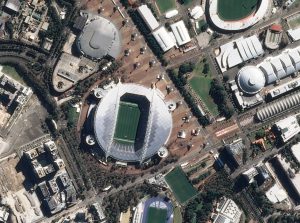
The 50-cm Pleiades 1B image we share here is from August 20, 2023, collected over Accor Stadium in Sydney, Australia where the Women’s World Cup final match would be held later that day. We can see the stadium encased inside a gleaming silver exterior and a retractable roof.
Be sure and check out our Work Break image and imagine a soccer game unfolding inside that impressively designed stadium. Mark your calendar for the 2027 Women’s World Cup in Brazil and tune in on TV to watch what’s bound to be some incredible matches.
Have a great rest of your workday! 😊
(Image Courtesy: Airbus. Processed by Apollo Mapping for improved grey-scale accuracy and clarity.)


 Copyright © 2025 All Rights Reserved -
Leave a Reply