
In the early 2000s, I showed teachers Google Earth – recently renamed from Keyhole – and we explored real aerial images using its basic tools. Like most novices, they zoomed into home and other places that were familiar. One in particular started waving excitedly. As I approached her, she began waving at the screen saying, “Hey grandma! Here I am!” I reminded her that we hadn’t quite reached that level of live interaction. It’s funny now, but thanks to satellites equipped with stellar cameras, we can access regular imagery updates of the planet. If we knew when grandma was working in the yard, we might be able to see her. This idea of being seen sent me down a different path. In a culture of Instagram worthy versions of life, who is the real you. Do the pictures paint an accurate view like something from a satellite, or in spite of the digital presence, are we feeling invisible?
We might start feeling invisible sometime during our school years based on popularity. We work hard to find our place in the world through careers and volunteer passions. As we make life choices, silos of belonging begin to form. Do you have children? Did you choose a well-acknowledged career? Do you have a life partner? Where are you from? Are you retiring? These questions lead to some bias whether you answer, “Yes” or “No.” Your brain might begin to spin up more questions. Why did they ask that question? Do I look or sound like I need to retire? Even with a satisfying career and home life, many still struggle to find their voice and visibility. Dr. Allison Cook recommends a healthy dose of curiosity and awareness to turn around invisibility in relationships. Some reasons for these feelings that Debra Smouse shares on her website resonated with my personal experiences:
 Canva creation by B. Duke.
- You learned at an early age to be physically present, but not call attention to yourself
- You fail to honor your feelings and ignore your intuition
- You’re sacrificing your visibility in the hopes of making other people happier
- You’re so good at your role in the family that you’ve become invisible to them
- You’ve kind of checked out of your own life
- You don’t matter in your social circles
- You need to work on your self-confidence
You can turn it around! Macy Baxi, a Cherry Creek High School student, shared a TED talk with some lovely insights that can work for any age. When thinking through, “How do you get there?”, she shares some simple but valuable nuggets to transform your communication skills, a key element to improving visibility:
- See yourself clearly first
- Recognize your worth and capabilities along with growth areas
- Listen and engage actively to steer the conversation
- Have focused goals
- Learn to reflect and value input from any conversation
If you’re serving in leadership, you can have a tremendously positive impact on those in your care. Leaders can help others evolve and feel impactful…seen. Jamie Kern Lima has some encouraging tips that help you see yourself and others more effectively:
- Give an honest compliment
- Notice and acknowledge someone
- Express appreciation
Even the most introverted folks can wrap their heads around these simple approaches. Wouldn’t we all like to feel appreciated? Don’t you stand a little taller with a kind, honest compliment from even a stranger? Knowing that someone sees and acknowledges your hard work, and time spent goes a long way to improving your invisibility lens.
It’s early in the year, so let’s all endeavor to help each other be seen and heard. Spread around a few more compliments and express your appreciation far and wide! We need each other.
Barbaree Duke
Geospatial Crusader
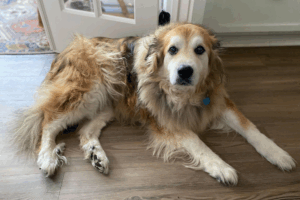 Photo by B. Duke: Twoee, 14.5 years old, guarding the office door.
The Flintstones cartoon from my childhood colored my perspective on prehistoric pets. Fred, Wilma, Pebbles, and their pet Dino, a small, but dog-like dinosaur seemed completely reasonable, along with the foot-powered car! Animals, in particular dogs, are so much a part of human life that even the futuristic, dystopian movies have at least a robot pet, or alien species that is treated like a pet. They’re our life companions without a doubt. I’m a dog person. My two current furry adoptees, that turned out much larger than expected, bring many snuggles and comfort. We love them and believe they love us too.
The connection between humans and dogs isn’t new. Historically, domestic dogs came from wolves. According to Science Daily, “Many scientists assumed, [for decades], that most dog diversity resulted from recent selective breeding practices that emerged with Victorian Kennel Clubs. This new work challenges that idea. Instead, it reveals that dogs were already showing substantial physical variation thousands of years ago, not long after they split from wolves.” Researchers are finding new data, and they have strong evidence that human and dog evolution occurred simultaneously.
So now I’m curious, what dogs are most popular now versus the Victorian Age? The American Kennel Club has an annual list of most popular breeds. In 2024, the Top 5 breeds were:
- French Bulldog
- Labrador Retriever
- Golden Retriever
- German Shepherd Dog
- Poodle
French Bulldog?! That one surprised me as the breed joined the Top 5 in 2017 and has been climbing since that time. If we go back in time, the most popular breeds of the 1880s were hunting breeds: English setter, Irish water spaniel, Irish setter, Gordon setter, pointer, fox terrier, dachshund, mastiff, and collie. The Vanderbilts who built The Biltmore left reminders of their love for dogs, in particular a St. Bernard named Cedric.
 Photo by B. Duke in Canva.
Prior to popular hunting breeds, the guardians take the favorite spot. There are records of a mastiff making the journey to “the new world” on the Mayflower. Those harsh winters and stark living conditions were made more palatable with a furry companion for sure!
We need to go even further back in our time machine to ancient China and Japan to find phylogenetic studies of dogs. The Chow Chow emerges as one of the first new breeds beyond the wolves in this research. (Fair warning: serious nerd DNA stuff in that link!) And to not forget the felines, they have a strong presence in Egyptian history, perhaps to help control rats and mice. Whether you’re a canine or feline fan, they have long walked with humans in life and work.
In an iScience article from a few years ago, they explored where some breeds originated. They looked at 205 dog genomes and found connections to Mastiff, Jindo and others in Asia. I’m reminded of one of my girls. When we adopted her at just 10 weeks old, we sent off the DNA test out of curiosity. I fully expected the result of “TILT”… it’s a dog! Much to my surprise, she returned ½ Great Pyrenees/Jindo and ½ Treeing Walker Coonhound. She’s an excellent, and very vocal, guard dog!
Why do you need a pet? There’s excellent evidence that having a pet can lower your stress related cortisol levels. Animals can influence positive child development, especially with neurodivergence. How often is an animal just a kind listener or the hug that you need? Johns Hopkins has evidence that these relationships can help keep you young! I’ve always had a dog, or two. I can’t imagine life without them. I encourage you to visit your local shelter or rescue organization and expand your home with an animal friend.
If you need me, I’m in the office working on next month’s column with my faithful assistant of 14 ½ years, Twoee (pronounced 2- ē; named for those two extra toes), guarding the door!
Barbaree Duke
Geospatial Crusader
Before you come for me and say I haven’t done my research, I’m well aware that the 2026 official Pantone Color of the Year is Cloud Dancer; however, if you ask researchers in Germany, it is azurite blue, a stunning, naturally occurring, bright blue. They have found evidence that Paleolithic civilization might have been using this particular blue. A recent Science Daily article says, “For many years, experts assumed that Ice Age artists relied almost entirely on red and black pigments, since nearly all surviving artwork from this time uses those colors. The limited palette was often attributed to a scarcity of blue minerals or to the belief that blue held little appeal.” It has the scientists rethinking color and ice age people’s perspective on the importance of color. “The presence of azurite shows that Paleolithic people had a deep knowledge of mineral pigments and could access a much broader color palette than we previously thought – and they may have been selective in the way they used certain colors,” Dr. Izzy Wisher, lead authority in the study, says. This makes me wonder…What importance does color have on our world?
As map makers, we know that color is vital. Professionals know to question “default” and consider what message we want to convey with the map. The Color Brewer by Cynthia Brewer and Mark Harrower at Penn State has long been a go-to. If you haven’t checked it out, you should. John Nelson regularly shares considerations and how-to’s on color and maps on his blog, Adventures in Mapping. Some of my favorite maps that feel more like professional graphics do a great job of sending the message without a traditional legend. In particular, I admire his map of happiness that uses color, shape and size to quickly convey happiness in countries on the map. Amidst the dark background, it is easy to understand the data factors contributing to happiness, like a complex multimedia piece of art that causes us to react.
 Image created in Canva by BD.
Humans respond to color. According to the Interaction Design Foundation, they respond in three ways: “biologically (e.g., red = fear), culturally (e.g., red = wellbeing in many Eastern societies) and personally from experience. Designers use color symbolism in (e.g.) logos to gain users’ trust and attention.” Many careers involve applying color theory across many fields, including Graphic Design, Interior Design, Fashion Design, and Branding, with roles like Color Consultant, Color Specialist, and roles in Packaging, UX/UI, and Web Design where you guide choices for mood, function, and appeal, often using digital tools and focusing on trends, psychology, and client needs. Think about it…Why do so many logos in the geospatial community have blue and green in them? If you’re working in the geospatial industry, we most often see earth colors and subconsciously trust those colors
Most people have a favorite color. Do you trust that color more? The folks at Verywell Mind speak about the effect of color psychology on mood feelings and behaviors. Have you been house hunting and find yourself jarred by the owner’s color choices? As you tour the house, you think, “That red kitchen has got to go!” or “What were they thinking by painting a whole room chartreuse?” For that reason, many real estate professionals will tell you to neutralize your home’s color palette before listing it. Do we trust beige? Not necessarily, but it does provide room for imagination. Interestingly, blue is considered the color of trust and loyalty. No surprise that it would become a popular choice for businesses. If there’s a color design dilemma at my house, blue generally wins. Everyone in the house likes blue.
If you like blue, then you might wear more blue. Are you wearing the right blue? Is blue in your wardrobe color collection? Some colors do make you look your best. These color collections are grouped by season and then light and dark various of those home seasons. You can hire an expert or find an app and let AI tell you. You probably already know. You feel best in some colors over others. Your hair color, eyes, and skin tone all play a role in looking your best…in color.
Color has been part of human life for ages. Early cave paintings featured red due to abundant clay pigments. Nature continually reveals new color combinations that influence our homes, fashion, and creativity. Which color inspires you most this year?
If you need me, I’m on a mission to find the perfect shade to repaint my bedroom. I’ve been living with samples for months, but it’s time to decide.
Barbaree Duke
Geospatial Crusader
Every Friday evening, I gather with a group of girlfriends for dinner and games, a tradition that grew out of the pandemic that has become a cherished mainstay in all our lives. We range in age from our 50s to 80s with a myriad of careers, backgrounds, and hometowns. While there is never a shortage of discussion, we were introduced to a product called “Table Topics.” It’s a box of discussion questions and topics to encourage conversation. A fun discovery for me has been the number of questions that are tied to geography or lend a geographic answer. Let’s pursue a few together. I’ll start, then you can contribute to the comments.
What’s the most beautiful place you have ever seen?
I find beauty in nature and landscapes. It’s hard to pick a favorite; however, there is a place that took my breath away unlike any other place…The Grand Canyon. If you have been there, you know. If you have not had the pleasure, start planning an adventure. There is nothing like walking onto that patio of the lodge and taking in that south rim vista for the first time. The time of day or weather does not dull the sheer grandeur and colorful expanse. As I gazed out and watched the birds surfing the wind currents, I couldn’t help thinking of pioneers headed west in a wagon across all that flat land only to find the canyon. Now that is a conundrum! Whether you download some great imagery or take a 3D video tour, it doesn’t replace the being there. Where have you been?
 Image created in Canva by BD.
Where do you want to visit?
How long do we have to answer this one?! While I’m luckier than most, I still have so many places in the world that I would love to see in person. What’s on your list?
Some things on my to do list:
- Gaze at the northern lights (We were lucky enough to see some pinks and purples last year as they dipped WAY south, but I still want to see them dance!)
- Attend a play at THE Globe Theatre (My inner literature nerd wants to be there IN PERSON on a bench to see a Shakespearean play.)
- Go on an African safari (I’d love to see the landscape and animals in their habitats.)
- See Istanbul (This ancient city has seen many empires and travelers. In writing curriculum, this city has appeared in so many eras as a pivotal place and important discussion point for the Roman Empire, the Black Plague, and trade routes.)
- Retrace around the world in 80 days (I’ve taught this novel and enjoyed opening students’ minds to mapping and adventure.)
What place holds the most memories for you?
The simple answer is home, but more specifically a seat at my dining table. There’s something special about a family table regardless of what “the table” looks like or the type of food. Oldways describes it as “the heartbeat of a family.” It’s easy to find solid research on the importance of gathering and talking together. This research certainly rings true from my experience. The family walnut-stained table is currently mine to curate, but it’s been with my family for as long as I can remember. I remember having a snack after school or doing my homework at my grandmother’s house at that table. It was “the adult table” for every Thanksgiving, Christmas, and family gathering from my childhood. When my mother inherited the table, it became the place where we welcomed many guests to offer some southern hospitality and feed them well. Can you smell the warm macaroni and cheese? Now, that table sees my friends and family as well as craft projects and stray items with cherished memories looming and new ones a spontaneous invite away. What’s your memorable place?
This article is the 14th in the Remotely Spatial series. As we close out 2025, perhaps remember to find things that make you happy, use your spatial skills for good, and be creative. Whether you’re celebrating, enjoying a cocktail, dining with friends, or on a safari, life has a point. Find your adventure. Keep it simple and encouraging!
If you need me, I’ll be enjoying the lights and sounds of the holiday season. It’s my favorite!
Barbaree Duke
Geospatial Crusader
“Beauty is in the eye of the beholder,” says the old adage. Feels like that’s also true for art and those irritatingly positive people, optimists. Today we’re going to appreciate the beauty in oddities.
I’m occasionally presented with a unique fact or article for inspiration. I was recently introduced to the “Ghost Shark,” the Spotted Rat Fish, who has forehead teeth that look prehistoric but in fact aid in the mating process. As I read about this interesting feature and behavior, of course, I wonder…What other odd features and mating behaviors exist in the critter kingdoms?
For all you Friends fans, perhaps you remember the episode where Ross and Rachel finally come together as Phoebe proclaims, “See. He’s her lobster.” While the lobster line made great TV, the science doesn’t quite line up. Lobsters do not mate for life, but they do have an interesting ritual complete with urine shooting from the female’s face to attract her mate. Other species that utilize urine in the process include porcupines and giraffes to signal their readiness or fertility. If we just concentrate on mating behaviors, we find a wild ride of interesting facts.
 Image created in Canva by BD.
Some groups have more risky, even dangerous habits, as they endeavor to propagate their species. With a hint of pheromones in the air, the male black widow will tap on her web to say, “Hello!” What happens next might end him, literally. Some black widow spider males will not survive her bite. The Deep-sea anglerfish males must choose carefully because they will bite onto the female and fuse with her…forever. Flatworms “fence” to become the loser and become pregnant. And those adorable, playful dolphins…males sometimes kidnap females to mate. You thought the human single scene was a jungle! Our animal friends have many challenges too.
It’s not all scary and treacherous. Many species are looking for a life mate like beavers, gibbons, wolves, swans, or vultures. Other species put on a lovely performance or offer gifts. Hangingfly males, also called scorpion flies, come calling with live prey to impress the females. Adelie penguins gather rocks to build a nest together. Perhaps some great dance moves are needed to catch the attention of a suitor, you could ask the jumping spiders for some tips. Who doesn’t love a peacock move! (Side note: you might enjoy meeting Earl, a jumping spider that made friends with a human.) Some garden snails stab each other with “love darts” of calcium to enhance fertilization. Hooded seals attract their mates with impressive nose balloons. The ruff birds protect their nests and dance to impress the ladies; however, it’s the white feathered male ruffs that play it cool and look more like the females to get closer. Don’t discount the friend zone! They’re playing the long game.
Animals have fascinated me all my life. Eagerly awaiting Mutual of Omaha’s Wild Kingdom on Sunday evenings as a kid is a favorite memory. I still love to visit a zoo or wander around a garden noticing all the insects and birds enjoying the flowers. I live in a stopover area for migrating monarch butterflies and get to see them annually dance through my flower beds. I could watch them for hours as they hop and fly around the trees. They remind me to never lose a sense of wonder and appreciation for our place together on the planet. In the end, we need to take care of each other, whatever species you are.
If you need me, I’m probably back at the nursery buying more butterfly and pollinator friendly plants.
Barbaree Duke
Geospatial Crusader
Building and growth is exponential where I live. Our fast-growing small town is the gateway to a summer destination creating a heavy seasonal population influx. Many of our restaurants are located on the south side of downtown to lure vacationers. When we see another construction site emerge, we wonder, “What’s being built there?” A friend of mine contends that there should be informational flyers provided by each site so concerned and curious citizens can be informed. The latest addition under construction is a burger joint. I thought, “What?! Not another burger place!”
Within a 5.5-mile stretch on one road, there are 18 burger restaurants. I was hoping for a little more diversity in food restaurant options for our expanding community of 28,000 people. How many hamburgers does a city need? That thought calls into question several factors: population, average income, need for fast or familiar food options, and more. So, what does the research say and how did we get here… I wonder.
There’s some debate on where the hamburger originated with documented ties to Germany, Connecticut, and St. Louis. We know that it’s become a solidly American staple. George Motz, a burger expert, shared in a CNN article that German migrants’ frikadellen dish came with them in the mid-1800s. It became a sandwich which earned a place in history as classic American fare found in homes and restaurants across the globe. The favorite treat is so popular that according to All About Burger more than 50 billion burgers are consumed annually in the USA. Yes, BILLION! They say that equates to about 3 burgers per week per person. While I’m not holding up that static at our house, there’s certainly ample opportunity in my community.
 Image created in Canva by Barbaree Duke.
Being a data and planet minded group of folks, you’re asking some questions in your minds. How many cows does that require? What about the condiments? What about the effects on the planet? Let’s tackle those questions one at a time. A cow can yield around 500 pounds of de-boned, trimmed meat, which can be ground into approximately 2,000 quarter-pound (4 oz) burgers. If we can trust those statistics, that’s 25 million cows. Do we have enough cows? According to the U.S. Department of Agriculture (USDA) data in its National Agricultural Statistics Service (NASS) reports from July 2025, they reported 94.2 million head of cattle and calves on U.S. farms, with 28.7 million beef cows and 9.45 million milk cows plus those being raised for future production. Interesting! Add to those yummy burgers the 11 million bottles of ketchup and 8 million gallons of mustard, and we’re making our way to some staggering, yet tasty statistics.
Now, how does that affect the planet? Where do we start? Each cow needs 1-2 acres of land. In an interesting PBS video from 2012, there’s compelling research about the gaseous issues with all those cows…methane gas to be exact. (Fun fact: I read recently about imagery being collected that sees methane!) We haven’t touched on the acres of wheat, lettuce, cucumbers, onions, tomatoes, and more that we need to garnish our delectable treat. We’ve fallen down the rabbit hole and are still faced with many beautifully crafted beef sandwiches on menus everywhere that say, “Eat me!”
What can you do? Eating less of them is the simple answer. In a University of Michigan 2018 study on Beyond Burger, they found that producing plant-based burgers used 99% less water, 93% less land, and 90% fewer greenhouse gas emissions. It’s something to consider for sure!
If you need me, I’ll be contemplating my life choices, lamenting that they put the calorie counts on the restaurant menus, and perhaps considering a veggie burger.
Barbaree Duke
Geospatial Crusader
During my travels, I began to observe an increasing number of roundabouts appearing in various communities. Each time I encounter one while driving, it brings back memories of my very first experience navigating a roundabout. I was a freshman in college, twelve hours from home without a car. Whenever anyone was going shopping, I easily volunteered to join. When my new friend down the hall offered a ride around town on a beautiful spring day, the answer was easily, “Yes!” I didn’t know the roads or have my bearings…or a paper map handy. That initial drive stands out in my memory–windows down, music playing, and a sense of adventure. The excitement, however, quickly turned to confusion when I realized we had no idea where we were.
 A screenshot from Image Hunter and modified in Canva by Barbaree.
How do we get back to campus? No map. “Let’s go this way” led us to “The Circle.” This type of road was a first for both of us. This one was particularly complex with 5 roads, each two to four lanes. We zoomed on and after one round, we realized that we didn’t know how to exit, especially in the thick traffic. We must have zoomed around that circle at least 5 times shouting and screaming before bravely shooting off in a direction to try. We survived and discovered that we were about a mile and a half way from campus. Go ahead and laugh. We did! And still do.
I’m encountering more and more of these traffic structures, not all created evenly. Just this week I encountered one that was two laned with concrete medians to navigate upon exit from the center circle. I felt like I was in a scene at the Arc de Triomphe in Paris. I entered and exited incorrectly multiple times. There were only 4 exits, but I was out of practice. Of course this makes me think! How many other weird, time-saving, mind bending traffic gadgets are there?
Traffic is an interesting rabbit hole filled with traffic flow maximization, congestion theory, and mathematical modeling. The U.S. Department of Transportation acknowledges a few intersection types: roundabouts, stop-controlled, signalized, reduced left-turn conflict, crossover, and other designs. Their site even has a video of the roundabout rules. (I could have used this one 40 years ago!) I certainly can identify with the disadvantages: learning curve (check), confusion potential (check), and potential costs. I can agree with one advantage: slows traffic. (because we’re confused…hello!) Near my home we have other options, among the “other category,” starting to appear. The reduced left-turn conflict feels very odd as it forces a controlled U-turn down and beyond the road for all traffic turning left. We also have a diverging diamond that seems like someone moved the road for construction (driving on the wrong side) and forgot to put the regular pattern back. Research shows that these innovative designs can keep us up to 80% more safe. That’s a statistic we like to see.
Where in the world are some of the most interesting intersections? The Top 5 video group created the top, most complex road intersections. The list of global locations ranges from beautifully lit and designed to downright scary to me. I encourage you to watch the video or zoom in with your favorite satellite view to see them for yourself.
- The Nanpu Bridge Interchange in Shanghai, China
- Meskel Square near Addis Ababa, Ethiopia
- The Gravelly Hill Interchange in Birmingham, UK
- Kathipara Junction, Chennai, India
- Jacksonville’s Turbine Interchange in Jacksonville, FL
- The Judge Harry Pregerson Interchange, Los Angeles, CA (made famous in the 90s movie Speed)
- The Eysturoy Tunnel in Faroe Islands, Denmark (home to the world’s first undersea roundabout)
- The Plough Roundabout, Hemel Hempstead, UK
- High Five Interchange in Dallas, TX (one of first and tallest interchange of its kind)
- The Magic Roundabout in Swindon, UK (seven roundabouts in one interchange!)
- Times Square in New York, NY
- Origami Intersections in Santa Monica, CA (public art carved into the roadway)
- Shibuya Crossing in Tokyo, Japan (1000-3000 people cross during a given traffic stop; also near the faithful dog Hachiko’s famous post)
- The Arc de Triomphe made number one on their list. (12 radiating avenues)
How many of these have you experienced? Do you have some fun traffic adventures? Are you the geospatial professional responsible for these crazy “adventures”?
I enjoy a roadtrip! Even now, every roundabout I pass reminds me of my dear friend. Our bond remains strong, often leading us to laugh together about that spring day in Texas when getting “lost” became a joyful adventure.
If you need me, I’ll be plotting my next trip. I have new tires on my car and I’m ready to roll!
Barbaree Duke
Geospatial Crusader
Summer is waning and the smell of school supplies looms in the air. I do love a fresh pencil! For me, it’s a signal for fresh ideas and problem solving. I’m reminded of how many ways the geospatial community is using their mapping technology and talents for good.
Geospatial work can have various impacts depending on its application. If “good” is defined as providing benefit to individuals or entities, there are multiple relevant examples. For this discussion, the focus will be on people, places, and initiatives. In April we explored some animal and tree tracking that also were doing good for the world. How many organizations are working for the good?
National Geographic Explorer, Nick Okafor and his organization, Trubel & Co, have invested in training young people, ages 18-25, to map and explore social and environmental justice. Their 2024 class explored issues in Florida such as mental health and heat stress, red tide, incarceration, and climate gentrification. These students are learning to explore data and tell analytical stories to “spark good trouble.”
The Food Empowerment Project believes that your food choices can change the world. According to their website, “Food Empowerment Project seeks to create a more just and sustainable world by recognizing the power of one’s food choices.” Their work extends beyond food into other community needs like school supplies for students and scholarships. The USDA Food Access Research Atlas allow you to preview and download data on access and income.
 Image created in Canva by the Geospatial Crusader.
Getting beyond expected uses of data and maps is important also. The Nature Conservancy and the Lincoln Institute of Land Policy are continuing their good work to protect nature and land. The World Vision Organization is mapping and championing the use of imagery to examine clean water. One of their projects focuses on water, sanitation, and hygiene initiatives. Their interesting use of high-resolution imagery to highlight and solve some of these challenges utilizes other open data sources as well.
If you want to branch beyond just mappy endeavors, AI for Good at Meta, “is helping organizations leverage open source AI models and datasets that help governments improve service delivery, researchers advance scientific innovation, and humanitarian organizations better reach populations in need.” They’re work is part of an ongoing zeal to create a robust community for open-source tools.
Even though the tools may be open, there’s still a need for data care. Data for Good has created a platform infrastructure designed to connect citizens, companies, and public organizations in a digital ecosystem. This system allows data sharing under individual citizen control, supporting the development of new digital services and generating insights.
Humanitarian initiatives globally and across various sectors are making a significant impact. Esri’s Humanitarian Hub has identified several key areas of focus for these efforts. Localisation means working with local organizations and communities to create solutions. Utilizing geodesign to not only prevent hazards, but also anticipate risk is vital to create more sustainable environments. They encourage us to pair those efforts with innovation and the power of geospatial thinking.
Finally, what can you do if you don’t work in one of these areas of the geospatial community? You can volunteer with the GIS Corps! In a recent project with the Food Bank of Central and Eastern North Carolina, “FBCENC sought the assistance of a GISCorps Volunteer with experience in developing aesthetically pleasing and informative ArcGIS Dashboards from Survey123. This project will be in support of the Pop Up Markets program–mobile food distributions led by Food Bank staff to address gaps in food access across the Food Bank’s service area.” Think about it. You might not need to leave your office to do something good!
If you need me, I’ll be volunteering with my local organization to help students. We can make a difference, one person at a time!
Barbaree Duke
Geospatial Crusader