
- You know you are a nerd when reading technology stories is one of the highlights of your day, haha–so without further delay, here is our August list of cool technology advancements:
Can solar cells improve arid landscapes?
This battery uses waste firewood to heat homes in the winter.
New method to reduce nutrient load in wastewater.
Universe’s missing ordinary matter found!
This building material is literally alive.
Low-cost, efficient catalyst to split water into hydrogen gas.
Another major step forward in green hydrogen production here.
And, finally, another reason to love coffee!!
 The global ocean surface experienced its third warmest June on record while a cold front brought snow, heavy rain and strong winds to the Eastern Cape province in South Africa, leading to deadly floods after rivers overflowed their banks. Heavy rain in Rio Grande do Sul also triggered widespread flooding. Hurricane Erick was the earliest major hurricane on record to make landfall in Mexico while South America had a warmer than average month. Globally, tropical cyclone activity was above average with nine named storms. North America had its eighth warmest record June on record and the sea ice extent for the globe was near record low for June. (Image Credit: NOAA Global Climate Report)
- The Global Climate Change Report for June 2025 has been released by NOAA’s National Centers for Environmental Information and it reveals further proof that global climate change remains a serious concern. June 2025 recorded the third highest June global surface temperature in NOAA’s 176-year record, which dates back to 1850. The temperature anomaly for June 2025 was 0.98°C (1.76°F) higher than the 20th Century average. This June was cooler than June 2023 (second warmest) and June 2024 (warmest). All 10 warmest Junes on record have occurred since 2016, and June 2025 extended the streak of consecutive Junes with above-average global temperatures to 49 years. Notably, June 2025 was the first month since May 2023 where the global temperature anomaly was below 1.0°C (1.80°F). Regionally, Europe and Asia both experienced their fifth warmest June on record. North America had its eighth-warmest June and Africa had its ninth warmest. While South America, Oceania, the Arctic, Antarctic and the Caribbean and Hawaiian regions also recorded above-average temperatures for June, their anomalies did not place among their respective top ten warmest Junes on record. It is worth noting that the Arctic’s June 2025 temperature anomaly of 1.20°C (2.16°F) was its lowest since June 2017.
- Every first Saturday of August, flower lovers fawn over the giants of the flower world–sunflowers. National Sunflower Day celebrates the golden blooms with pokey brown centers that brighten everyone’s day. The special day was launched by the National Sunflower Association in partnership with the North Dakota Tourism Division. Did you know…
- Sunflowers are famous for heliotropism, meaning they twist their heads to follow the sun from dawn to dusk.
- Sunflowers are sometimes more than 12 feet tall.
- Across cultures, sunflowers stand for happiness, loyalty, and vitality. Their bright faces exude optimism, making them a go-to for bouquets meant to up-lift spirits.
- Sunflowers don’t just look good, they also do good. Their deep roots can clean soil by pulling out toxins. Plus, their seeds feed birds, bees, and humans alike.
GIS technology is used often by sunflower farmers in various ways, including in the production of these glorious golden flowers. Remote sensing data (like Sentinel-2 imagery), analyzed with GIS, can be used to estimate sunflower yields at different stages of growth, providing valuable information for planning and management. GIS can map the spatial distribution of sunflower diseases, helping identify areas at risk and track disease outbreaks. GIS also can map sunflower planted areas using remote sensing data, helping track changes in cultivation, and assess the impact of various factors on sunflower production.
Brock Adam McCarty
Map Wizard
(720) 470-7988
brock@apollomapping.com
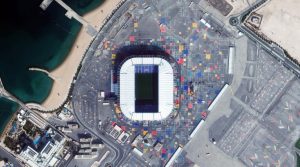 The 974 Stadium in Doha, Qatar boasts 40,000 seats and is a one-of-a-kind architectural structure made out of 974 shipping containers in an effort to use sustainable materials in its creation. The shipping containers also pays homage to the site’s strategic location, industrial history and the international dialing code for Qatar. The stadium hosted the FIFA 2022 World Cup and was the first planned temporary venue in FIFA World Cup history. The stadium hosted test matches during the 2021 FIFA Arab Cup and was a landmark venue during the 2022 FIFA World Cup. While the stadium was to be dismantled and moved to Africa or South America, and the former site it sat on was to be transformed via a waterfront development, as of February 2025, those plans had not materialized and the stadium currently still sits in place at its original site. Most recently, the venue was used for the 2024 FIFA Intercontinental Cup and the 2024 Trophée des Champions. It was initially committed to go to Maldonado, Uruguay, where it would be used for the 2030 FIFA World Cup; however, the Uruguay–Argentina–Chile–Paraguay bid did not succeed. Other plans were floated to transport 974 Stadium to an African nation, but those did not materialize either. In the WorldView Legion image feature here, we can see 974 Stadium and its colorful shipping container design. This 30-cm Legion image was collected on December 23, 2024, and has custom processing and color balance applied by Apollo Mapping. (Satellite Imagery © 2025 Maxar Technologies)
In this monthly article, we travel the world to check out unique, fun and sometimes a bit weird 30-centimeter (cm) color imagery samples from the WorldView constellation. In July, we looked at stunning imagery from high above the Neom campus in Saudi Arabia. For this edition of the 30-cm Color WorldView Image of the Month, we feature an image of Stadium 974 in Doha, Qatar.
30-cm WorldView-3 (WV3) launched in late 2014, WorldView-4 (WV4) launched in late 2016 and then the first WorldView Legion satellites launched in 2024. Taken together, this is the most advanced satellite constellation the commercial marketplace has ever had access to. Here are a few of the features that really set these satellites apart from the competition:
- Improved Resolution
- Higher resolution means you can see more detail in WorldView imagery.
- Data collected at nadir will have 31-centimeter (cm) panchromatic, 1.24-meter (m) visible and near infrared, 3.7-m SWIR (WV3 only) and 30-m CAVIS (WV3 only) bands.
- Additional Spectral Bands
- If spectral analysis is part of your project, then no other satellite can match WorldView-3 and WorldView Legion with their 8 bands of visible and near-infrared data; and then 8 shortwave infrared bands (WV3 only) which are crucial for geological studies.
- Better Positional Accuracy
- With accuracies of 3.5-m CE90% or better (without ground control even!), the 30-cm WorldView constellation has no rivals for its enhanced positional accuracy.
- Daily Revisits
- With multiple WorldView-3 and WorldView Legion satellites orbiting our planet, daily revisits are available for most locations.
- WV4 is no longer collecting new imagery.
- Increased Collection Capacity
- WV3/4 feature 13.1-km swath widths (at nadir) with the ability to collect up to 680,000 square kilometers (sq km) of high-resolution data per day per satellite (though WV4 is dead now).
- When fully launched, WorldView Legion will feature six 30-cm satellites, significantly boosting the collection capacity of this leading high-resolution constellation.
If you are interested in WorldView-3, WorldView-4 and/or WorldView Legion imagery for your next project, please let us know by phone, 303-993-3863, or by email, sales@apollomapping.com.
You can also find more WV3 samples and technical information on our website here; WV4 samples and information can be found here; and then finally here is more information about WorldView Legion.

Cricket’s Chirp is created for Apollo Mapping by Ron Ruelle, a Wilmington, NC (formerly Boulder, CO) based cartoonist, lllustrator and teacher. No animals are harmed in the creation of these comics, but Ron sometimes breaks a pencil in frustration. You can see more of his work at www.ronruelle.com
If you are searching for medium and high-resolution satellite imagery, the search is over as Image Hunter is the solution you’ve been looking for! Featuring satellite and aerial imagery as well as digital elevation models (DEMs) from a constantly expanding list of 60+ constellations/datasets and 19 vendors, our database contains more than 200-million images/records meaning there is just no other website out there with this breadth of commercial data products. Our interface is slim-lined and modern, loading quickly on all platforms, browsers and operating systems. Further, our database is updated multiple times an hour with the most recent images collected by WorldView-3, Pléiades 1, PlanetScope, SuperView-1 and many more so you are sure to get the most current view of all the imagery and DEM databases we work with. Once you submit your request, an Apollo Mapping representative will be in touch within 4 Colorado business hours to get you the pricing information you need for your project.
So why wait? Give Image Hunter a try now to find the imagery and/or DEM data you need for your next mapping project!
Key Improvement(s) From The Past Month

As we have hinted at recently, we are happy to welcome in a new 50-centimeter (cm) 4-band satellite system this month, that is ST Engineering Geo-Insights’ DS-EO! In fact, DS-EO is so new to Image Hunter that we do not even have a website put up for it yet, but we will be working on that over the coming weeks. On top of adding in this new satellite, we have been busy improving Image Hunter just for you.
Here is a summary of the changes/improvements we made to Image Hunter during the past month:
- Added 50-cm 4-band DS-EO satellite imagery.
- Optimized data updates across our constellations of satellites and DEMs.
- Restored long-lost TeLEOS-1 previews, yay!
- ID searches now include all SuperView Neo datasets.
- Improved back-end handling of SuperView-1, SuperView-2 and SuperView Neo-1/3.
Data Alert–An Automated Daily Imagery Search
Have you checked out Data Alert which lets you define an area of interest anywhere around the globe, the resolution your project requires and the number of months we should keep the alert active? Once an alert is set up, we check for new data over your area of interest every single day, and send you an email when we find coverage that meets your specifications. We have a short YouTube video with directions to set up a Data Alert, check out the last video; and we have written directions for Data Alert here.
The Sensors Available in Image Hunter
As you might have seen in past articles, we now feature hourly updates (seriously!) of GeoEye-1, KOMPSAT 3/3A, Pléiades 1 and Neo, SPOT 6/7, SuperView-1/2/Neo, WorldView-1/2/3/Legion!
Image Hunter can be accessed 24 hours a day, 7 days a week and is a one-stop shop for every major source of medium and high-resolution satellite (and aerial!) imagery on the market today, including:
- WorldView Legion
- WorldView-4
- WorldView-3
- WorldView-2
- WorldView-1
- QuickBird
- GeoEye-1
- IKONOS
- EROS B
- KOMPSAT-3A
- KOMPSAT-3
- KOMPSAT-2
- Pléiades 1 constellation
- Pléiades Neo constellation
- TerraSAR-X (TerraSAR-X, TanDEM-X and PAZ)
- GEOSAT-1
- GEOSAT-2
- TripleSat
- BJ3A
- BJ3N
- SPOT 1 to 7 constellation
- RapidEye
- GaoFen-2
- GaoFen-1
- ZiYuan-3 01/02 (mono and stereo!)
- FORMOSAT-5
- FORMOSAT-2
- ALOS PRISM (stereo)
- AW3D Standard (DEM)
- SkySat constellation
- PlanetScope constellation (including 5-band SuperDove data)
- SuperView-1 constellation
- SuperView-2
- SuperView Neo-1 01/02
- SuperView Neo-3
- Landsat 1-8
- TeLEOS-1
- DS-EO
- Hexagon (HxGN Content Program aerial imagery) imagery + DEM
- WorldDEM
- WorldDEM Neo
- Vricon DEMs
- Orbita Hyperspectral Satellite (OHS)
- KazEOSat-1
- KazEOSat-2
- Jilin-1 Optical
- Jilin-1 Video (including nighttime imagery)
- Jilin-1 GF/DP
- Jillin-1 KF
- Orbita Video Satellites-1/2/3 (OVS-1/2/3)
- BlackSky Global series
Key Features of Image Hunter
If any of our readers have struggled with other geospatial search engines that are clunky, only query one data source and/or do not provide image previews, then Image Hunter is the solution to your woes as it features:
- Online browsing of satellite and aerial imagery from 19 data providers and 56 satellite and aerial imagery derived datasets.
- Near-instantaneous loading of low-resolution preview imagery with collection date, cloud cover and other key metadata.
- The ability to define your area of interest by address, coordinates, geometric shape or shapefile/KMZ.
- A responsive basemap with street names to provide spatial context when discovering data as well as crowd-sourced updates for the most accurate map possible.
- Exports of the area of interest you create as well as the scenes you select in shapefile or KMZ format.
- Support for all operating systems, and not just our friends with Windows machines!
Image Hunter can be accessed here all day and night, we are excited to find out what you think about our imagery search engine! So if you have any ideas and/or feedback to improve Image Hunter, please let us know at sales@apollomapping.com or (303) 993-3863.

 NEOM is an arcology and planned city under construction by Saudi Arabia in their Tabuk Province. Launched in 2017 by crown prince Mohammad bin Salman, the site is at the northern tip of the Red Sea, due east of Egypt, across the Gulf of Aqaba and south of Jordan. The total planned area of Neom is 10,200 square miles. Multiple regions are planned, including a floating industrial complex, global trade hub, tourist resorts, and a linear city powered by renewable energy sources. Saudi Arabia claimed that NEOM would create around 460,000 jobs and add an estimated $48 billion to the country’s GDP. Thousands of people have been forcibly moved to make way for the project and villages have been razed. Most of the city is planned to be completed by 2039, though some experts have expressed skepticism about the ambitions of the megaproject. The project’s estimated costs exceed $8.8 trillion (more than 25 times the annual Saudi budget). Saudi Arabia originally aimed to complete major parts of the project by 2020, with an expansion completed in 2025, but fell behind schedule. The name NEOM is derived from two words. The first three letters come from the Ancient Greek prefix neo–meaning ‘new’. The ‘M’ is the first from ‘Mustaqbal’, an Arabic word meaning ‘future’. The M is also the first letter of the Crown Prince’s name, Mohammed bin Salman. In the 30-cm WorldView Legion images featured here, we can see the NOEM campus where all of the workers are housed; and in the other photo, we can see the construction of The Line building. The WorldView Legion images featured here were collected on January 29, 2025, and have custom processing and color balance applied by Apollo Mapping. (Satellite Imagery © 2025 Maxar Technologies)
In this monthly article, we travel the world to check out unique, fun and sometimes a bit weird 30-centimeter (cm) color imagery samples from the WorldView constellation. In June, we checked two images over agricultural fields northeast of Gaborone, Botswana. For this edition of the 30-cm Color WorldView Image of the Month, we feature two images from high-above the Neom campus in Saudi Arabia.
30-cm WorldView-3 (WV3) launched in late 2014, WorldView-4 (WV4) launched in late 2016 and then the first WorldView Legion satellites launched in 2024. Taken together, this is the most advanced satellite constellation the commercial marketplace has ever had access to. Here are a few of the features that really set these satellites apart from the competition:
- Improved Resolution
- Higher resolution means you can see more detail in WorldView imagery.
- Data collected at nadir will have 31-centimeter (cm) panchromatic, 1.24-meter (m) visible and near infrared, 3.7-m SWIR (WV3 only) and 30-m CAVIS (WV3 only) bands.
- Additional Spectral Bands
- If spectral analysis is part of your project, then no other satellite can match WorldView-3 and WorldView Legion with their 8 bands of visible and near-infrared data; and then 8 shortwave infrared bands (WV3 only) which are crucial for geological studies.
- Better Positional Accuracy
- With accuracies of 3.5-m CE90% or better (without ground control even!), the 30-cm WorldView constellation has no rivals for its enhanced positional accuracy.
- Daily Revisits
- With multiple WorldView-3 and WorldView Legion satellites orbiting our planet, daily revisits are available for most locations.
- WV4 is no longer collecting new imagery.
- Increased Collection Capacity
- WV3/4 feature 13.1-km swath widths (at nadir) with the ability to collect up to 680,000 square kilometers (sq km) of high-resolution data per day per satellite (though WV4 is dead now).
- When fully launched, WorldView Legion will feature six 30-cm satellites, significantly boosting the collection capacity of this leading high-resolution constellation.
If you are interested in WorldView-3, WorldView-4 and/or WorldView Legion imagery for your next project, please let us know by phone, 303-993-3863, or by email, sales@apollomapping.com.
You can also find more WV3 samples and technical information on our website here; WV4 samples and information can be found here; and then finally here is more information about WorldView Legion.
Sometime in June of 2019, I went with an older colleague, a female in her late 60s, to see the band Phish play in Charlotte, about a 90-minutes’ drive from where we lived. Typically, at Phish shows it’s common to find people getting “loose” (i.e., twisted up on drugs and alcohol), and this time was no different. I, however, was completely sober, as was my friend. This wasn’t an issue for me, as I have no problem attending concerts sober, and in fact, sometimes even prefer to do so–safer drive home, better night’s sleep, normal next day. Don’t get me wrong, I still like to get twisted up from time-to-time, but my desire to do so gets less and less the older I get. So it goes…
Anyhow, we had good seats at the amphitheater, under the awning and not too far from the stage. I notice a group of late-20s/early-30s friends all dressed in white, swaying to the music. Some of them are very clearly hopped up on goofballs, judging by their facial contortions and antics, and the others may be as well, though it was less obvious and it was clear they’re enjoying the music regardless of whether something is coursing through their system or not. One of them in particular catches my eye, a beautiful gal with long, dirty-blonde hair, wearing a long white flowing dress, white skater shoes, and white-rimmed sunglasses. I mention to my older female companion something along the lines of, “That girl is beautiful. She’s exactly what I’m looking for.” My friend responds, “I’ll introduce you…”–I certainly don’t want anyone introducing me to someone they don’t know–“…I know her.” My body freezes. Of course, I want to meet this beautiful woman dancing in front of me, but it gave me the shivers because of its forced-nature, the potential for awkwardness–that I was sober, and she assumedly was not. At set-break, my friend introduces us, and it goes about as I’d hoped it wouldn’t: it was awkward, the gal seemed slightly bored and more interested in what else was going on around us. I was happy once the clumsy exchange ended, and disappointed in myself for fumbling it. That was that. Or so I thought.
About a month or so later, my older friend ran into the beautiful dancing girl at another concert, texting to tell me. Feeling surer of myself since I was not in her direct presence, I asked my friend to see if I could have the beautiful dancing girl’s number–to my shock, she said “yes.” I texted her the next day, and we planned to go see the documentary of the singer/guitarist from Phish that had just been released. She’d arrived at the movie theater before me and had seats, all the way in the back row on the aisle. Obviously, movies aren’t exactly the place to get to know someone, but through a couple of brief exchanges, it seemed like we were enjoying each other’s company. Afterwards, I asked her if she wanted to grab a beer, but she declined, indicating that she didn’t drink that much. I wasn’t ready to let it go, so I inquired into finding another time to hang out, and we settled on the following Sunday for a hike. Great, I had another chance.
 It will only be a matter of time before one of us is aggravated with the other anyway.(Image retrieved from here and comes courtesy of Odonata Wellness Center.)
I picked her up early that Sunday and she quickly let me know she’d been out late partying and was a little out of it. Awesome. We had a good conversation, though, both on the 2-hour roundtrip drive and the two hours it took to do the hike. However, I felt that I’d been nudged into the friend zone, no option for actually dating. And that’s what held for the next several years.
We saw each other sporadically between then and 2023, sometimes grabbing lunch, occasionally going to a concert together, but never did it ever seem like there was any option for dating. And that was fine. She was a little awkward and sometimes I thought she was dismissive, aloof, or bitchy, but I couldn’t tell if that was just me misreading her. For whatever reason, maybe her beauty, maybe other things, I remained intrigued by her. All this time she had a few failed relationships with other dirtballs she met on Phish tour, and I’d met a couple of them–that they ended quickly and messily was never a surprise. Then she met a non-Phish fan and started an actual relationship, maybe late 2022. I saw her infrequently after that, usually at the grocery store, and the conversations had become less intriguing, and I eventually would sometimes avoid her there if possible. I no longer saw the point. Maybe that sounds rude or mean, but we weren’t ever going to date, we didn’t really hang out as friends anymore, and there didn’t seem any reason to make awkward small talk. Then fast-forward to early May of 2025, and the story takes on a different trajectory.
During that period of time where we had minimal interaction at all, we would check in around the times Phish was on tour to see if we’d ever be in the same place at the same time, and rarely were we. With the summer 2025 tour just announced, she texted me to see if I’d be at any of the shows, and since I’d already made my extensive non-music summer travel plans before their tour announcement, I wouldn’t be, but I told her I’d just been in the Pacific Northwest to see them play a couple times, so I felt okay missing them this summer. She told me the dates she was going to catch, and then we chatted about other shows, with me asking her about a band or two I was planning on seeing soon, telling her she should check out one of them specifically. The exchange ended with her saying she would and that was the end of it. Maybe she’d show up, maybe she wouldn’t. Who knew, and frankly, I didn’t really care. We weren’t really friends any longer–no bad blood at all–it’s just that she was in a relationship, so I was more focused on what was closer to my regular social circle anyway.
The next day around 5pm, she texts me indicating that she’d had a weird dream about me and my (ex)girlfriend, indicating that my ex kept playing with her hair and telling her she was pretty. I thought it a bit odd but engaged in an innocent back-and-forth to see what prompted it. Some flirting ensued, and I told her I hoped she had another good night of dreams. She responded, “I would be so lucky.” I replied, “Well, glad I can at least contribute to a good dream.” She answered, “I guess so.” I paused for a moment sensing her creating an “in” for me to probe the situation deeper. My retort, “Well, if you ever need someone to tell you you’re pretty and play with your hair, I can provide that service. ☺” Three hours later, I’m at her place.
So, it’s been about two weeks now that we’ve been hanging out. In case you’re wondering, she’d broken up with the long-term boyfriend about a month earlier. I haven’t really gotten the full story on it, but I haven’t really asked about it. I also don’t know what I expect–or what I want–from this. As mentioned, I’m about to depart for an extended period of time, combining work and travel, so it’s not exactly the best time to get into a relationship, so I don’t know how to navigate those waters. Strange thing is, this poor timing has happened a few times before on the cusp of my summer departures, so I guess it’s Groundhog’s Day–and I guess when spring turns into summer is when people currently unadorned start looking for relationships. So, here we are. I wonder what will come of it. The moral of the story is that sometimes there is a long game being played even after you’ve taken yourself out of the lineup…
Marco Esquandoles
Unfriended
 This map shows the areas imaged by the Pléiades 1 constellation from February 19 to May 19, 2025 over Europe and its islands, minus Russia. Please note that in many instances, multiple images were collected over the same area which is difficult to portray on this static map.
In this monthly piece, we give our readers a sense of the high-resolution imagery coverage collected over a geography during a specified window. To do this, we pick a high-resolution satellite constellation, a defined time period and area of interest, then report key statistics on the total amount of imagery collected in square kilometers (sq km). Without further delay, let’s jump into our analysis.
Graphic Region of Interest: Europe and associated islands minus Russia
Land Mass Covered: 5,966,899.4 sq km
Time Period: February 19 to May 19, 2025
High-Resolution Satellite Constellation: Pléiades 1 (i.e. Pléiades 1A and 1B)
Pléiades 1 Constellation Imaging Statistics–Europe Minus Russia
Total Area Collected: 2,230,968.3 sq km; 12,394.3 sq km per satellite/per day
Area Collected @ 20% or Less Clouds & 30 Degrees or Less Off-Nadir: 1,247,923.9 sq km; 6,932.9 sq km per satellite/per day; 55.94% of total

We love maps.
We love imagery.
We love work breaks.
We hope you like them as well!
This summer, rackets will be swinging hard as elite tennis players head to the courts for the 2025 Wimbledon, which will be held June 30th to July 13th in Wimbledon, England.
The championships is organized by the All England Lawn Tennis and Croquet Club in collaboration with the Lawn Tennis Association. It is the third of four Grand Slam tennis events each year, held after the Australian Open and the French Open, and before the US Open. It is the oldest tennis tournament in the world and is widely regarded as the most prestigious. Wimbledon has been held since 1877 and is played on outdoor grass courts; it is the only tennis major still played on grass. It is also the only major that retains a night-time curfew, though matches can now continue until 11 p.m. under the lights.
The 88-centimeter black and white only WorldView-1 image we share here is from the July 8, 2022 finals match at Wimbledon with a unique high-tilt bird’s eye view of the day’s events. We can see the stadium in which the matches are played and the surrounding complex. On this date, the Men’s Single final match was held on the center court where Novak Djokovic won 2-6-6-6 over Cameron Norrie who ended the match at 6-3-2-4.
Be sure and check out our 88-cm WorldView-1 image and see if you find it as intriguing as we do. Then grab your tennis racket and hit the court as you gear up for this year’s Wimbledon.
Have a great rest of your workday! 😊
(Image Courtesy: Maxar. Processed by Apollo Mapping for improved grey-scale accuracy and clarity.)