
In this month’s edition of Mapping for Good we’ll take a look at an exciting tool used to gauge the effects of climate change. ClimateWizard, developed by a partnership between The Nature Conservancy, the University of Washington and the University of Southern Mississippi, allows users to view climate data from the past and present as well as view several predictive models.
 ClimateWizard provides access to climate data and allows users to compare climate change statistics across time periods.
While several tools have been created to display climate data, ClimateWizard bills itself as being “the first time ever [that] the full range of climate history and impacts for a landscape have been brought together in a user-friendly format.” The ultimate goal of the project is, as stated, to take scientific information that’s difficult to understand and then display it on a map in a way that the average person can easily comprehend the magnitude of climate change. Several layers can be turned on and off, and the databases from which the map pulls its statistics cover a range of climate metrics and uses:
- Historic temperature and rainfall maps for anywhere in the world
- State-of-the-art future predictions of temperature and rainfall around the world
- View and download climate maps in a few easy steps
ClimateWizard not only allows for the comparison of time periods but also has the option for users to choose the “severity” of the predictive model that is being displayed. In other words, users can view the predicted outcomes of climate change with “bad, worse and worst” case scenarios in mind. What will likely startle many who visit the site is the fact that even the most conservative estimates of the effects of climate change show extreme changes both regionally and globally.
If you’d like to try out the tool or learn more about the project, visit www.climatewizard.org.
Fletcher Berryman
Cloud Tamer
(970) 710-0909
fletcher@apollomapping.com
Hello, citizen scientist and welcome to the Zooniverse! Here you will find a plethora of science and research opportunities at the tip of your fingers. With a simple click of button you can explore the depths of the Universe, identifying galaxies, hot stars and supernovae. Outer space not your thing? Don’t worry! You can suss out bats, sea lions, big cats or animal faces instead. Not impressed? How about transcribing handwritten documents by Shakespeare or Civil War era telegraphs? Classify orchids? Measure the rain forest? Tag Humpback Whales? I could go on, and on, and on, but I’ll you check it out for yourself here.
In the Zooniversee there is a project for everyone, and more than one at that. Scientists around the world need help trolling through a vast amount of data. While technology has come a long way, don’t let Hollywood films fool you, automated algorithms aren’t as readily available as you might think. The human eye is much better equipped to identify certain objects and bodies then a computer. Especially when the images aren’t perfectly clear and the subject is obscured, blurry or turned at an angle. For example, the Milky Way Project is looking for people to identify and measure objects like bubble nebulae and bow shocks along with anything else in the imagery that could be of interest to researchers. A computer can’t measure or identify objects that are ‘interesting.’
In other cases, an automated algorithm can be made, but there needs to be a large body of control data first. Once enough specimens have been identified and marked, then the computer can crunch the numbers and come up with a pattern to identify specific objects or species. The Understanding Animal Faces Project is one such example. By marking the placement of the eyes, nose and mouth of each animal, the computer can eventually tell the difference between an otter and a panda in a more automated fashion.
Another is Gravity Spy, here people are more adept then computers at identifying the differences between images. By noting the glitches in the Laser Interferometer Gravitational-wave Observatory (LIGO), database researchers can come up with an automated system to remove the noise that obscures their data. With the public’s help they can better tune their instrument to identify gravitational waves, a recent and immensely groundbreaking confirmation of one of Einstein’s theories.
So saddle up and put your down time to good use here in the Zooniverse!
In this monthly feature, we span the globe to examine Our Changing Landscape with time series of medium resolution RapidEye satellite imagery. The RapidEye archive dates back to late 2008 and already contains more than 8 billion square kilometers of data. Last month we found ourselves in a shadowy valley in Lebanon looking at the construction of a dam, and in March we travel east with a look at a rapidly-growing Chinese city, Shiyan, for this Our Changing Landscape.
The RapidEye Constellation
RapidEye is a constellation of five 5-meter medium resolution satellites each offering five spectral bands of information. The RapidEye constellation offers daily revisits to every location on the planet with a huge footprint that is 77-km wide. The data is priced competitively with a starting cost of $1.28 per square kilometer for all five spectral bands–academics do receive discounts. RapidEye adds a fifth band, the red edge, to the ‘traditional’ multispectral set of blue, green, red and near-infrared (NIR). The additional spectral data in the red edge band allows users to extract more useful land ‘information’ than can be from traditional 4-band imagery sources. When RapidEye imagery is ordered as a Level 3A Orthorectified product, images from multiple dates are extremely well registered, making it the ideal data source for Our Changing Landscape.
The Growth of Shiyan, China

Click on the image above to see an animation of 5-meter natural color RapidEye imagery collected over Shiyan, China on November 23, 2009, June 24, 2011, October 9, 2013 and May 5, 2016. In these images, you can see many changes from 2009 to 2016, including new roads, highways, structures and clusters of buildings. These images definitely confirm the rapid growth of the Shiyan metro area as well as the mountain top clearing alluded to in this article. (Images Courtesy: Planet @ 2017)
As all of you are aware of, China is a rapidly growing country, particularly in its eastern half; and Shiyan is a good example of this, averaging 3 to 4% annual growth over the past few decades. Actually, Shiyan is considered a prefecture-level city, meaning it is between a county and a state if you want to put it in American terminology–perhaps akin to a metropolitan statistical area (MSA) but with a unified regional government. While population figures can be hard to verify in China, according to a 2010 census, about 3.3 million people lived in Shiyan with some 768,000 in its urban center.
Shiyan is located in the northwestern portion of Hubei province, about 650 miles (or 1,050 kilometers) west of Shanghai and the East China Sea. The prefecture covers 459 square miles (1,190 square kilometers), with the city proper covering 78 square miles (203 square kilometers). The prefecture is situated in a valley that is surrounded by the Qinling, Wudang and Daba Mountains with the Han River running through from west to east. The mountains that surround Shiyan are considered some of the holiest locations to the Taoist faith.
With 3% plus annual growth rates in recent history, it is not surprising to hear that multiple development projects are planned and/or underway for the prefecture. For example, there is a 245 mile (395 kilometer) high-speed train planned to connect Shiyan with Wuhan. The prefecture is also the site of one of China’s most ambitious growth projects (as well as one of the most widely critiqued for its environmental impacts) whereby they are literally flattening mountains to expand habitable lands. And finally, it appears that the city center of Shiyan is under renovation (or planned to be) in many locations though this article is a bit hard to follow. So now it is time to turn to the 5-meter RapidEye archive to see how the city has changed since 2009!
If you would like to find out more about using RapidEye for your academic studies, engineering projects or any landscape analysis, let us know at sales@apollomapping.com or (303) 993-3863.
In our February edition of the Pléiades 1 Stadium of the Month we stopped at the site of Super Bowl LI and for March we head to Evansville, Indiana with a look at a historic baseball diamond, Bosse Field, with Major League Baseball (MLB) Spring Training games just around the corner!
-
- Name & Its Origin: Bosse Field is an iconic baseball stadium that appears to be named after the mayor of Evansville from 1914 to 1922, Benjamin Bosse. Mr. Bosse devised a plan to purchase the land for the stadium by working with the local school board to share the use of the venue.
-
- Location: Located on the north side of Evansville, Indiana, Bosse Field is about 2 miles (mi) (or 3 kilometers, km) from the Ohio River. The stadium is some 385 feet (117 meters) above sea level.
-
- Stadium Capacity/Size, Architect & Build Date: Bosse Field was built in 1915, opening June 17th, and since then it has been renovated at least two times, in 1930 and 1958–with some resources suggesting the 1958 upgrade was the last. Surprisingly there are few details on the construction and renovations of the ballpark. At an original price tag of $50,000 to $65,000, Bosse Field apparently holds 7,180 fans though that number varies from website to website–with one suggesting 5,181 chair-backed seats.
-
- Type of Field Surface: The photos we have seen of Bosse Field as well as multiple online resources refer to a grass playing field–with some going as far as Bermuda grass without citing evidence.
 A 50-cm color image of Bosse Field in Evansville, Indiana collected on October 16, 2016 by Pléiades 1A. To see this stadium in SPOT 6/7 1.5-meter resolution, check out this month’s feature on SPOTMaps. This image has custom processing and color balancing applied by Apollo Mapping. © CNES 2017, Distribution Airbus Defense and Space / Spot Image S.A., France, all rights reserved.
-
- Key Sports Teams: The Evansville Otters are the only professional team that appears to play at Bosse Field. They are part of the MLB Frontier League which is an independent league in the minors not affiliated with a specific team.
-
- Most Popular Yearly Event: Baseball is definitely the main attraction at Bosse Field but it does appear to host other events–well at least the nearby open field, Garvin Park does, for example a classic car show.
- Fun Factoids: (1) The classic baseball movie, A League of Their Own, was filmed at Bosse Field. (2) I bet you did not know that Bosse Field is the third oldest continuously-used ballpark in America behind Wrigley Field and Fenway Park. (3) Many famous athletes have played a baseball game or two at Bosse, including Don Mattingly, Hank Greenburg and Warren Spahn.
The Pléiades 1 High-Resolution Satellite Constellation
The Pléiades 1 constellation (or at least part of it!) has been in orbit since December 2011 and if you have not had a chance to check out any sample imagery, take a few moments and have a look at the gallery on our website. If you work with high resolution imagery, you should consider Pléiades 1 for your next geospatial project.
A variety of Pléiades 1 products are available from both a growing archive and as a new collection, including 50-centimeter (cm) pansharpened imagery and 50-cm panchromatic–2-meter (m) 4-band multispectral bundles. We are happy to discuss the technical specifications, pricing and tasking options available with this satellite constellation.
Working with Pléiades 1 since the launch of the first twin satellite, P1A, we have noticed that:
- Airbus Defense and Space is able to deliver on their tasking feasibilities.
The Apollo Mapping sales team can answer any questions you might have about the high resolution satellite constellation, Pléiades 1. We can be reached anytime at (303) 993-3863 or sales@apollomapping.com.
More sample images and technical information about Pléiades 1A and 1B can be found on our website here.

The world is full of mapping data that people need, but they don’t have the knowledge to access. From county assessor data to trail maps for a day out hiking. Large, well-funded counties, like Boulder County Colorado, have the resources to make all kinds of maps available to the public. Other, smaller counties might not have these kind of extensive resources.
Enter Map Mavin, for a starting cost of only $20 a month an organization can easily share this kind of data with their users. There is no need for expensive software that users can’t afford, and you don’t have to hire a company to set up an extensive enterprise GIS system.
 Get a sneak peak of your data in Map Mavin.
Not only can users see all your trail maps, but you can update them when they are under construction or closed for the season. With a click of a button, a person can see the length of the trail, the difficulty level, the elevation change, if the trail is washed out or closed during certain seasons, or if there have been recent bear sightings in the area. Any information you want to share can be queried using Map Mavin.
Do you have clients who want to see recent home sales in the area? How much they sold for and who owns the property? All this information can be put into a publically available map. Users can search by address, click on a property, and access all this data. You don’t have to maintain servers or deal with programmers or infrastructure. Map Mavin is designed to bring your data to the people who need it most, they only have to click a link to see your public facing maps. You can cut down on user error and confusing interfaces.
Check out our demo map to see Map Mavin in action here. Your first month on Map Mavin is free, so give it a try!
Apollo Mapping is proud to announce that our long-awaited GIS cloud, Map Mavin, is now up and running! With Map Mavin, you can make maps in minutes online and share them around the world, without any background in mapping and with no need for expensive and tedious desktop software.
 Here is a web map we made with Map Mavin–it shows bike routes and subway entrances in Manhattan and Brooklyn.
We believe that mapping shouldn’t require a degree or complex training just to get started. And how about the hassle of lugging around a laptop computer just to open and view your maps and data? With Map Mavin these hassles will never plague your projects again!
Okay, so we’ve made it easier to make maps and to store and view geographic data…but you may be asking: why Map Mavin? Why not another online mapping service? And how can this service benefit my team?
We considered your team when we designed and built Map Mavin. In noting our own qualms as well as the needs we heard from many of our clients, we developed a standout feature that will change the way you collaborate on all of your mapping projects:
Introducing Screen Share.
With Screen Share, you can invite as many users as you need all to one central map. With a built-in chat feature and the ability for all users in the group to manipulate the map being viewed, everyone is, well, literally on the same page. For example, as one user in New York highlights a site with his cursor, users in Mumbai, London and Buenos Aires can all watch as the changes are reflected right on their screens. The possibilities opened up by our revolutionary screen sharing tool are endless!
Best off, our price can’t be beat. Map Mavin is only $20 a month for 5 GB of storage and data download, and then only 75 cents for each GB after that. Plus you can cancel at any time and you even get your first month free.
So what are you waiting for? Sign up for a free trial and/or schedule a live demo today by visiting www.mapmavin.com or by sending us an email at support@mapmavin.com.
For some projects, satellites cannot offer the resolution or cloud-free conditions demanded by your project. In these instances, the solution is our 15-centimeter (cm) and 30-cm aerial imagery. Delivered in color or with four multispectral bands, our new collections of aerial imagery are a reasonably-priced solution for your next geospatial project in the United States (and beyond) for areas down to 100 square kilometers (sq km).
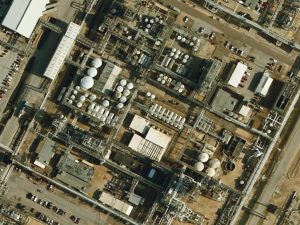 A 30-cm color aerial imagery sample collected over Houston, Texas late September 2013.
Here are the key specifications of our tasked aerial imagery offering:
- Minimum Order Size: 100 sq km
- Spectral Bands: natural color, color infrared (i.e. green, red and near-infrared) or 4-band multispectral (i.e. blue, green, red and near-infrared)
- At Nadir Resolution: 15-cm or 30-cm
- Typical Delivery Time: 1 to 2 months
- Possible Coverage Area: continental United States (other geographies may be available with a custom quote)
- Horizontal Accuracy: ~3-m CE90 (dependent on terrain, can be improved with ground control points)
 And now a 15-cm color aerial imagery sample collected over Pittsburgh, Pennsylvania on April 10, 2014.
Our aerial imagery offering is ideal for customers requiring competitively priced, cloud-free data at resolutions not available from a satellite sensor.
If you would like more information on our tasked aerial imagery services, you can reach us by phone at (303) 993-3863 or email. In the meantime, you can check out additional samples and product specifications on our website here.