

- For this month’s technology review, we cover a wide variety of topics including new ways to (possibly) detect alien life, enjoy!
This material can control where it emits heat.
A new way to detect possible alien life.
Researchers recreate stellar carbon building blocks using lab-grown space dust.
A new way to revive old antibiotics.
A lightweight alloy for more fuel-efficient trucks.
Naturally occurring weight-loss drug discovered.
Dreams are not random as our experiences shape them.
A plant-based way to dress wounds.
Evolution often converges using different paths.
Healthier French fries with microwave-assisted frying.
Plant-based plastic inspired by silk.
This yarn is elastic and recyclable.
From plastic waste to hydrogen fuel and sequestered carbon.
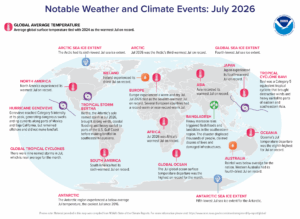 Hurricane Genevieve reached Category 5 intensity at its peak in July, causing dangerous swells and rip currents to form along parts of Mexico and Baja California, but didn’t make landfall. Rainfall was below average in Australia, and western Australia recorded its fourth driest July on record. Heavy monsoon rains in Bangladesh triggered flash flooding and landslides in the southeastern region. The storms displaced thousands of people, killed dozens more and damaged infrastructure. Africa endured the hottest July on record in 2026, as did Asia, while Ireland experienced its driest July on record. (Image Credit: NOAA Global Climate Report)
- The Global Climate Change Report for July 2026 has been released by NOAA’s National Centers for Environmental Information and reveals further proof that global climate change remains a life-or-death concern. In July 2026, the global surface temperature was 1.18°C (2.12°F) above the 20th Century average, tying with 2024 as the warmest July since global recordkeeping began in 1850. The 10 warmest Julys on record have all occurred since 2016, with the past four years (2023–2026) taking the top four spots. Only three Julys – 2023, 2024, and 2026 – have experienced temperature departures exceeding the 1.0°C (1.8°F) threshold. This month also marked the 55th consecutive July with above-average temperatures; the last below-average July temperature occurred in 1971 (-0.04°C / -0.07°F). Climatologically, July is the warmest month of the year. Since July 2026 tied as the warmest July on record, July 2026 and 2024 are also the warmest months on record for the globe since 1850. Global ocean temperatures reached a record high in July averaging 1.02°C (1.84°F) above normal. This edged out the previous July record set in 2023 by 0.03°C (0.05°F). The past four Julys (2023 – 2026) are the four warmest Julys on record, with 2026 marking the first July to surpass +1.0°C (+1.8°F). Across all months since records began in January 1850, July 2026 tied with August and September 2023 as the third highest monthly temperature departure on record. It trailed the tied recordholders of January and February 2024 by just 0.01°C (0.02°F). Notably, all of these top-ranking months occurred during El Niño episodes, which we are currently experiencing as we draft this article.
- Everyone knows Labor Day falls in September, but another important holiday that claims a spot on the September calendar happens to be Grandparents Day. This holiday, which falls on the first Sunday after Labor Day, recognizes grandparents and the bond between them and their grandchildren. In fact, the official flower for Grandparents Day is the forget-me-not. One fun way to celebrate Grandparents Day is by learning more about ancestors. Every 10 years, as directed by the Constitution, the U.S. government must count every person living in the country with the Census. Thanks to Story Maps ARC GIS, grandkids can learn more about those who came before them. They can use Ancestry Classroom’s 1950 Census Search to find a relative, noting “Home in 1950,” street name and house number. Submit as much data about the relative as possible. This includes data from the home in 1950, street name, house number and occupation fields in the census record. Submit the data in the form below to compare with others. The results are shown in the form of charts, graphs or maps. The creators of the system state that the instructional activity is best used by middle school or high school students. People also can add their own family history information to map and create digitized historical maps and other tools to analyze their own family history information in a geographic context.
Brock Adam McCarty
Map Wizard
(720) 470-7988
brock@apollomapping.com
This entry was posted in The Geospatial Times and tagged apollo news, News Snippets, The Geospatial Times Bookmark the permalink.


 Copyright © 2025 All Rights Reserved -
Leave a Reply