

- With May flowers comes our next edition of amazing technological advancements that could improve all of our lives:
Our cells have internal liquid currents.
Warmer temperatures can actually delay spring’s onset.
A new water-based, low-cost battery.
A bio-based solution for forever chemicals.
A new way to recycle acrylic.
From sludge to usable phosphorous.
A microbe-powered battery.
Trees generate electricity during lightning storms – while cleaning the air.
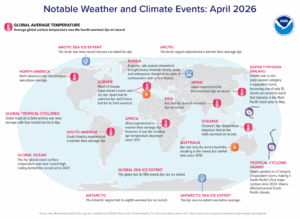 In April of 2026, the Arctic Sea experienced near-record low sea ice extent for April while the Antarctic Sea’s ice extent was also below average in April. Tropical Cyclone Vaianu reached Category 3 status, making it the South Pacific’s first major cyclone since 2023. Super Typhoon Sinlaku was a rare, early season Category 5 storm, becoming one of only 10 storms on record to reach that intensity in the West Pacific basin. In Russia, a severe late-season snowstorm brought heavy snowfall, strong winds, and widespread disruption to parts of northwestern and central Russia. (Image Credit: NOAA Global Climate Report)
- The Global Climate Change Report for April 2026 has been released by NOAA’s National Centers for Environmental Information and reveals further proof that global climate change remains a concern. The global surface temperature for April 2026 was 1.12°C (2.02°F) above average, ranking as the fourth warmest April since global records began in 1850. Notably, all 10 of the warmest Aprils in the 1850 – 2026 record have occurred since 2016. The Southern Hemisphere’s ocean temperature was 0.91°C (1.64°F) above average – the highest on record for April. This was only 0.01°C (0.02°F) higher than the now second highest temperature set back in 2024. Meanwhile, the Southern Hemisphere’s land mass ranked as the seventh warmest on record. Combined, the Southern Hemisphere as a whole experienced its second warmest April on record.
- The 12th International Yoga Day falls on June 21, 2026, with the theme “Yoga for Wellness, Wisdom & World Peace.” Yoga is a holistic practice that involves physical postures (Asanas), breathing exercises (Pranayama), meditation (Dhyana), and ethical principles (Yama and Niyama) to promote physical, mental, and spiritual well-being. The word “yoga” comes from the Sanskrit word “Yuj,” which means “to yoke” or “to unite,” symbolizing the cultivation of a sense of harmony between the mind, body, and spirit. The practice of yoga is said to have originated in ancient India, with roots stretching back more than 5,000 years. GIS technology has been used to map and organize global yoga participation, adding a tech element to a peaceful, holistic practice. For example, Yogamplify is an app by Esri India. It uses a Geographic Information System (GIS) backbone to help yoga enthusiasts locate a Yoga Centre and join in International Yoga Day celebrations. A cross-platform yoga app, Yoga Glo, provides curation tools that let its users filter yoga and meditation classes. The app guides users through various exercises for fitness and meditation for better sleep and flexibility. GIS also can be used for accessibility mapping, which identifies what’s known as “fitness deserts” where communities lack access to green spaces or wellness centers. Fitness deserts are commonly found on Native American reservations, according to one report, as well as in lower-income cities, such as Baltimore, Maryland.
Brock Adam McCarty
Map Wizard
(720) 470-7988
brock@apollomapping.com
This entry was posted in The Geospatial Times and tagged apollo news, News Snippets, The Geospatial Times Bookmark the permalink.


 Copyright © 2025 All Rights Reserved -
Leave a Reply